
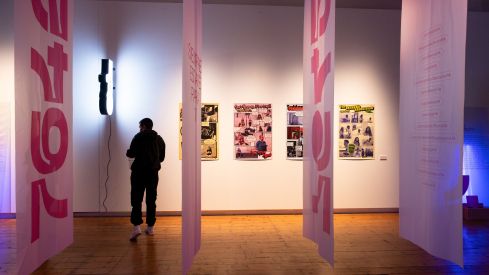
The exhibition cycle Temporals 2025–2026 continues touring the civic centers of Barcelona, now with the exhibition Arriba 7621 “I will always be there for you”.
After having passed through the Centre Cívic Cotxeres de Sants and La Farinera del Clot, the project arrives at the Centre Cívic Can Basté, where it can be visited until July 18 of this same year.
Curated by Federica Matelli, the exhibition focuses on the relationship that adolescents establish with digital technologies, especially social networks and video games. The exhibition addresses this reality with a critical but also playful approach, incorporating humor as a tool to approach complex issues of the digital world.
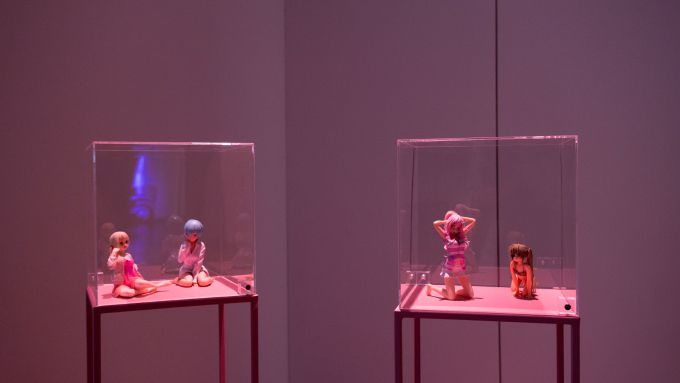
The artists Maria José Ribas, Raquel Hervás Gómez, Joan Pallé and Anastasija Pavic are part of the project, who bring diverse perspectives on the digital world and its contradictions. Their works combine installation, image and interactive devices to generate immersive experiences.
The name of the exhibition
According to research published by the historic American magazine Wired, dedicated to exploring how technology influences culture, education, economy and politics, 7642 is a numerical combination used by younger English-speaking internet users on platforms like TikTok and WhatsApp. This code serves to show support to someone who needs it and to express affection creatively. It literally means: “I will always be there for you”.
And indeed, this key symbolizes a world: that of adolescents who seek on the internet a space of support among peers, autonomous and away from the gaze of adults. On the internet, they find a place where they can socialize, freely express their personal and gender identity, strengthen friendships, consolidate their own values, embrace trends and, of course, open up to love.
Around the algorithm
One of the main axes of the project is, precisely, the reflection on the construction of personal identity on the internet. Through the different works that can be seen, and which range from sculpture to and participatory workshops aimed at young people and adults, the public is invited to think about how we present ourselves on social networks and how these platforms influence the perception we have of ourselves and of others.
Also addressed is a topic especially relevant today: the influence of algorithms on the circulation of information. The project analyzes how these systems can generate information bubbles that favor ideological radicalization and cultural homogenization, and that at the same time limit the diversity of points of view.
A participatory project
Alongside all the pieces on display, a collective work created by teenagers from the neighborhood is included, produced during a theoretical-practical workshop taught by the artist and researcher Mónica Rikić.
Furthermore, on June 4 and 6, workshops are scheduled that are designed to foster intergenerational debate on technology, culture, and contemporary society.
You can find all the information on the web of Can Basté.
An international artist
The project curator, Federica Matelli, is a researcher, professor, and cultural agent with extensive international experience. She has published in various media and gives lectures at seminars and conferences of universities and institutions worldwide. She has collaborated with prestigious centers such as the ZKM, Center for Art and Media Technology (Germany) and has worked as an independent curator at international festivals.
Furthermore, Matelli holds a doctorate in theory and history of contemporary art from the University of Barcelona, and her research addresses the relationship between everyday life and contemporary society, with special attention to the period 1980–2014 and the theoretical changes of the 21st century, integrating perspectives from philosophy, sociology, and cultural studies.


