
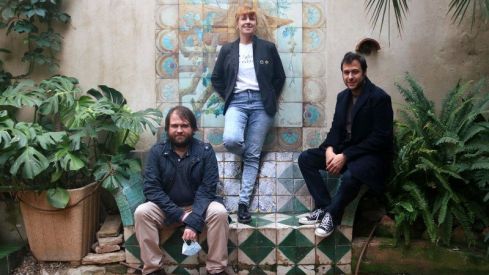
Ricard Planas (Barcelona, 1981) is one of the driving forces behind the Barcelona-based publishing house Males Herbes, alongside Ramon Mas and Pau Clemente. The project began in 2012, at the start of the wave of independent publishing houses in Catalonia, with examples such as Raig Verd, Saldonar, or Descontrol, among others. More than ten years later, the Males Herbes team maintains the spirit of the first day: promoting non-realistic narrative (also known as imaginative narrative) in Catalan.
Planas explains confidently that the key to success is "having consolidated a brand that is already very visible in libraries and bookstores." Above all, he adds, it's about "building community" through reading clubs, presentations, social media outreach, and contact with booksellers. The key is knowing what the reader wants: "You have to be part of a network and offer something that no one else does, and have people accept it."
"There's always the dichotomy drawn between large groups and independent publishers, but the fact is that within the independent world, we're not all the same, and that's a problem," he states. Planas explains that there's an issue that troubles publishers. It concerns the "professionalization of the publishing sector" and the fact that there are so many alternative publishing houses right now.In this regard, he points to publishers "who don't charge for production," whom he identifies as direct competition: "The main problem is when these publishers don't want to professionalize and publish contemporary Catalan narrative."
He points out that this phenomenon is explained, in part, by the "tradition of voluntarism in the Catalan publishing world," which was particularly accentuated with the advent of democracy. "At that time, it was necessary and appreciated for someone to set up a publishing house in their free time. The problem that continues to exist is when there is no intention of professionalizing, which means earning a salary and paying wages," he notes.
Economic and Qualitative Factor
The editor of Males Herbes identifies two main problems in this context. The first, speaking in economic terms, is that these companies are "unfair competition," because "for publishing houses that don't live off this, sales are relative," but they don't stop competing with them for shelf space in stores.
Planas reflects on how these publishing houses operate and points out that, while their voluntarism can be seen as positive, this phenomenon leads to a misunderstanding: “It’s a fallacy that the more editorials there are, the more readers there will be, because people increasingly have to choose from a wider catalog and bookstores are overflowing with books”.
The second reason he presents, and on which he places more emphasis, is that "Catalan literature will be devalued" if things continue this way. To argue this, he explains how he is surprised every time works that Males Herbes had rejected are published: "We will not compete with Pilar Rahola's book, but we will compete with publishers who are publishing original texts that we have already rejected."
"We compete with publishers who are publishing original texts that we have already rejected"
In this vein, he returns to the theme of considering his work as a craft, that is, a task based on reading a lot, being in contact with the writer, and applying appropriate literary evaluation criteria. Based on his experience, he explains that he has detected that original works are being published "that do not reach the standard they should to be sold professionally." This is happening because there are publishing houses "that are much less demanding and do not work on the text because they don't have time."
Consequently, this leads, on the one hand, to imbalances because "we are all in bookstores and there are no professional and non-professional stores, and authors have to fight among themselves in a rather unequal battle." In the long run, this will result in "finding interesting works will be like looking for a needle in a haystack because the haystack will keep getting bigger."
One more threat to the sector
The publisher argues that this scenario is a further threat to the independent book sector, which is already experiencing the consequences, as he points out, "of artificial intelligence and self-publishing." "There have always been crises, but now what I see is oversaturation," he adds. He also laments that the flood of titles comes from independent publishing houses themselves, since, as he says, it is already known that the major groups "flood the new release tables."
Finally, Planas throws his hands up in despair when he sees that the current context leads to "a writer can publish all the texts they have in their drawer if they want." He strongly defends that this should not be the case: "To have important literature, there must be important demands, and historically, literary publishers are the ones who set the quality bar."
With an eye to the future and despite the difficulties mentioned, Planas remarks that "it would be a shame if, thirty years from now, whoever reviews Catalan literature being produced today is not aware of the sweet moment we are experiencing at a literary level due to overpublication."


