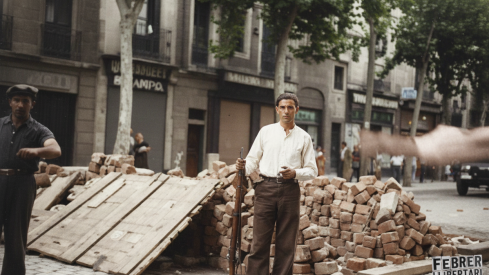
The strident sound of a deafening siren while different aerial images of bombings in the neighborhood intertwine. This is how the trailer 1936, Sants revolucionat begins. The video, which already has over 2,000 views on social media, allows us to delve into one of the most combative eras of this Barcelona neighborhood thanks to the digital tool of the moment: artificial intelligence (AI).
Like a kind of advertising claim, this five-minute audiovisual document is a sample of what can be seen at the exhibition of the same name, which can be visited for free until February 27 at the Lleialtat Santsenca space, on Olzinelles street. The project is the work of this same entity and is part of the new edition of Febrer Llibertari, an annual cycle that throughout this month programs cultural activities of all kinds, such as historical routes, talks, debates, book presentations and exhibitions.
In the framework of this cycle, the entities of the social fabric of Sants once again look to the past to understand the present. And this time they do so commemorating the 90 years of the Social Revolution of 1936, which marked a before and an after in the history of the neighborhood and the city of Barcelona.
When viewing the video, which serves as a witness, the viewer is taken back to the first months of the Civil War. Specifically, it takes a tour through the different settings that hosted the working-class neighborhood of Sants at that time, such as factories, schools, kiosks, athenaeums, and libraries. In these spaces, the neighborhood and union fabric of the area was clandestinely organized to confront the rebel forces
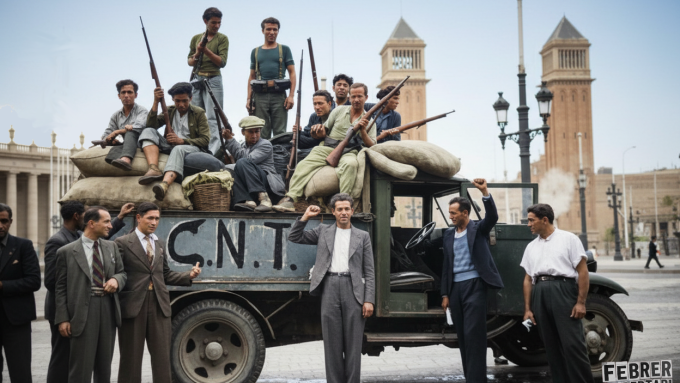
Animated imagesIt was in this context that many Sants residents portrayed, with their cameras, the reality that threatened the city at the time. Now, 90 years later, La Lleialtat Santsenca has recovered the photographs and given them a new use. "Most of them we have extracted from the District's photographic archive," explains Agustí Giralt, one of the project's promoters
He himself points out that some of the resources used are the work of a photographer who lived on Dalmau street, who, upon seeing how the church of Santa Maria de Sants was burning in July 1936, went out into the street to record what was happening.
Other photographs have been recovered from international archives. "Some exiles took them when they emigrated and many are in Amsterdam, but since the material is digitized we have been able to access it," explains Giralt.
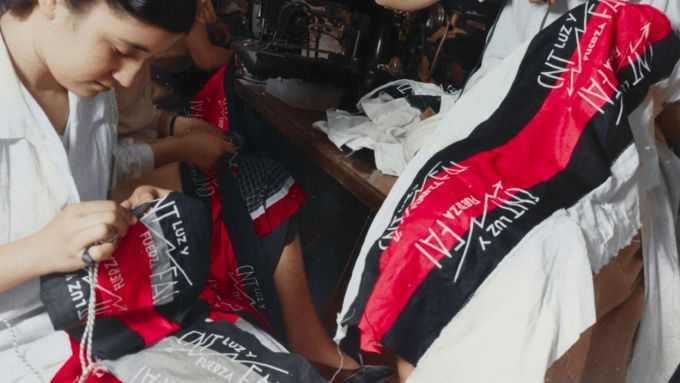
After collecting them, the next step has been to transmit, in the most faithful way possible, "the atmosphere of struggle and collectivity" that was breathed in the streets of Sants. To do this, members of the Lleialtat Santsenca have used artificial intelligence programs to improve the resolution of photographs, affected by the passage of years. "We started by processing them so they would have more quality, and that led us to experiment with artificial intelligence," says Giralt. This is how they have managed to animate both aerial images of Sants buildings and street-level photographs of groups of self-organized young people
From the Lleialtat Santsenca they celebrate that the trailer has reached "such a wide" audience, which serves them to "generate expectations" and invite people to visit the exhibition that is already underway. "The exhibition is very linked to current events, as it is exhibited in a building built by the neighborhood movement of the 20s, which shows the organizational capacity we have inherited," values Giralt. And it is that, despite the transformation of the neighborhood in recent years, it has been the associative fabric that has revived the memory of a neighborhood network that defended the revolution from the streets of Sants


