
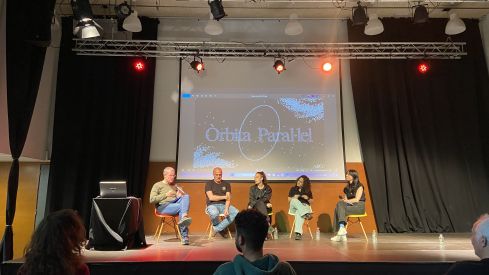
How many live music venues are there in Barcelona? Which is the most culturally neglected neighborhood? "Nothing is known," journalist Nando Cruz emphatically stated last Friday at the Centre Cívic Albareda. This facility in the Barcelona neighborhood of Poble-sec hosted the presentation of LUPA, the first web map to discover all live music in Barcelona.
Cruz, who unveiled LUPA as someone who shows a gift they have been preparing for a long time (in his case, two years), showed the tool before an audience made up of dozens of people from Poble-sec entities, such as Salvadiscos, and others linked to Barcelona culture. Before unveiling the tool, the journalist highlighted that this Poble-sec space was the first to host the exhibition Altres escenaris possibles, the result of the project that the journalist carried out for decades with photographer Martí Fradera and that led them to X-ray more than 200 spaces. That itinerant exhibition was, in fact, the spark that ignited LUPA and that today already totals 400 music venues: “We don't even get to know 25% of the spaces that exist in the neighborhoods,” said Cruz.
Rosalía yes, and neighborhood culture also
The LUPA simulator that was presented on Friday is attractive for two reasons. On the one hand, it becomes an agenda of infinite plans and, on the other, it will allow, as the journalist pointed out, “to understand the city more” and change generalist discourses. “If we know how many people listen to live music, we will break the discourse that Barcelona is the shit just because Rosalía or Bad Bunny come. It's about putting the Razzmatazz concert at the same level as that of a neighborhood space,” he reflected.
LUPA is a project driven by the Casa de la Música de Barcelona in collaboration with the music journalist Nando Cruz, which aims to make visible the musical richness of the city. The filter option offered by the tool is attractive, as you can mark the district, the neighborhood, the types of space, and the time slot of the musical activity you desire. The test that the journalist did in front of the attendees transported him to Sala Upload, inside Poble Espanyol, also in Poble-sec. "Now it is a troubadour of stages and soon it will be a troubadour of activities," pointed out Cruz, who added that it will be necessary to wait a few months to have access to LUPA.
Does music gentrify neighborhoods?
The presentation of the project gave way to the round table Music and community: imaginaries, challenges and tensions, which put on the table some of the dilemmas that today cross the relationship between music, urban space and coexistence. The conversation started from the specific case of the Poble-sec neighborhood, a neuralgic point for much of the musical activity, a fact made evident this weekend, as the neighborhood has hosted the Òrbita Festival, a musical showcase that has brought together the Barcelona underground scene in the venues around Paral·lel.
Precisely, several neighborhood agents were present in a conversation moderated by Nando Cruz where Irene Armangué, director of CC Albareda; José Mansilla, urban anthropologist; Judit Panxeta, neighborhood resident and member of the Cor Monstruós del Poble-sec and Adriana Alcover, co-director of ASACC and Curtcircuit participated. The first to intervene was Armangué who, asked about what diagnosis she makes of Poble-sec, pointed out that it is a neighborhood where associative fabric predominates, as it has more than 200 entities and that it has a “diversity of population, which is a richness and an opportunity”. “Once, a neighbor and activist of the neighborhood said that immigration makes the fumes go down in Poble-sec and I agree with it”, added the director of the Albareda. Armangué nuanced it by saying that, despite the quantity of entities, she misses more union between projects and referred to Panxeta's work as a member of the Cor Monstruós, which rehearses every Monday at the Albareda.
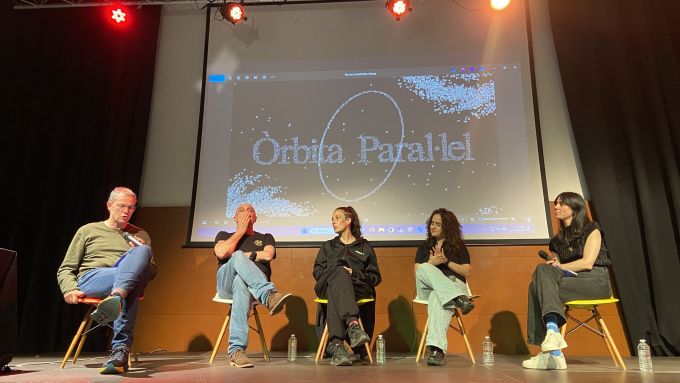
Immediately after, Cruz gave the floor to the urban anthropologist José Mansilla so that he could reflect on the fact that, last summer, within the framework of the Festa Major del Poble-sec, the group of versions Sybarites stopped playing in the gardens of the Tres Xemeneies del Poble-sec due to sound limitations. Mansilla responded the following: “The City Council uses all tools to end disorder and this becomes evident during the major festivals. Any party that wants to end cultural activity will first end the movements of the masses”. The anthropologist added that the area around Paral·lel is “a pending subject for the City Council since the time of Trias, as it brings together festivity, culture, heritage and facilities”.
Expanding on the theme of how night and day coexist, and with a gaze set on the future, this newspaper asked how the entities face the future transformation of the gardens of Les Tres Xemeneies, a project formalized in 2023 between the consortium and Conren Tramway, owner of two empty buildings in Les Tres Xemeneies of Paral·lel. The future gardens will welcome what has been baptized as 3X Paral·lel, which will combine the recovery of industrial heritage with the construction of a high-end office building.

The director of Albareda pointed out that they live it with the same “expectation” as the integration into the neighborhood of the new student residence that opens in September. Among the public, a neighbor showed herself firmly against 3X Paral·lel. “Those offices should not be there, a reclassification of the land was done to make them and this will make the people who went to rap and paint have no place. This was also culture,” she pointed out.
Finally, the debate ended with the intervention of Adriana Alcover, co-director of ASAC and Curtcircuit, who pointed out, by way of summary, that music venues are conditioned by four major factors. The first, that the consumption of culture has been declining for years, a reason that causes music not to be "considered a priority, a necessary good"; the second, "the neighborhood persecution due to noise", which accelerated during the pandemic; the third, Barcelonian gentrification, and the fourth, consumption habits. "I believe that the neighborhood should make the spaces more their own", reflected Alcover.
To conclude, all the speakers appealed to the institutions to activate more public policies that protect the culture of the neighborhoods. They also celebrated the creation of LUPA, because, as Cruz said, it will highlight the richness of a city that cannot be limited “to filling stadiums four days a year.”


