
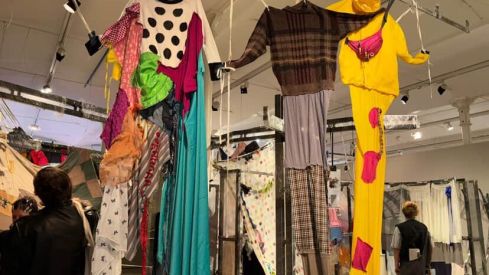
The Tecla Sala Art Centre of l'Hospitalet hosts until September 13, 2026 the exhibition project quemando medias de lycra recordé por si acaso. islaaaaa66rgrsrrtrc_enreda66, a textile and sculptural installation that transforms objects that society often neglects into an organism that lives from our memory, affection, and experimentation.
The proposal, curated by Núria Gómez, has been built over almost a year of collective work with the artist and architect Roger Serret Ricou and the Isla6 collective (formed by Carla Di Girolamo, Bela Altarrui, Julieta Giorgiutti, Marc Espinar, Ivana González and Mariel Sallaberry), all of them from l'Hospitalet. It is in this city where they develop a great diversity of artistic disciplines with dynamics that often escape the traditional categories of museums. This fact was key for the curator to invite them to participate in the exhibition, as they are voices often little represented in institutional spaces.
Unattended objects, active memories
Unlike the usual exhibition formats, the project does not start from pre-existing works by these artists, but from an open process of creation from scratch, driven by the program of the Cultural District of l'Hospitalet.
The conceptual starting point of the exhibition is the material culture of neglected objects: pieces of clothing, fabrics and accumulated materials that have fallen out of use, but that persist in our wardrobes and homes due to affection, memory or foresight. Far from being waste or museum pieces, in this exhibition they have become raw material for creation. “They did not want already made works, they wanted new creation,” explains the curator, who underlines the singularity of a dialogue that is not between a curator and an artist, but with an entire collective.
On the other hand, Gómez also highlights the paradox of creating a new exhibition with recycled materials. The collective works with these materials from a logic of recycling and transformation: “It's a great paradox, we wanted to make new art pieces, but we have done it by recycling”, summarizes the curator.
From the closet to Tecla Sala
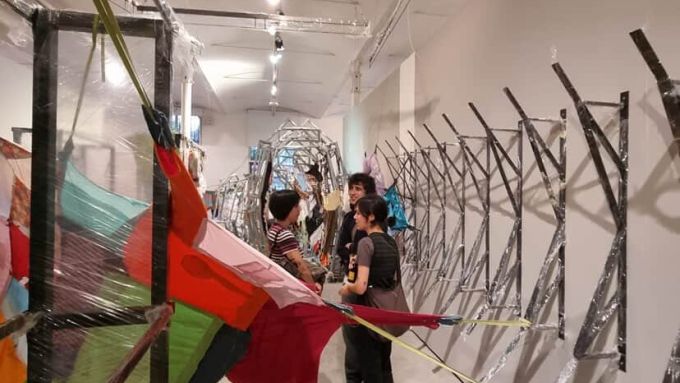
Dresses that contain possible versions of ourselves, coats that evoke moments or places, amulets or fragments that survive for their symbolic value. In this ecosystem, objects not only remember, but project possible futures or simply sustain a quiet presence in the space that welcomes them.
In this sense, the exhibition proposes a “poetic ecology of waste” that forces to look closely at the texture of what we leave inside our own stomach. A stomach that, in this case, metaphorically, digests objects, vital moments and even social classes.
From the reflections on these elements and from the game between the curator and the collective, their transformation into works of art that are now exhibited is born. Because if they had one thing clear before starting the assembly, it is that at Tecla Sala they came to play and to deploy a less normative gaze on the different materials.
An architecture that reconfigures itself
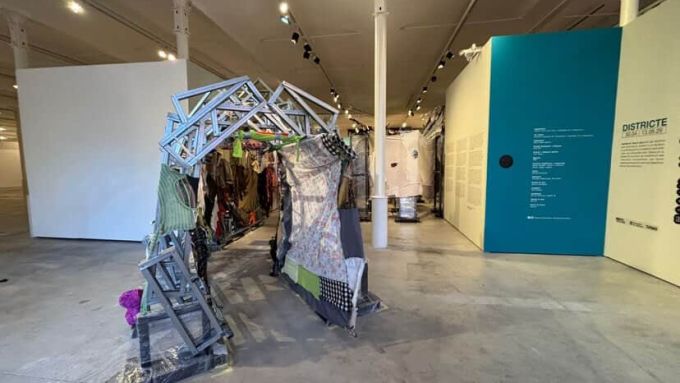
The spatial dimension of the project has been developed with Roger Serret Ricou and his collaborators, with an installation that questions the usual logic of exhibitions, often based on ephemeral and disposable materials, to propose a reusable and mutable architecture. The result is an installation that behaves like an organism: it breathes, digests and resurrects materials, affects and narratives. And we, the visitors, can enter inside.
Beyond the final piece, the curator highlights the value of the process: a slow, collective and sustained work over time, that moves away from the accelerated dynamics that we often find in the artistic system. “I am very happy to have been able to do this slow, collective work, which escapes the more capitalist or fast logics of museums”, she states.
In this sense, the exhibition not only presents transformed objects, but also a way of doing: a practice based on care, reuse and prolonged attention to what usually remains out of field, as are also the exhibition spaces, which in this exhibition helps us to see, even the skeleton of the structures that traditionally exhibit works of art.
A choral sample
Isla6 was born in 2022 as a collective and alternative space based in l'Hospitalet de Llobregat, with the aim of generating a support network for artists of the underground and queer, dissident, and migrant communities. They have programmed concerts, listening sessions, and dance floors in collaboration with collectives such as Usthelesbians, Me Siento Extraña, El Pumarejo or Lágrima Collective, as well as in spaces like Razzmatazz. They also promote emerging art markets and photographic and textile creation laboratories based on the upcycling.
Roger Serret Ricou (1985), for his part, works between architecture, art and exhibition design, with a practice focused on the reactivation of disused spaces and the creation of cooperation networks. He has developed projects in spaces such as La Capella, Arts Santa Mònica, Hangar or MACBA, among others, and habitually collaborates with diverse artists and collectives.
Finally, the curator Núria Gómez Gabriel (1987) is a writer, researcher, and curator. Her practice explores the intersections between critical and feminist pedagogies, curatorship, and contemporary culture. She has worked with institutions such as the MACBA, the CCCB, or La Casa Encendida, and regularly writes for platforms such as Texte zur Kunst, A*Desk, or CCCBLAB. She is the author of Love me, Tinder (2019) and Traumacore. Crónicas de una disociación feminista (2023).
“The name of the exhibition does not please anyone and pleases everyone”, summarizes Gómez Gabriel. It is an authentic remix of everyone's ideas together, as in fact this collage exhibition that you can see these days at Tecla Sala is.


