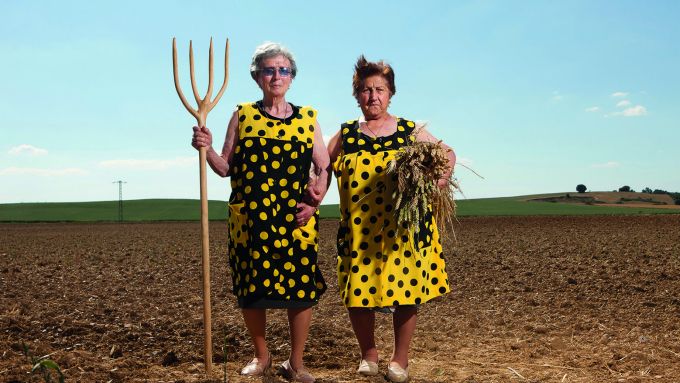
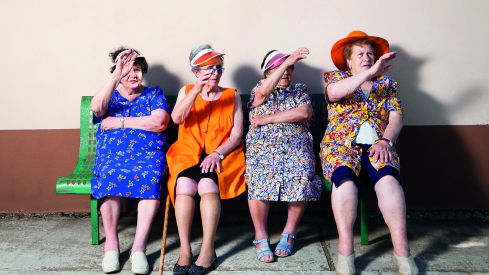
From a wedding it is said that another couple of lovers can emerge, but also, why not, a photography project, as happened to Lucía Herrero. This woman from Madrid, settled in the Born neighborhood of Barcelona for years, went to the wedding of a cousin in Villarmienzo, a town of 45 inhabitants, in Palencia. There she met Constancia, a woman from the village who, as Herrero says, was “the poet of the village, although nobody knew it”. When they said goodbye, the neighbor lamented that they would never see each other again. “I told her no, that I would return”. Indeed, the photographer, after a year, was stepping on Villarmienzo with a van full of robes, bought wholesale at the Rastro de Madrid and others made by herself. All this to portray a type of woman she calls the ‘woman of the robe’, or in other words, the “matriarchs who have lived in a patriarchal world”.
That trip to Villarmienzo was the starting point of Tribute to the Robe, a project that until May 16 can be seen at Mailuna Bienestar, a space in the Raval of Barcelona that offers cafeteria and massage service. The photographer shares that it is a different place from those where she usually shows her work, since since 2018, when the project finished, the images have been exhibited in art galleries and museums. From Mailuna they proposed her to do the exhibition and she gladly accepted. “This space is decorated with wooden chairs that seem taken from a grandmother's apartment, so I already like it,” comments Herrero.
A triple homage: the gown, the grandmothers and the field
To portray six women “in danger of extinction”. This was the photographer's intention. The set of images touch upon two major themes. On the one hand, the role of women in the rural world and how they have been relegated to domestic tasks and have not had, as the artist says, “permission to participate at a cultural and economic level” in society. And, on the other hand, it deals with the theme of depopulation. “It is not only geographic, it is human, since we lose traditions, songs and contact. I like the idea of capturing it before it ends,” she points out.
This artistic and historical union, the photographer has christened it as a genre of “the Fantastic Anthropology”, a name she invented as a result of her first work, Tribus. “Everything I do comes from a previous anthropological study”, she points out. One of the photographs that best represents this combination is one in which we see a woman, Resu, with a shotgun in her hand. “People are happy to see these women with power, as they transgress their functions”, details Herreo.
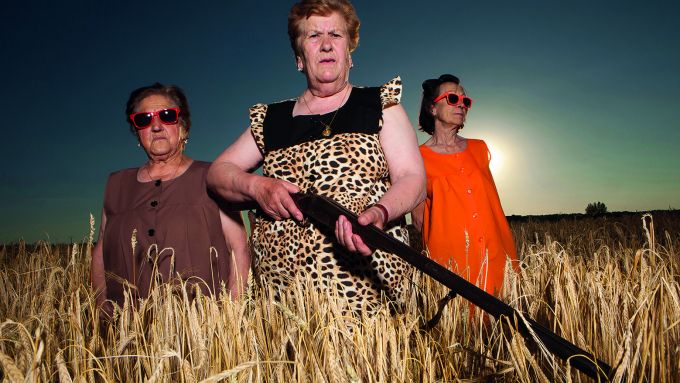
The apron, therefore, is the common denominator of these images. This piece of clothing that is put over clothes so as not to get dirty is, for the author, a symbol of the domestic work to which these country women have been relegated. "You will never see a sculpture of a woman like this, and for this reason I pay them tribute," she asserts.
Herrero adds that if the public received the project so well, it is, in part, because it came out at a transgressive and key moment for feminism: “I published the photos after the movement Me Too. Before people were not ready”.
“It was the artistic baptism in my country”
The artist, who has accumulated a long international career abroad, in countries like France, Slovakia, Norway or Japan, explains that this project made her gain recognition in Spain. "During the pandemic the project gained weight again and, in fact, it was my baptism as an artist in the country. Everyone interviewed me and I became a feminist symbol," she values.
Finally, if the images are observed, it can be seen that all show apparently everyday scenes, like working in the field or resting on a bench, but with some extra element, such as a robe with a striking print or colorful berets and glasses. This is precisely the artist's way of working. “I love to portray transparent women like them, but I always push people to do something. Let's say I turn up the volume of what they already are,” concludes the photographer.
Until May 16, the photographs can be bought in the form of a print at the Mailuna space or through Herrero's website. In addition, on Saturday, May 16 at 7 p.m., the author will give a guided tour. Admission is free.