
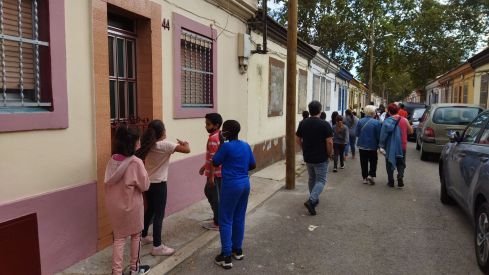
At the beginning of 2022, the Barcelona City Council and the Generalitat re-housed the Cases Barates del Bon Pastor in Barcelona. Almost fifty families began to live in public housing in buildings that were part of the remodeling process of this neighborhood in the Sant Andreu district.
Months before, primary school students from Institut-Escola El Til·ler, specialized in music, created La Rumba del Bon Pastor, a community initiative promoted by the Artixoc Association and the La Fàbric@ Cooperative, with the support of musician Oriol Luna and the ICUB, with the aim that the children would learn about the past and present of the neighborhood. In fact, at the time the project closely involved some of those students, as some of them lived in the Cases Barates with their families.
Four years later, La Rumba del Bon Pastor now returns transformed within the framework of this year's edition of Calidoscopi, a cultural program of the Sant Andreu district. Tomorrow, Tuesday, June 2, at the Centre Cívic Bon Pastor at 5 p.m., the project will be presented in live show format. The live performance will also be the raw material for the new music video that Jep Jorba, audiovisual creator specialized in culture and storytelling, will record during the performance.
“The houses looked like a sardine can, they have no terrace or balcony. And we would go out to the square with chairs to eat botifarra and turrón. Certainly, they seemed small, but everyone fit inside,” those students who are now in ESO sang in 2022 from the old Cases Barates.
Those children are now teenagers and in recent months they have incorporated reggaeton, electronic bases, and live instrumentation into the original piece, accompanied by Francesc Llull Pons, music teacher at Institut-Escola El Til·ler, and Tuna Pase, composer, improviser, and ethnomusicologist born in Istanbul and based in Barcelona.
The project has revived thanks to the collaboration that the Institut-Escola has made with the Centre Cívic Bon Pastor. “We wanted to link school projects with the neighborhood and I proposed recovering that rumba,” Pons details. The project was incorporated into this 2026 Calidoscopi program and, immediately, students and teachers got to work. Oriol Luna, creator of the original rumba, has shared the chords of the piece and, on the one hand, the music teacher of the center has adapted the song for the students to play it with guitar, bass, keyboard and batucada, and on the other hand, Tuna Pase has dedicated himself to the reggaeton part and electronic bases.
To know the history of the neighborhood
Àgia Luna is the director of Artixoc, an entity from the La Bordeta neighborhood that has been creating projects related to community theater with young people for 27 years, such as La Rumba del Bon Pastor. Luna is happy that that 2022 project is taking shape again. She remembers the creative process, which focused on recovering the historical memory of the neighborhood, as the students got to know the area with the help of various neighbors and entities: “We focused on daily life, on how those houses, as the song says, used to be a sardine can. We did it with the three pillars of all our projects: rigor, daily life, and humor”.
However, what reflection of Bon Pastor does the rumba make? “It speaks of a struggling people who lived in a border-neighborhood and had a left-wing past,” Luna adds. The idea that summarizes the song is the fact that Bon Pastor was part of the municipality of Santa Coloma de Gramenet until 1945, when it was annexed to Barcelona.
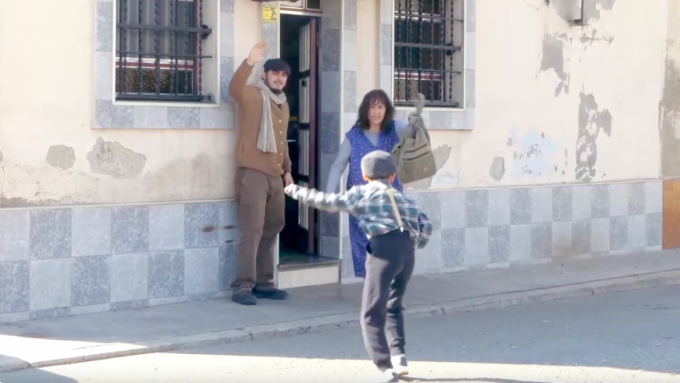
On Tuesday the project will sound again, but now without the Cases Barates in the background (with the exception of those included in the MUHBA), since last September the demolition of those that remained ended and now the construction of social rental buildings and with services for the elderly must begin. “Everything that appears in the music video, went to the ground,” comments the director of Artixoc.
Although the current work has been more musical than historical, the professor comments that resuming the project has served so that the “students who are not familiar with the neighborhood or live outside get to know the past and the present through music”. Ultimately, it is evident that there is no lack of art and love for the neighborhood in this school. This is demonstrated by the final part of the song: “And look how cool our school is, which turns out to also be a high school. We have a patio, trees and a climbing wall and we do theater classes and we love making music in the classrooms”.


