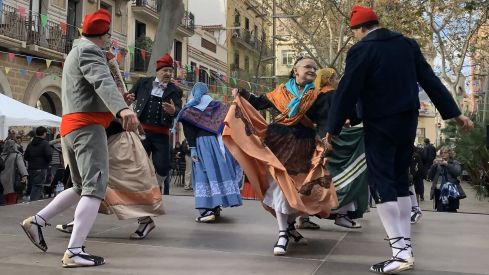
The Poble-sec neighborhood will experience an unprecedented evening on December 20th at the Parish of Santa Madrona. For the first time, the Esbart Dansaire Renaixença and the Coral 4 Vents, two entities with decades of roots in the neighborhood, will join forces in a show that will combine traditional Catalan dances with live choral singing. A proposal born from the desire to strengthen the local cultural fabric and which, if successful, could initiate a shared line of work. The show will begin at 8 PM and admission will be free.
The show will include four traditional ballets performed by the company's dance troupe, two pieces performed jointly with the choir directed by Maria Teresa Noguera i Puyol, and a finale with Christmas carols. It should be highlighted that one of the most special pieces will be the Ball del Ciri de Moià, which will be danced with the accompaniment of the choir and the presence of representatives of Moià's tradition, who have been expressly invited.
An unprecedented proposal
“This is the first time we’ve done something like this,” emphasizes the president of Esbart Dansaire Renaixença, Frederic Gaude, regarding the collaboration with the choir. Why? Because until now, the dances had traditionally been accompanied by a *cobla* or their own music, like the *gralles* of their *bastoners”.Furthermore, the setting will also be unprecedented: instead of taking place in the square as is customary, it will be held in the church of Santa Madrona: "Given the time of year and the type of show we were proposing, we thought the parish church would be an ideal space to hold it." The event will begin at 8 p.m., immediately after mass, and will be free admission until capacity is reached, with no prior reservation required.
A first collaboration that could continue
Gaude highlights the complexity of the rehearsals, which have been carried out separately, with a joint weekly meeting to adjust details and leave "everything ready." A way of working where the enthusiasm generated by the possible outcome has already begun to be noted, and which, as it could not be otherwise, makes them think about the future: "Obviously, the possibility of repeating the experience later, or even expanding it, has crossed our minds," replies Gaude. At the very least, they prefer to wait until December 20th to see the result and begin to evaluate it.
In any case, from the Esbart Renaixença they are aware of the importance of publicizing and maintaining traditional Catalan dances, whether through the usual public performances or through collaboration with other artistic groups. "There are times when the world of folklore is at its peak and at other times when it is in decline."Despite the difficulties, the president of the entity also analyzes that it is increasingly complicated to maintain certain dynamics when rehearsing and forming a group: "People have become more individualistic" and "they reject the word commitment." For this reason, he considers perseverance to be the key to preserving cultural identity: "The time will come when the movement will rebuild itself," he trusts. In this case, the cultural exhibition will serve to lay another stone on the path that seeks to preserve traditional Catalan dances.


