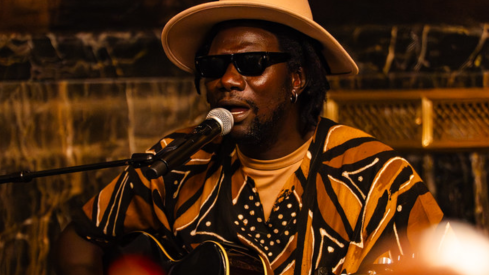
Kara Diabaté is a bassist, composer, and arranger born in Tambacounda, in eastern Senegal, and has been living in Barcelona for three years. Once here, he formed the afro-fusion band Kara Afri-Kang, which in Mandinka, his mother tongue, means 'the voice of Africa'. The group has been rehearsing for a year at the rehearsal rooms of the Centre Cultural Albareda, in Barcelona's Poble-sec neighborhood, where Diabaté has been a resident for a year.
The band blends traditional West African rhythms and melodies, reinterpreting them through reggae, funk, blues, jazz, and contemporary music. Kara Afri-Kang is made up of musicians from Senegal, France, Andalusia, and Italy. With the exception of the Senegalese members, he met the rest of the artists in renowned venues like Jamboree or Marula. He explains that since living in Barcelona, he attends the jam sessions at these venues and connects with other artists to join his project.
In recent months, the band has played in renowned venues in Sants-Montjuïc such as Sinestesia, Paral·lel 62, Mescladís, and a month ago, on June 19, they were part of the Concerts Al Pati series organized by Albareda. He has very fond memories of this last experience: "The concert was incredible, people were happy and dancing. In concerts like that, you can feel yourself," says Diabaté. That day the band performed in full format: a saxophonist, a drummer, a keyboardist, guitarist, percussionist, a singer, and a bass, Kara. Additionally, if needed, they can also be hired in a smaller format.
As he explains, Diabaté is in a sweet spot, as he and several colleagues are devising a project that will consist of offering temporary residencies for musicians from Barcelona and across Spain to settle in Senegal for a few months to "promote cultural exchange between flamenco, rumba, and traditional Senegalese music." The project is in its early stages, but once detailed, the musician will publicize it.
The musician's origins
Family can be a great influence for a musician, and even more so if you grow up in a griot family, which is the figure of storytellers, poets, and musicians in West Africa who preserve the oral traditions of the people. Specifically, Diabaté's father played the guitar, his mother sang, and his uncles were also musicians. "When I was little, my mother recited and sang traditional Mandinka poems to me that later inspired me to make modern music," explains Diabaté, who incorporates texts by Senegalese poets into his shows.
Trained in music since the age of three, he had to fight to pursue musical studies, as his family opposed it from the beginning. Nevertheless, he studied at the National School of Arts in Dakar, the Senegalese capital, where he graduated in 2009. Later, he studied Law for two years at the University of Dakar, which he abandoned to focus on a musical career that would never stop. He immediately established contact with artists from Senegal, Guinea, and other countries with whom he played as a bassist in different musical formations.
Throughout his career, he has accompanied emblematic voices such as Aida Samb, Abdou Guitte Seck, and has also collaborated with references such as Dara and Thierno Mamadou from Guinea, as well as the Senegalese-English Diabel Cissokho.
It wasn't until 2017 that he thought he wanted to come to Europe to deepen his career. "When I was little, my dream was to live in Barcelona," he confesses, and explains that all these years he has traveled through Europe with one goal: to achieve his Mandinka identity. "In Africa there are many rhythms and by mixing them with European ones you achieve another identity, which at the same time is a reflection of my vital mix. I want people to feel this rhythm as their own," he relates.
"It's not easy to play in Barcelona"
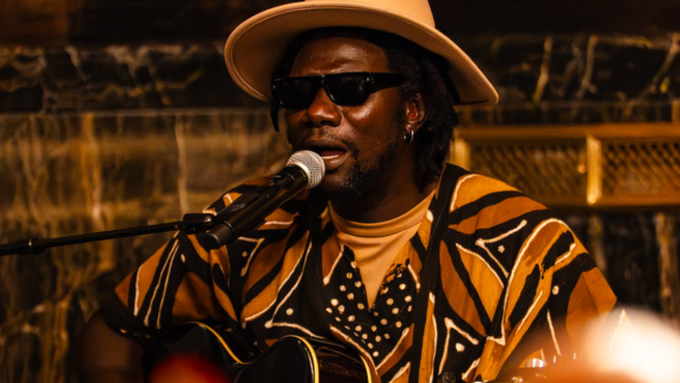
Diabaté is critical of the difficulty of playing in venues or small halls in Barcelona: "It's not easy to play here, and even more so being new. I do everything myself and get gigs through friends, but in general, music isn't paid well."
Regarding the audience for African music, he believes there is one, both local and foreign, but at the same time he misses a greater connection between people and traditional African music, a fact he attributes to a lack of knowledge.
Despite the difficulties, there is no doubt that the key is to keep working hard like him and meet as many people as possible. In fact, that's how he managed to perform on June 8 at the Saló de Cròniques of the Barcelona City Council. He did so within the framework of the institutional event organized by the City Council around May 25 to celebrate Africa Day, a date that commemorates the creation of the Organization of African Unity (OAU) in 1963. "The celebration of Africa Day is a moment to give voice and visibility to this continent and to highlight African societies and their diasporas as a source of dynamism and social and cultural innovation," detailed the council on its website.
The event featured the participation of the Deputy Mayor for Presidency, International Relations, Education, Health, Human Rights and Life Cycles, Maria Eugènia Gay, and the Commissioner for Citizen Relations and Cultural and Religious Diversity of the Barcelona City Council, Richard Sánchez. The meeting ended with the performance of this artist in acoustic format, that is, with two guitars, percussion and voice. "It was a great opportunity for me," concludes the musician.


