
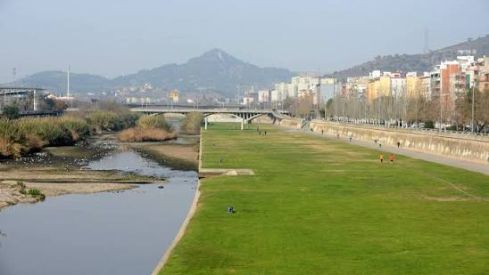
Enjoying an interesting exhibition or cultural show is always pleasant, but it is even more so when the surroundings offer privileged views, whether of the sea, the mountains or the city.
Today we offer you a guide to five cultural spaces in Barcelona and the metropolitan area where you can enjoy an exhibition and, before or after the visit, observe the surroundings. Through exhibitions of photography, history, sculpture and urban art, we start in Sant Just, jump to Turó de la Rovira and then slide along the Besòs river to visit the Bon Pastor neighborhood, La Verneda i la Pau and end in Sant Adrià de Besòs.
1. Can Ginestar Cultural Center (Sant Just)
The Can Ginestar Cultural Center is located within the Can Ginestar Gardens, one of the most welcoming places in this municipality of Baix Llobregat and from where you can enjoy privileged views of Collserola and the entire metropolis. Can Ginestar houses the municipal historical archive, the library, the municipal radio station, plastic arts workshops, spaces for entities, a cafeteria and the El Celler exhibition hall.
Regarding the current program, the Can Ginestar Gardens have hosted the exhibition Dones de Sant Just since May 27, a photographic exhibition promoted by the Sant Just Desvern City Council and made by the Sant Just Photographic Association. The exhibition brings together photographs of women from the municipality of different ages, profiles and fields, with the aim of reflecting the diversity, richness and plurality of female experiences present in Sant Just. The images have been taken by members of the Sant Just Photographic Association within the framework of a project developed jointly with the city council.
Hours: Monday to Friday from 9 a.m. to 11 p.m. and Saturday and Sunday from 10 a.m. to 11 p.m.
2. Turó de la Rovira. Barcelona History Museum (El Carmel – Barcelona)
In March 2011, the heritage site of Turó de la Rovira was inaugurated, which meant an improvement for an area of the city that until then was quite degraded, isolated and unknown, where the remains of an anti-aircraft battery that defended Barcelona from aviation attacks during the Civil War were preserved.
The Museu d’Història de Barcelona Museu has wanted to highlight all these historical and heritage sediments, on the one hand, through the in situ installation of five information panels that facilitate the self-guided visit, the publication of two urban history guides, and the programming of guided tours. On the other hand, by promoting a methodological reflection that has allowed a heritage intervention based on archaeological criteria adapted to the conservation of fragile and modern structures.
Hours: from Tuesday to Sunday from 10 am to 7 pm
3. Cases Barates del Bon Pastor (El Bon Pastor, Sant Andreu, Barcelona)
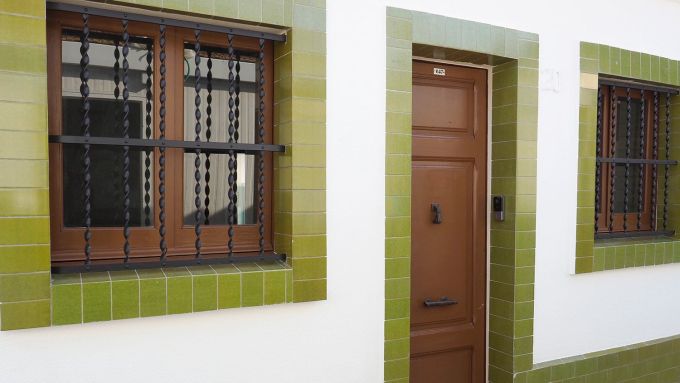
To get an overview of the Barcelona that borders the Besòs, we recommend visiting the Bon Pastor neighborhood, where the museum of the Cases Barates del Bon Pastor is located, managed by the Museu d’Història de Barcelona. The museum space aims to reflect the memory of the history of housing in Barcelona during the 20th century through the musealization of a block of the cheap houses of this working-class neighborhood, one of the four housing estates built in the city in 1929. The block is made up of sixteen houses, of which ten have been musealized: four show the struggle for housing in the city and the other four, how life was in the Bon Pastor neighborhood and the evolution of the interiors of the cheap houses between 1929 and 2017. The remaining two show general aspects around the represented themes.
The Cases Barates museum project began in 2010 at the initiative of the Bon Pastor Neighborhood Association, which obtained the support of the Sant Andreu District and the Municipal Institute of Housing and Rehabilitation of Barcelona. The proposal was consolidated with the alliance with the Museu d’Història de Barcelona (ICUB). After a decade of work, funding through the Neighborhood Plan made the new museum space possible.
Hours: Thursday from 10 am to 2 pm; Saturday from 11 am to 3 pm and from 4 to 6 pm and Sunday from 11 am to 3 pm and from 4 to 6 pm
4. Piramidón Centre d’Art Contemporani (la Verneda i la Pau, Barcelona)
From the rooftop of Piramidón Contemporary Art Center, located on the seventeenth floor of a skyscraper, there is a panoramic view from Besòs to Montjuïc, from sea to mountain. You can see the flats of La Verneda and La Pau and the gigantic 22@ of Poblenou. This gallery opens its rooftop once a month, when they celebrate a cultural vermouth open to everyone and also offer concerts, open-air cinema, and dance performances throughout the year.
Beyond this view, on the 16th floor is where the art gallery is located, which also enjoys bird's-eye views. The exhibitions are itinerant and serve to showcase the work of resident artists. These days, and until September 15, you can see the exhibition Espai Contaminat by Iacopo Pinelli, who transforms small traces of his environment into sculptures and installations that explore the relationship between nature, memory, and space, such as an olive pit, a lizard's tail, spider droppings, the dust from an empty hole, or a cicada's shed skin.
Hours: Monday to Friday from 10 a.m. to 7 p.m.
5. BesArt The River Museum (Sant Adrià de Besòs)
We return to the Besòs river and in this case, we highlight the BesArt Museum, inaugurated in March 2023, which is an urban art project that aims to become the largest open-air urban art museum in the world. In collaboration with Mediterranen Street Art and the Reial Cercle Artístic de Barcelona, it was born to paint with graffiti the 18 kilometers of wall on both sides of the Besòs river with works by national and international artists.
The ambition of this project is to reach five kilometers and 250 murals by 2030. This was announced in January by President Salvador Illa, who described the project as a "transformative" idea. Months ago in Cultura B we spoke with Andrés de la Bastida, of Ecuadorian origin and a resident of the Sant Antoni neighborhood of Barcelona for a year. He is one of the artists who has painted at the Besart Urban Art Museum. In this case, his work paid tribute to all immigrants who at some point have arrived in Santa Coloma and have put down roots there.
We invite you to walk on both sides of the Besòs river to discover the works that are already painted while enjoying the landscape.
Hours: from April 1 to September 30 from 8 a.m. to 9 p.m. and from October 1 to March 31 from 8 a.m. to 6 p.m.


