
For many years, Barcelona was considered the world mecca of skateboarding. Its squares, its streets, and its architecture turned the Catalan capital into a unique setting that attracted skaters from all over the planet, international brands, and specialized magazines that wanted to immortalize the movement. Among the people who have best known how to explain this era is Julien Deniau.
A French photographer, filmmaker, painter, and skater, he has lived in Barcelona for a long time. For more than thirty years, he has worked as a freelance photographer for European and international skate magazines, and also as a filmmaker for French television. His camera has traveled streets around half the world, but one city holds a special place in his imagination: Barcelona.
Now Deniau presents Barcelona Streets, a photographic exhibition and video screening in Ciutat Vella, at the Bien Cuadrado Studio gallery until June 28. An exhibition where he combines analog and digital photography and where the artist takes a journey through the Barcelona skater scene between 2000 and 2020.
Two decades watching Barcelona skating
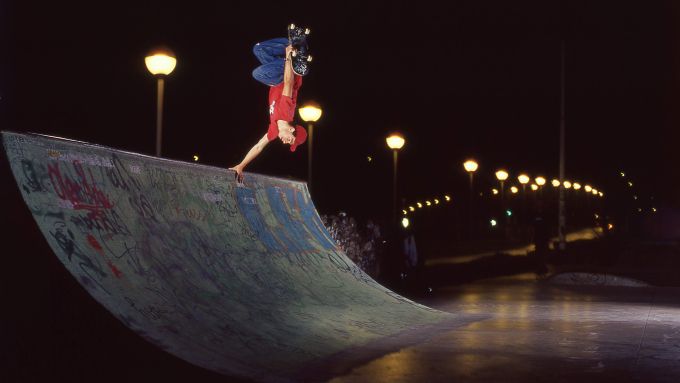
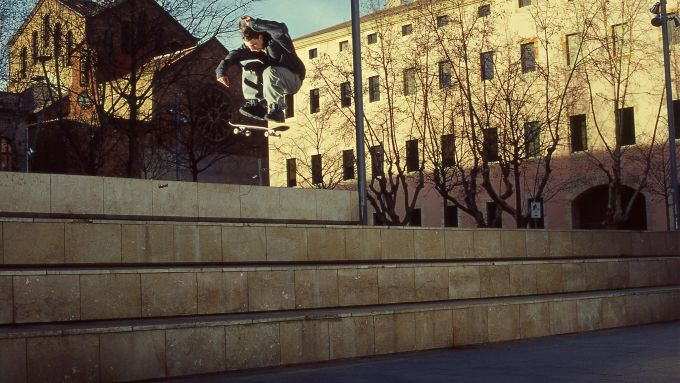
The exhibition is divided into three levels. The first is a retrospective of the skater movement in Barcelona, a documentary look at an era when the city was an international meeting point. "Barcelona was considered the mecca of skateboarding in the world. All the brands came, all the international magazines wanted to take photos here," explains Deniau. During these years, he accumulated more than a million images related to this culture.
The second space shows a more personal Barcelona, observed from different points of view between 2007 and 2015. Everyday streets, squares, and corners that, thanks to the artist's gaze, explain scenarios that became spaces of collective memory for the movement.
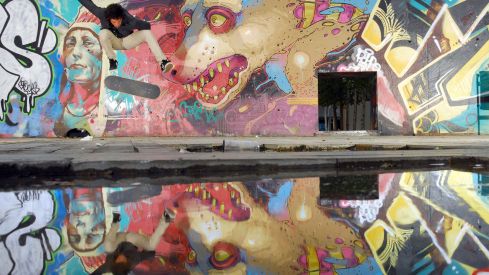
The third part, titled Reflections, plays with reflections in puddles, mirrors, and urban surfaces to show different angles of this world. A way of looking at the city that goes beyond simple sports photography.
In addition to the photographs, the exhibition includes a projection of videos recorded during those years, when Deniau also documented skaters from different neighborhoods of Barcelona.
"Skateboarding has been my life since the nineties"
To understand his work, one must understand his relationship with this practice. The photographer is not just someone who has photographed this culture; he is also part of it. And here lies a point that differentiates him from other photographers who have approached the movement. He himself skated for many years, with sponsorships like the one he had from Adidas, participating in competitions and tours. He was also a protagonist in front of the camera before becoming the one behind the lens.
Much more than art
For him, it's all much more than a sport: "I have lived skate from the inside, I live it from the inside. It's been my life since the nineties. My social life also revolves around it." "Skate is art. It's not just skating: it's also the art on the boards, the aesthetics, the way of dressing, the philosophy of life. For many years it was an underground culture, we were the rebels, an urban tribe," he adds.
A perspective that also explains his artistic evolution. In 2005, he began to paint and draw, seeking a new way to express himself beyond photography and video. Over time, the skate boards themselves became his main canvas. And now that's what he works on: he creates sculptures from used skateboards.
Currently, he is an artist in residence at the Artevistas Gallery, where he exhibits part of his sculptural work.
In 2020, Deniau practically stopped photographing after his analog camera was stolen, but he also felt it was time to seek new paths. Now he is mainly focused on his sculptures with recycled boards. "Even though I do other things now, skate remains present in everything I do," he says.
A Barcelona less friendly to these practices
Settled in Raval, this photographer and artist explains that these years have allowed him to discover a Barcelona that many Barcelonians are unaware of: "I have been able to see a different Barcelona. Sometimes I think I know the city better than many people who were born here." Now, however, he believes that the golden age that Barcelona experienced as a global reference for skate is behind us. He explains that he observes with concern the changes the city has undergone and believes that urban space is increasingly leaving less room for this practice.
“Skateboarding is not like playing padel or badminton. A skater skates out of their house. It's part of the journey, of the city. It's not an activity you only do when you arrive at an enabled place,” says Deniau with resignation, who especially remembers emblematic spaces like Plaça dels Àngels, in front of MACBA, or Plaça dels Països Catalans, in Sants, places that for decades have been references for the community. These spaces are now under construction and it is not clear if they will return to being as before, or if it will be possible to continue skating there. In this vein, he believes that institutions increasingly want to create specific spaces for skating without understanding its practice and vindicates the work of collectives that fight to preserve spaces like Plaça dels Àngels and Plaça dels Països Catalans. He also values self-managed initiatives, such as those promoted by skaters who build their own spaces with cement, as happens in Parc del Poblenou or at La Bòbila in Badalona, and recalls the recovery of what is considered the first skatepark in the province of Barcelona, located in Arenys de Munt, a space that had been abandoned and that the community rescued from oblivion.
An exhibition open to everyone
With Barcelona Streets, Deniau invites both skate lovers and those who have never had contact with this universe to discover a culture that goes far beyond a sport. A way of understanding the city, art, and freedom that is reflected in each of his photographs. A passion that he also conveys when he talks about his life journey and a scene he has experienced from within. Because, after more than thirty years behind the camera, he continues to look at this world with the same eyes as when he started: those of someone who does not simply photograph a scene, but a way of living on wheels.


