
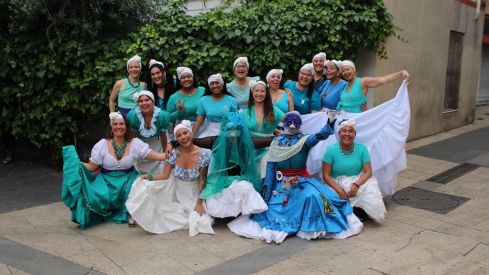
Gabriela Espinosa has been a resident of the Barcelona neighborhood of Carmel for five years. She arrived from Chile to study a master's degree in art and education. For a few months now, she has been the leader of Tumberas en Barcelona, a Barcelona group formed by women who dance tumbe, an Afro-descendant dance from northern Chile. Specifically, Espinosa emigrated from the city where this dance was born, Arica, which borders Peru.
According to her, the tumbe was lost with the War of the Pacific (1879-1883), when all kinds of cultural expressions of the Afro-descendant and indigenous people of the territory were prohibited. But in 2003, when Espinosa was still in Chile, she learned that a group of young people, called Oro Negro, recreated this dance based on the oral memory of Afro-descendant grandparents. The "memory was restored," as the Chilean likes to say. "The young people went out in comparsa through the streets of Arica and this generated recognition among the population," details the resident of Carmel, who adds that she also was part of several dance groups. The dance, as she says, has evolved over time and, although it maintains historical movements associated with cotton harvesting and agricultural work, "now it is closer to styles typical of Carnival."
A dance that connects Chile with Carmel
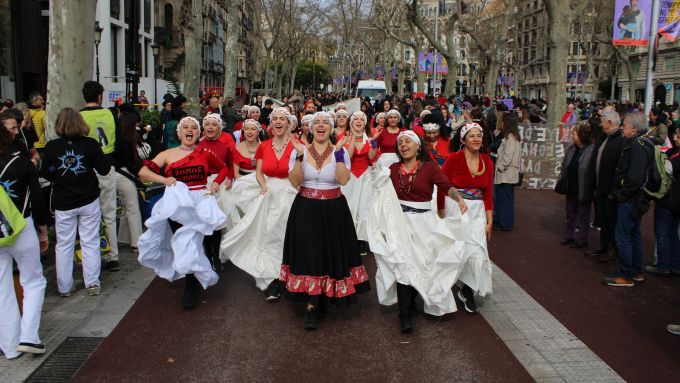
Once in Barcelona, Espinosa wanted to "tumbar los malucs" again, as she says (in fact, that's why the dance is called tumbe). First, she got in touch with the Mujeres Palante entity in l'Hospitalet, where she did a workshop on this dance applied to social well-being and, later, she knocked on the door of the Casal de Barri La Barraca del Carmel. There, new Barcelonians from Chile, Bolivia, the Dominican Republic and, "surprisingly," also Catalans began to gather. "Since we had lit a flame, in January we thought of making a call through social media to go out and dance at the March 8 demonstration, as we do in Latin America," she recounts.
Thus, since January, every Sunday about thirty women gathered on the Rambla del Carmel or at the Casal de La Barraca to rehearse. Espinosa stood at the front and with a whistle gave indications with her hands for the women to follow her steps. “We didn't just dance, we created a group of anti-colonial and anti-racist women, because we reclaim dance as a political space,” reflects Espinosa. From the Casal de Barri La Barraca del Carmel, they were lent sewing machines to make the costumes for the parade.
The performance at the feminist demonstration was a complete success and, in fact, has been the way for them to be known throughout Barcelona. For example, they were immediately contacted by the Casal de Barri Can Travi and last May they held a family workshop there and performed within the framework of the Cultural Diversity Festival organized by this facility. The next appointment is on July 4 at the Karmela Fest, the alternative main festival of Carmel. Espinosa explains that the group's agendas are smoking and that they will try to do some more performances before the summer.
Tumbe classes, starting in September
The leader of Tumberas en Barcelona says that in September she plans to start teaching regular tumbe classes in one of the cultural spaces with whom they already have contact. “In neighborhood spaces, self-organization is valued and they are very hospitable to us,” she says. In fact, the group wants to return with more musical strength. Specifically, they need drums, since right now they play music with a loudspeaker.
Finally, Espinosa, in view of the current success, reflects that this initiative that she started to connect with her roots is serving, not only to remember where they come from, but to integrate into Barcelona culture: “We are generating culture. It is a way of dialoguing with the culture here without losing your roots,” she concludes.


