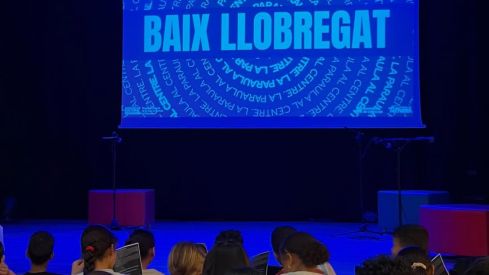
“We are the cry carried by the wind, the word that time does not erase. We will build a new future in which we will finally tear down the wall,” sing a group of students from the Maria Aurèlia Capmany institute, in the Sant Ildefons neighborhood. They probably admire Cecilio G, the ‘cursed’ poet of trap, as he is known by the young people of the old Ciutat Satèl·lit, the blocks and streets that have welcomed migrants since they were built, half a century ago.
And like their idol, they also ‘engineer’ collective rap songs to explain their experiences. And they do it with Ildesons, the name of an educational innovation project where more than 170 students from institutes and schools in the neighborhood have unleashed their imagination and creativity, always with an eye on their daily lives.
Sense of belonging to the neighborhood
“Through music, students have developed a sense of belonging to the neighborhood,” explains Laura Riera, one of the Catalan language teachers at the Maria Aurèlia Capmany institute and one of the teachers involved in the aforementioned project, promoted by the Department of Education of the Generalitat, with the collaboration of the musical cooperative Versembrant, self-defined as an “itinerant popular school” that aims to foster critical awareness among young people, through urban art and hip hop, to AMIC Cultura.
Through projects like Ildesons, the cooperative aims to transmit to young people the capacity for reflection and criticism in the face of situations of discrimination, such as sexism, homophobia, racism or the rise of the far right, as well as other topics of current interest and special influence among young people, such as drug consumption, social networks, bullying or gender roles.
“Every two weeks, the psychologist and feminist and anti-capitalist rap singer Bittah, from the group Tribade, came to the institute to bring rap music to the classrooms, as a tool for protest and social struggle,” Riera details about the process of creating the songs performed at the final course show, at the Auditorium on June 8.
With her, the students began to compose very personal songs, based on their life in the neighborhood, always in Catalan so that “they feel it as a tool for neighborhood cohesion,” adds Riera, who believes that the project, which also includes other educational centers in the Terres de l’Ebre and Central Catalonia, “will have continuity because it has contributed to the development and growth of the students.”


