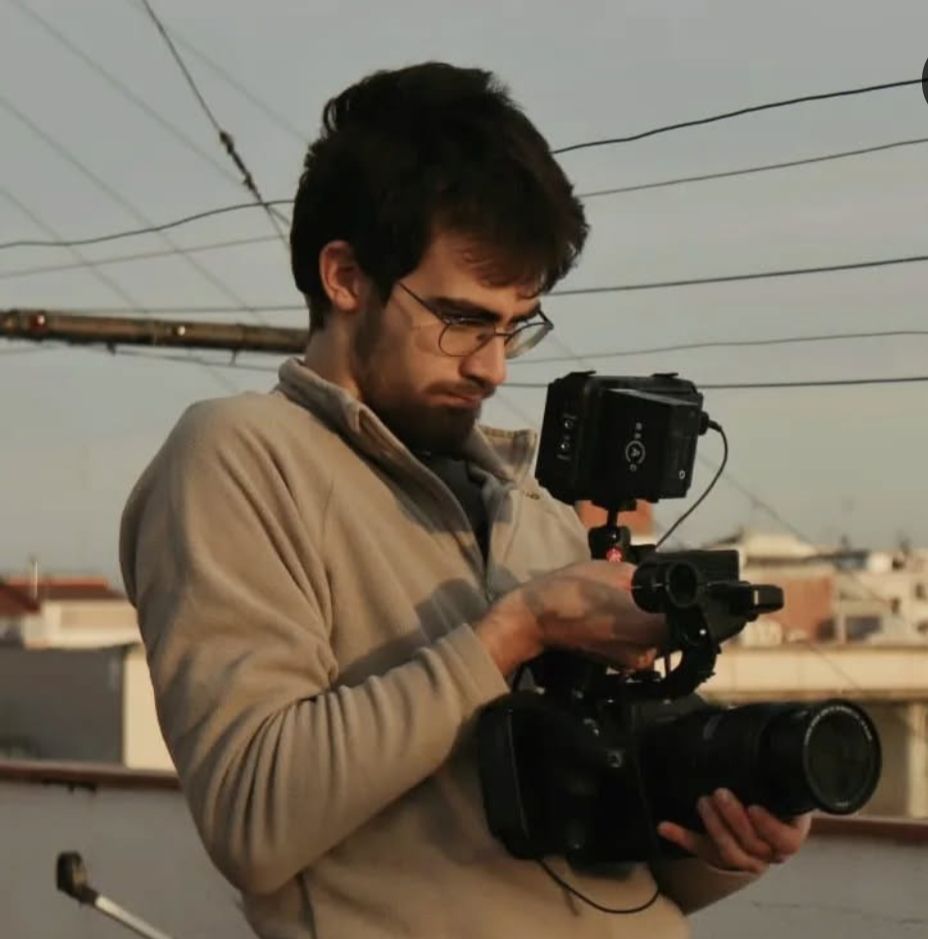
At just 17 years old, the great-grandfather of the young filmmaker from Sant Just, Pol Arazuri, had to go to the front to fight against the Nationalists at the end of the Spanish Civil War in Catalonia, as the Francoist army was already approaching the municipalities around Barcelona. Although he was not from Sant Just and was not one of the 20 residents of the famous "Quinta del Biberó" (Baby Bottle Class) who received institutional recognition in 2019 on the 80th anniversary of the aforementioned conscription, the story of that very young soldier has partly inspired the also young local director in writing the script for the short film L’última quinta.
“My great-grandfather was a member of the Biberó Levy, but the short film is not based on his life,” Arazuri specifies. At that time, his relative was doing his military service and was not called up when he was at home, like other young men, he explains in more detail. The audiovisual artist has a family past related to the war, like many other people. In this regard, during a telephone conversation, he confesses that his other great-grandfather was a Francoist soldier.
The War in the Family
"For me, the topic of the Civil War has always been latent, because I received very different stories from both sides of the family. That's where my interest comes from and that's what motivated me to research this period," he reflects, while vehemently opining that the Biberó Levy is the "cruelest episode of the war," due to everything it entailed to make young people fight – and die – who, in the words of the then Republican minister Frederica Montseny, "still had to be drinking from a bottle."
For his research, which began as a high school research project, he had the support of the Centre d’Estudis Santjustencs (CES), and especially Juli Ochoa, who explained to him the main events that took place in Sant Just Desvern towards the end of the conflict.
"He's a bright young man with a lot of potential to do something in the film industry," says local historian Juli Ochoa about him
According to the aforementioned local historian and founding member of CES and the magazine La Vall de Verç, as well as the author of numerous research works, some on this period of recent history, as he confirmed to this publication, five years ago they both worked for several sessions during which Ochoa passed on to him "everything he thought might be useful for his purpose." "I remember he was a bright young man with a lot of potential to do something in the field of cinema," comments Ochoa, who believes that "something really good will surely come out" of this project.
One in thousands
"I've tried to create a fictional character who is a summary of the experience of all the thousands of young people who went to the front," says the young director during the interview, which takes place a few weeks before the start of the short film's shooting, "which will be at the end of January," as confirmed by the student from the Escola Superior de Cinema i Audiovisuals de Catalunya.
He also informs us that it will not be filmed in Sant Just Desvern because the town "has modernized too much" and is not suitable for an ideal setting for the plot. They will probably choose rural towns in the Tarragona region - the Terres de l'Ebre, he hints - or Lleida, and perhaps also some old industrial colony, "because they retain that more ancient air," he points out. Of course, he assures us that they will try to collaborate with the residents of his town "so they can come and be extras." According to Arazuri, they will need young men and intend to propose this to the local high school.
Don't Lose Memory
To conclude, he comments that although he focused on the final days of the war in the town, just before the Francoists entered, the script aims to refer to the war in a general and universal way, not just focusing on a specific time and place.
All in all, to help pass on – and not let be lost – the memory of the past to today's youth, who for the most part are very detached from and indifferent to the drama that was experienced in Sant Just and throughout the country last century, Arazuri wants to move forward with this cinematographic project with limited resources, but considerable enthusiasm.
The Call to Arms of Thousands of Minors
The "Baby Draft" was the name given to the conscripts of 1938 and 1939 of the Republican army during the final phase of the Spanish Civil War. Mobilized by order of the President of the Second Republic, Manuel Azaña, 30,000 minors were called up.


