
Barcelona is a city that is often recognized everywhere for its great tourist icons: the Sagrada Família, Park Güell, Casa Batlló… But beneath this layer hides a quieter city, and much less known and crowded, where there are spaces that do not usually appear on the usual routes, but that explain very valuable fragments of the history, culture, and life of the neighborhoods.
From war shelters to old monasteries or farmhouses converted into restaurants, these places allow you to see the city with different eyes and enjoy it, without crowds.
Anti-aircraft shelter in Sant Andreu
Under the Societat Cultural de Sant Andreu, an anti-aircraft shelter is preserved that recalls daily life during the Civil War and the importance of historical memory in the neighborhood. This space can be visited currently. It can be seen on Tuesdays, and some Saturdays. The price to enter is 2 euros per person and free for people associated with the entity and with the FAC, the Federació d’Ateneus de Catalunya.
For more information and reservations, you can write an email to infolalira@gmail.com.
Beyond this visit, La Lira hosts different sections at its headquarters linked to disciplines such as the Chess Club, the Sant Andreu Table Tennis Club or the Grup Sardanista Maig and the Orfeó La Lira, among others. On the other hand, it also has a regular theatrical program. You can consult the entire program on its website.
Can Basté and neighborhood photography
At Can Basté, photography has been the protagonist for more than thirty years with exhibitions and activities that have turned the space into a cultural reference point.
You can consult the entire program of the center on its website and visit them Monday from 16 to 21.30 h; Tuesday to Friday, from 9.30 to 14 h and from 16 to 21.30 h; and Saturday, from 10.30 to 14 h and from 16.30 to 20 h. You can get there by public transport with bus (34, 47, D40, D50, V27, V29, H6) or metro (L5, Virrei Amat stop).
The hidden paintings of Les Corts
The interior of the Church of Remei de les Corts hides paintings that surprise many visitors and that are part of a little-known heritage. Inside the church, four holy women from the Old Testament are represented, in completely surprising paintings, because we rarely see them depicted. They are Sarah, Judith, Esther, and Ruth. If we move towards the right side, in the direction of the presbytery, we find four men from the Old Testament “chosen by God to show the prophetic revelation of the Messiah”: Abraham, Moses, David, and Elijah, whom the Bible says participated in the history of salvation, “keeping their faith alive even in the most difficult moments”.
A farmhouse in the middle of the city
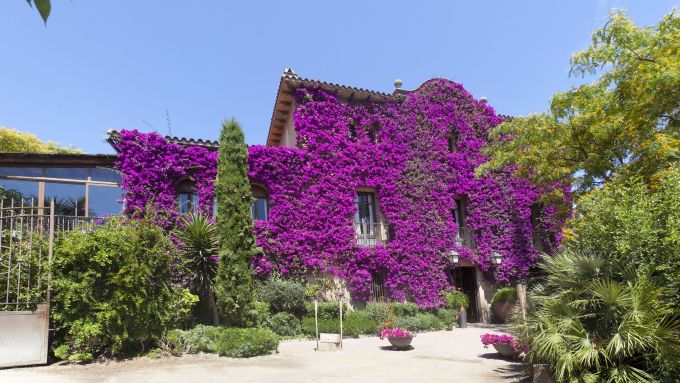
The restaurant Can Travi Nou allows entry into an old Catalan farmhouse that preserves its rural essence within the urban fabric. This still maintains the typical structure of Catalan farmhouses, with a rectangular plan and two floors. During the 1920s, the farmhouse was renovated at the request of the new owners and became a stately residence.
Despite the various interventions, or precisely thanks to them, the building allows one to understand its evolution over time, as well as the modus vivendi of its inhabitants from the 17th century until the beginning of the 20th century.
The twin bell tower of Vila de Gràcia's
Gràcia has, among its streets and squares, a host of stories waiting to be discovered. Beyond its best-known spaces, there are corners that often go unnoticed and that tell surprising episodes of this old town. One of these is Can Pardal, a place that hides a little-known secret: a second bell tower almost identical to the one in Plaça de la Vila de Gràcia.
To understand this singularity, one must go back to the year 1870, in a tumultuous moment in history. That year saw the revolt of the quintas, a popular uprising against the compulsory military recruitment system. Gràcia, which was then still an independent municipality, was one of the prominent settings for this protest. The bell tower of Plaça de la Vila, in fact, played a key role, as its bells served to alert and mobilize the population.
As a consequence of these events, the authorities made a strong decision: they prohibited the municipal bell tower from ringing again. This measure not only affected the daily life of the neighborhood, but also one of its main symbols of community cohesion. And it is, in this context, when Can Pardal appeared. Located going down the torrent de l’Olla, this building became an unexpected response to the prohibition.
Vestiges of Torre Melina
In the Torre Melina area, remains of an old stately estate that marked the landscape of the area can still be seen. This historic complex was maintained until 1992, when the tower disappeared coinciding with the urban transformations linked to the construction of the Rey Juan Carlos I hotel. This hotel closed in 2020 and, after an intense renovation process, reopened its doors under the name of Torre Melina Gran Meliá, recovering the original name of the space.
A sanctuary with a social vocation
In 1895, the first stone of the sanctuary of Sant Josep de la Muntanya was laid, a building of great religious and cultural importance, located in the La Salut neighborhood, in the Gràcia district. This temple, the work of Francesc Berenguer, a regular collaborator of Antoni Gaudí, annually receives thousands of pilgrims and includes a center for minors at risk of social exclusion, following the work initiated by the blessed Petra de Sant Josep, promoter of the temple.
The old parish of Sarrià
In Sarrià, one of Barcelona's neighborhoods with the most distinct identity, there is a church that is part of the deepest memory of the territory: the parish of Sant Vicenç de Sarrià. Its history is so old that it even precedes the formation of the urban core, of the old town of Sarrià.
The origins of this temple date back, according to the first references, to the 5th century, which makes it one of the oldest religious spaces in the city. Throughout the centuries it has been rebuilt several times: there was a Romanesque temple consecrated in the 12th century, subsequently a Gothic church in the 14th century, and finally the current building, from the late 18th century.
The medieval garden of Pedralbes
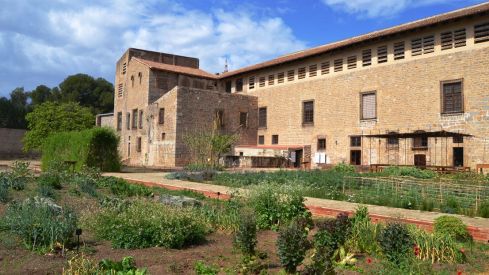
At the Royal Monastery of Santa Maria de Pedralbes, a medieval garden that connects with the monastic tradition is still kept alive. The Hort Petit of the Monastery, located on the south facade of the Royal Monastery of Santa Maria de Pedralbes, is a walled enclosure of almost 3,000 square meters linked to the religious community since the foundation of the convent in 1327. For centuries, the nuns cultivated vegetables, legumes, fruits, and medicinal herbs there for the community's food and medicine. The space, traditionally called Hort Petit, was located in front of the Procures room, where the harvest was formerly stored.
Beyond these specific spaces, the city still hides little-traveled corners where the pace slows down and a more intimate and silent Barcelona can be discovered.


