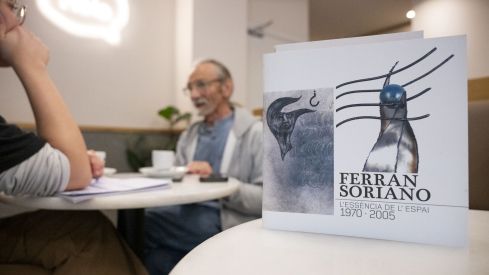
Describing the work and figure of sculptor Ferran Soriano is not an easy task. In the past, the former mayor of L'Hospitalet, Núria Marín, stated that he was one of the city's "most international local artists." Others, like the renowned poet Miquel Martí i Pol, called him "Mediterranean and passionate," who with his work "walks sentiment, eyes, and hands through mythology, and exalts the nobility of the gods." And voices like that of the writer and journalist Paco Candel did not hesitate to see Soriano as a classic example of those artists "from humble families" whose economic condition was a burden to fully dedicate themselves to the world of art.
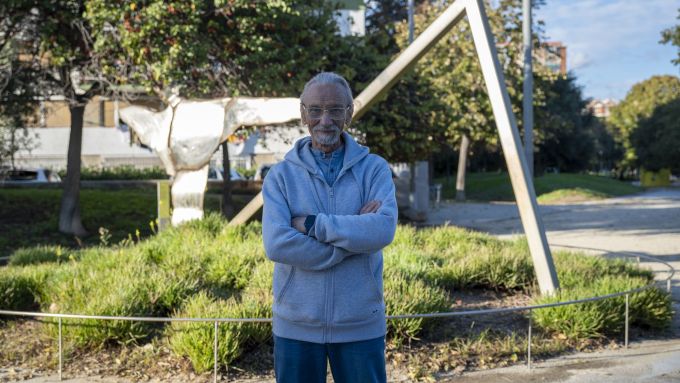
Today, however, we may have to agree with the words of local historian Ireneu Castillo, who recently defined him in an article as "the true and forgotten artistic reference of L'Hospitalet de Llobregat." And it is that, despite having 29 public artworks in Catalonia – and 36 in the world – a dozen awards, and having held nearly 70 solo exhibitions, Soriano's mark seems to go unnoticed. To rescue this figure from collective oblivion, however, we meet him at the foot of his sculpture Conseqüències d’equilibris, in Bellvitge Park, in L'Hospitalet.
Painter, sculptor, and car bodyworker
Born on October 1, 1944, in the Les Corts neighborhood of Barcelona, Soriano delved into the artistic world through drawing. According to him, from a young age he spent his free time with paper and pencil in hand. "I can't say when I started, nor why I got into it, but I do remember the feeling of frustration every time my drawings didn't turn out well, and how I kept trying again and again," he explains.
Technical drawing classes at school helped him formalize his practice, but not for long. From the age of 14, after two years as a watchmaker's assistant in El Clot, Soriano had to leave school to become an apprentice car bodyworker at the Citroën factory in the center of the Catalan capital, where his father worked.
Curiously, his passion for sculpture came to him amidst the pieces of steel and large metal components with which he welded and repaired dented cars that came to the workshop. In fact, the first time he created a sculpture was around the age of 20, when he was working at the new Citroën headquarters in Esplugues de Llobregat. "In the workshop, I started picking up scrap metal and moving it around as I pleased, half joking, half serious. And by trying and tweaking, they ended up coming out," recalls Soriano. From those first spontaneous and natural experiments, Soriano made three sculptures that he exhibited alongside his paintings in his first show in 1971, at the Agrupació d’Amics de la Música in the municipality of L'Hospitalet – where he had been living since 1969.
On the same day as the presentation, an art collector bought two paintings and a sculpture from him, and in fact, he was one of the first to see his potential as a sculptor. "He told me my paintings were fine, but that I moved much better with iron," he admits. "That's how my obsession with sculpture began," he jokes.
Paco Candel, friend and mentor
In the following years, Soriano continued to hold exhibitions throughout Catalonia and Spain: in '72, at the Caixa de Pensions in Ibiza and at the Estudi d'Art of Ràdio Barcelona; in '73, at the Galeria Taller de Picasso, at the Sala Montparnasse in Seville, and at the Galeria Atena in Terrassa; and in '74, at the building of the Banc Mercantil in Barcelona. That same year, he traveled to Paris on a study trip, and in '75, the Hospitalet de Llobregat City Council awarded him a scholarship to study in Rome with the sculptor Ricardo de Miceli for six months. "In Rome, I learned the traditional methods of sculpture, but I realized they didn't suit my character or my way of understanding it," he admits.
Although Soriano's artistic career has been prolific since its beginnings, he himself admits that one of the people who "opened the doors to recognition and the press" for him was the writer and journalist Paco Candel. During this artistic period, Soriano and Candel met at an exhibition and became friends, mutually captivated by each other's work. In this regard, from their first meeting in '72, Candel would regularly attend all of the sculptor's presentations, or they would even often meet for breakfast at the bar La Flama in L'Hospitalet. In fact, their friendship grew to such an extent that Candel presented Soriano's exhibition at the Galeria Taller de Picasso in '73, also wrote countless articles about Soriano's sculptures, and finally, wrote the sculptor's biography in a book published in 1988 by the Barcelona City Council. "Candel, besides being a great friend, was also my mentor, and I always knew his most human side," he insists.
Thus, in total Soriano had over 75 solo exhibitions, as well as numerous group exhibitions in Catalonia, Spain, Italy, France, Holland, Russia, Andorra, Belgium, and the USA, among others. He also won a dozen awards and created 36 public works, including in the metropolitan area, the *Vol dels Coloms* (1976) in Hospitalet de Llobregat, the work Sant Jordi (1976) at the Diputació de Barcelona, the Homenatge a Maria Aurèlia Capmany (1991) in Barcelona, the sculpture A Gaudí (2003) in Sant Boi de Llobregat, or Projecció de l’Atleta Mediterrani in the garden of the FC Barcelona training ground. Furthermore, it should be noted that a large part of his works always had a significant social justice undertone, as is the case with Conseqüències d’equilibris, a sculpture that aims to recognize the memory of the neighborhood that fought for essential services in Hospitalet during the era of self-built neighborhoods.
Despite this abundant career, it should be noted that Soriano combined artistic creation with work in the workshop until '92 to make a living. In fact, when he took the plunge to try to dedicate himself to sculpture in 1992, the crisis caused "the entire network of contacts and regular buyers to disappear," and for this reason, he was forced to return to the car workshop.
Losing the Study, Losing the World
Besides the car workshop, Soriano had an art studio in Sant Boi de Llobregat. For almost 30 years, the sculptor created and exhibited much of his paintings, poems, and sculptures in the town in Baix Llobregat, becoming a cultural epicentre. In 2023, however, Soriano's art was also disrupted by the housing crisis. "Real estate pressure and vulture funds meant I couldn't renew the contract and was forced to leave the studio," he laments.
In this regard, he recounts this episode with great pain, both artistically and personally. "I was left empty. Losing the studio was like losing the whole world I had created and where I had always felt most free," he repeats. He has never been able to find a space of the same dimensions again, and in fact, it was the Sant Boi City Council that gave him a warehouse to store his works. "It's not a place to make sculptures, but to store everything I had in the previous studio," he emphasizes. However, he assures that every time he goes there to retrieve some document, his "heart sinks."
Nowadays, Soriano exhibits sporadically wherever he is called, as with the exhibition Splashes of a Life, in L'Hospitalet. He assures that he still has projects in hand, especially linked to the world of poetry. "I would like to publish all my poems and drawings in a single book, and I am waiting to see how to publish it," he emphasizes. Thus, although he has had to stop his frenetic production of sculptures due to "health problems," the loss of his studio, and because he no longer has "the same energy as before," Soriano's artistic and life trajectory effectively make him "the true artistic benchmark of L'Hospitalet," as Irineu Castillo says


