
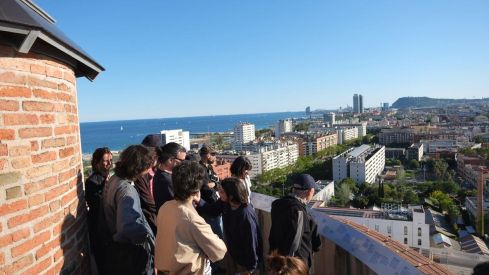
The Historical Archive of Poblenou celebrates its first fifty years of existence this 2026. It does so, among other initiatives, with Vint-i-nou xemeneies i una torre, a large-format exhibition and artistic proposal that will extend over several months and invites to rethink the industrial history of the neighborhood and its contemporary transformation.
The initiative is part of the Barcelona 2026 World Capital of Architecture program and is mainly deployed at the Archive's headquarters, the emblematic Torre de les Aigües del Besòs, with extensions to Palo Alto and other spaces in Poblenou.
A proposal with multiple dimensions
The project's curator, Xavier Acarín Wieland, explains to AMIC Cultura that the proposal "has three or four legs": an evolving exhibition at the Archive, artistic interventions at the Torre de les Aigües, a public program of activities and meetings, and a final exhibition with BAU students in Palo Alto.
According to Acarín, the set of activities is an opportunity to review Poblenou's industrial heritage, the urban renewal of the territory, and the processes that have shaped the current neighborhood.
The event starts from a powerful image: the twenty-nine chimneys that are still preserved in Poblenou, survivors of the more than two hundred that existed during the area's industrial past. These structures, often decontextualized and surrounded by taller contemporary architectures, have become symbols of a landscape that continues to transform.
Originally agricultural, Poblenou became an important industrial hub thanks to the availability of water and land during the 19th century. The subsequent deindustrialization and the impetus of the 1992 Olympic Games opened the door to a profound urban reconfiguration, culminating with 22@ and the superblocks, which have turned the area into a laboratory for new city models.
In this context, the Historical Archive of Poblenou, founded in 1976 by architecture students, has played a key role in preserving the collective memory of the neighborhood. Half a century later, it continues to be a living space for research, dissemination, and cultural activation.
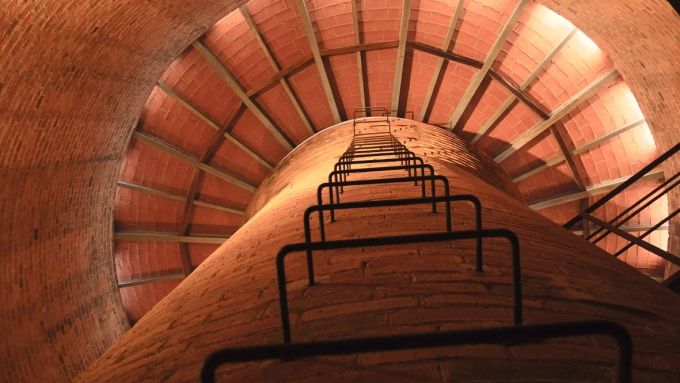
Artistic interventions at the Torre de les Aigües
One of the highlights of Twenty-nine chimneys and a tower is the artistic intervention at the top of the Torre de les Aigües del Besòs, where several creators have developed specific projects.
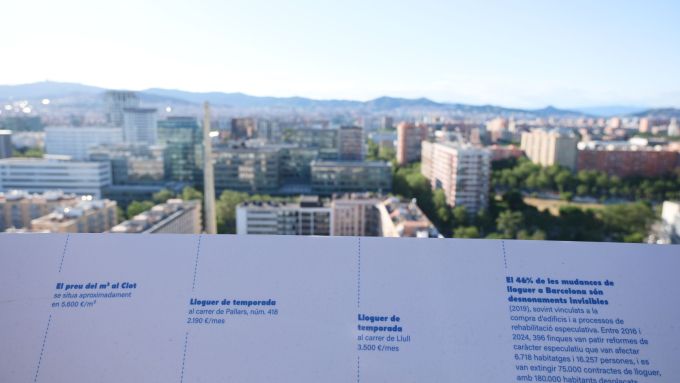
Violeta Mayoral presents Skyline invertit, an installation that contrasts city silhouettes with data on density, housing, and tourism. Through these "anti-skylines," the tower reflects on gentrification and the social transformation of Poblenou, with views of the neighborhood.
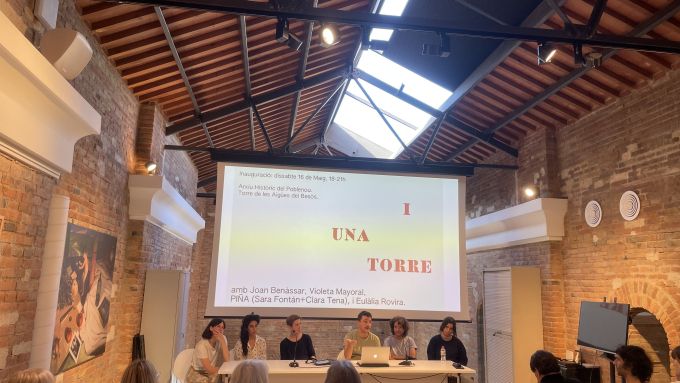
The space also hosts works by Sara Fontán and Clara Tena, who present an audiovisual performance conceived as a response to industrial environments, among other proposals.
A time capsule for 2043
Beyond the Tower, one of the central initiatives of this special anniversary program is a beehive-shaped time capsule created by artist Joan Bennàssar. The piece collects materials, testimonies, and reflections on the past and future of Poblenou and will be symbolically sent to 2043, the year in which the bicentennial of the neighborhood's industrial origins is expected to be commemorated.
The initiative involves researchers such as Isaac Marrero, Pepa Martínez, Tura Tusell, Eduard Pagès, Eugeni Santos, and Jordi Fossas, as well as the support of the Poblenou Neighborhoods Observatory. Collectives such as BAU University Center of Arts and Design and Lumbung Press also participate.
An exhibition in chapters that transforms every month
Until November, the Archive's headquarters at the Torre de les Aigües will also host different exhibitions organized in chapters that will address issues such as the history of factories, working conditions, industrial architectures, and neighborhood struggles to preserve this heritage.
Acarín emphasizes that this open structure allows "for a living exhibition, which never fully closes, but is rewritten with new perspectives and materials."
Chapters that build memory
This June, an intervention by Marià Hispano and Ramon Pascual will be presented, recovering the experience of the last workers of the neighborhood's industry based on a personal photographic album by Pascual, one of the last workers of industrial Poblenou. The result is an assembly that combines image and word to reconstruct recent working-class memory.
In July, there will be an exhibition focused on the Icària neighborhood and its disappearance to make way for the Olympic Village. An exhibition that will be the culmination of the research of urban studies commissioned at the time by the company responsible for the transformation of the area and recently rediscovered in the Sant Martí District Archive. Nearly 600 photographs documenting disappeared warehouses, depots, and industrial buildings have been digitized.
Debates, activities, and a look to the future
Over the next few months, debate sessions will also be organized, such as the planned session on 22@ and the Poblenou Neighborhoods Observatory on September 29, in addition to weekly guided tours of the Torre de les Aigües. There will also be specific activities on June 17 and July 10 within the public program.
According to Acarín, they not only celebrate industrial heritage but also promote "a critical look at the current city and its urban tensions," a reflection especially pertinent in the year in which Barcelona holds the World Capital of Architecture. In this sense, he emphasizes the fundamental role of neighborhood struggles in the preservation of factories and spaces like Can Felipa and argues that the project aims to "re-establish the relationship between neighbors, heritage, and the city." The ultimate goal is not only to revisit Poblenou's industrial past but also to project it into the future.


