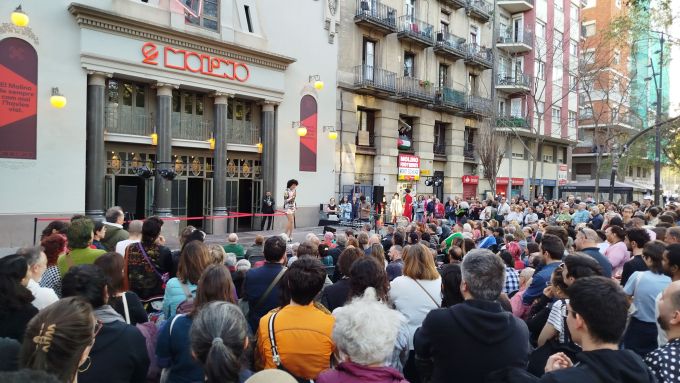
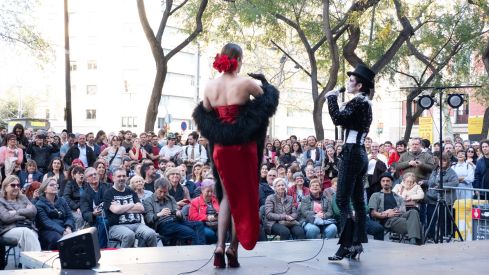
Cabaret, drag, transformism, burlesque, clown, magic or song. Variety arts remain very much alive in Barcelona, but their professionals denounce that they do so from precarity and invisibility. With this underlying reality, Torna Paral·lel was born, an association that vindicates these disciplines as living cultural heritage of the city and demands to have an active role in the future of the avenue that made them a symbol of popular entertainment.
"Torna Paral·lel is born to bring together all these artists," explains the president of the entity, Sara Brown. "We are inspired by the tradition of Paral·lel, where for much of the 20th century, varieties were fundamental to Barcelona's cultural life. Afterwards, this world has been disappearing, but we continue to exist," says Brown.
Presentation to society
The association was officially presented on June 30 at the Centre Cultural Albareda, culminating more than a year and a half of collective work. The project brings together artists from the different disciplines that have historically been part of varieties. And they also call on cultural managers and neighbors to join. They can do so through this form.
For its promoters, however, the birth of this new association goes much further than creating a new cultural entity. It aims to be a response to the situation the sector is experiencing, to denounce it and to put different alternatives on the table.
"The precarization is enormous"
"When we perform in bars or venues in Barcelona, it's very easy for them to take advantage of us. They pay us very little, often we are not even considered workers, and we end up accepting working conditions that are not dignified," denounces Brown.
As she explains, today many artists take on all the tasks of their shows. "We are producers, communicators, technicians, directors... We end up doing all the departments ourselves. We do it because we have a great desire to create, but this is not sustainable," laments Brown.
A community before a claim
The origin of Torna Paral·lel dates back to 2024, when several artists began to organize themselves through a WhatsApp group. Despite working in different disciplines, they shared stages, audience and problems. "Cabaret, drag or varieties have different languages, but we live in the same environments. Historically, they have always been part of the same ecosystem," details the artist.
All in all, it ended up becoming a workspace that today already operates with a board of directors, several driving groups, and an open general assembly that will meet periodically, every three months.
However, they felt the need not only to have an entity that put them on the map and brought them together, but also to build community. "To claim anything before the institutions, we first had to create a strong entity," Brown details.
In this sense, the first public act as a constituted entity has been a complete success: "We brought together very different people, but with the same will to think about the future together. In our sector there is a lot of individualism, and one of the things we want to recover is precisely the idea of community." For the president of the association, this change of mentality is essential. "It's very striking to see to what extent people are not used to artists coming together and organizing themselves. This has been one of the comments we have received the most," she adds.
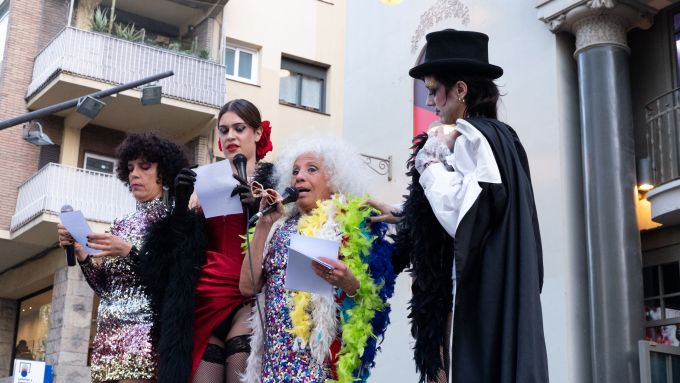
Recovering the legacy of Paral·lel
The new entity claims that variety arts are part of Barcelona's cultural history. They recall that Paral·lel was for decades the great epicenter of music hall, cuplet, revue theater, and drag, also becoming a space of cultural resistance and freedom for many dissidents.
According to the entity, this legacy has been disappearing as cultural policies and management models have prioritized a more commercial offer, leaving little space for the disciplines that historically had given identity to the Barcelona avenue.
Establishing a dialogue with the Barcelona City Council
For all these reasons, one of the main demands of the association is to establish a stable dialogue with the Barcelona City Council. "We want to build a bridge with the council so that variety arts are institutionally recognized as heritage of Paral·lel and Barcelona," says Brown. "The venues of Paral·lel have a public function even if their management is private, and we want to be part of their programming," she adds.
The entity assures that it has already initiated conversations with the council and that it also works jointly with other cultural groups in the city to actively participate in the cultural life of the Catalan capital.
Professionalizing the sector
Beyond institutional recognition, Torna Paral·lel also wants to promote the professionalization of variety arts. The idea is to share knowledge among artists about production, direction, management, economics, and labor rights, generating a kind of peer mentorship. "Knowledge is power," summarizes Brown. "If we share everything we know, we become stronger as a collective and can avoid very unfair labor situations, like working many hours for only seventy euros," she says.
The association also wants to preserve the memory of these disciplines and facilitate generational handover, connecting established artists with emerging creators.
The next steps
The first public activity will arrive on July 24, within the framework of the Poble-sec Festival, with a show they are already preparing.
Towards autumn, they will also carry out professionalization workshops at the Centre Cultural Albareda dedicated to variety arts. The program, still in the process of definition, will include workshops on clowning, stage technique, show production, and the history of Paral·lel.
All in all, the most important challenge facing this new cultural actor in Barcelona, according to its president, is that varieties (and all their history) continue to be part of the present and future of Barcelona.