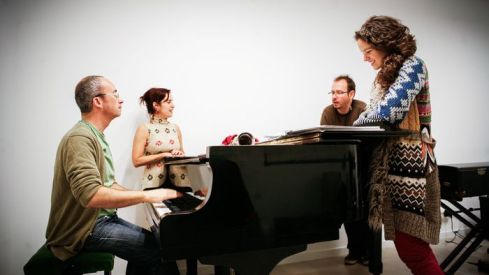
In 2012, a twenty-year-old Rosalía, still unknown, went to the program Toni Rovira y Tú as part of the flamenco-jazz group Kejaleo. There, the tarot reader Francisco Dorado stated: "In four years she will be a great star." He was not wrong. Exactly four years later, in 2016 Rosalía released her first single with C. Tangana, "Antes de Morirme", which would mark the beginning of her meteoric rise. Rosalía's career is one of those that seems written by destiny. A girl from Sant Esteve Sesrovires who has been able to catapult herself to a level reserved for great global divas. Precisely about her career, the journalists Oriol Rodríguez and Yeray S. Iborra have just written a book: in Buscant la Rosalía (Libros del Kultrum), they reconstruct in detail the path of an artist who has broken molds until becoming an international icon.
The book reviews Rosalía's family history, who inherited the name from her maternal grandmother, the same one who taught her films of copla divas (like Lola Flores or Carmen Sevilla) and who sang while doing the laundry at noon. Although she inherited her passion for music from her father, José Manuel Vila. Of course, her sister Pilar Vila Tobella is also referenced, with whom she has a very strong bond. Pili accompanies her everywhere, and is her advisor and confidante, and is the mother of Genís, the nephew to whom Rosalía sings in "G3 N15", a song that is precisely closed by the grandmother, with a reflection on family (“Family is so important, family is always important”).
Buscant la Rosalía recalls the origins: from the first performances in her hometown, or at the end-of-course festival organized by SeS Dansa in 2007, to the participation in a festival promoted by the Entitat Cultural Flamenca de Sant Esteve in 2009. It was also there where she discovered Camarón de la Isla, with whom she became deeply fascinated by his untamed wail, a fact that led her to delve into the flamenco genre.
She studied at the Taller de Músics de Barcelona from 2010 to 2014, the year in which she obtained the only available place to study flamenco singing at the Catalonia College of Music (ESMUC). There, mentored by the singer Chiqui de la Línea, whom she defines as her teacher, she completed her musical training while building the foundations of her career.
Also during those years, Rosalía met a young man from Madrid passionate about urban music, Antón Álvarez, better known by the name C. Tangana. They artistically inspired each other, and even maintained a very intense romantic relationship, which was reflected in various musical collaborations. There are still videos on YouTube of Rosalía singing at C. Tangana's concerts in Madrid venues like Ochoymedio Club.
He was very present in the studio when Rosalía was making El Mal Querer (her final degree project at ESMUC), and in fact he is in the credits of eight of the eleven songs on the album. But when she released the album in November 2018, they had already broken up. In the final credits, Rosalía thanked her family, collaborators, friends and “also the one who broke my heart”.
The relationship between C Tangana and Rosalía is living legend and will go down in history. The fact that two personalities so energetic, magnetic and passionate about art, who have become icons of their generation, had a passionate relationship in their youth, and that from that came artistic collaborations just before breaking up and becoming stars separately, turns their relationship into a legend.
Before El Mal Querer, which is her second album, Rosalía released Los Ángeles in February 2017. It is a flamenco genre album that addresses the theme of death in all its songs. The fact that after having released the single "Antes de Morirme" she decided not to directly opt for the urban genre, which would have given her immediate popularity, showed that she has always had a deeper ambition.
Rosalía has always wanted to dare to work with different genres and create her own personal brand, without being pigeonholed into any mold. And that is precisely what she has continued doing throughout all these years, adding to her discography the albums Motomami and the most recent LUX. She is an unpredictable artist and that is part of her magic. Many projects have been necessary for people to understand that she draws from many artistic influences and does not want to give up any of them.
To explain Rosalía's career, we also cannot forget that night in 2017 when she sang in a small theater in Madrid during the tour for the album Los Ángeles, and one of the fifty people in the audience was the singer Juanes. He was completely captivated by her performance and spoke with her manager Rebeca León about that girl from Barcelona.
Only a few months later, León became Rosalía's manager and, undoubtedly, her international rise would not be understood without her work. It was she who facilitated the great collaborations with J Balvin and Ozuna, singers whom she also represented, which allowed her to enter through the main door into the world of urban music at a time of great boom for this genre.
Ultimately, that prophecy of 2012 today seems a scene written with too much precision to be a coincidence. Rosalía is today a great star who has built her own universe that does not understand borders between genres, traditions or avant-gardes, but dares to constantly evolve without losing her roots. The good news is that it hasn't even been ten years since her first album, and everything indicates that her career has just begun.


