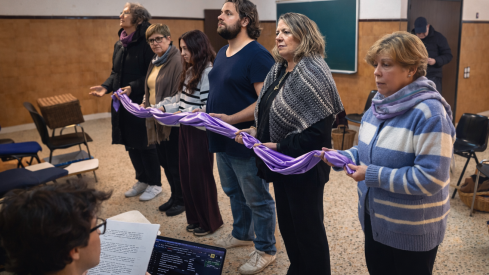
The Grup Teatral Antifaz will bring to the stage 'Teixint la vida en color lila' , a production directed by Eva María Fernández based on a text by Carmen Torrico, with performances scheduled for late February and early March, coinciding with International Women's Day. The play can be seen at the Centre Cultural Els Catalanistes on February 28 and March 7, and at the Centre Cívic Sant Andreu on March 8, with two sessions in the morning and in the afternoon.
The proposal does not follow a linear narrative, but articulates various short stories united by a symbolic common thread: sewing and weaving as a metaphor for women's lives. “It is not a work that tells a story from beginning to end, but a set of stories that are linked by the common thread of sewing,” explains the director. Fernández has adapted and translated fragments of Torrico's original monologue to turn them into theatrical pieces with various characters, a process that has involved transforming stories conceived for a single voice into choral scenes.
Stories of the past and of the present
On stage, the audience will find stories that evoke different generations. According to Fernández, the production goes through “stories of the past and stories of the present” that can refer to grandmothers, mothers or aunts, but also to experiences closer in time. Scenes appear that refer to gatherings of women who sewed together and shared experiences, childhood memories and, also, situations that connect with current realities. “There is one of the stories that touches very closely on the present and the current conditions of women in many places in the world”, points out the director.
Without wanting to point out a single theme, the work traverses different perspectives on the female condition. “We don't touch on a specific theme, but rather it touches on various themes,” explains Fernández, who speaks of women who enjoy what they do, of others who don't, of women forced to assume certain roles, of more empowered profiles and of others more submissive. The whole draws “the entire range of possibilities” that traverse the experiences of women.
A mostly female cast
The cast is mainly female, although an actor participates. “We have an actor, we don't leave aside the male person, very important too, but the rest are women,” details the director. In the technical team there is also male presence, but the project falls mostly on women from the theater group. Precisely, when assigning the roles, Fernández has taken into account the availability and trust in the performers, and has wanted to give opportunities to people who until now had had more secondary roles or had not been on stage for a long time. “I wanted to give this opportunity, this voice to people who perhaps have been more in the shadows,” she explains.
Open spaces of conversation with the public
Beyond the representation, the team wants to open a space for dialogue with the public once the performance is over. “It is one of the objectives we have: to open this debate, to open an interaction between the public and us,” points out Fernández. The objective is to generate a conversation around what the work proposes, although the director admits that live performance always leaves room for unpredictability and that she does not know how the public will react.
The director defines the production as a different proposal from what is usually found on stages. “It is neither a story from beginning to end, nor is it a tale… it is something different,” she explains. Fernández describes the work as “a tribute to the figure of women” and trusts that the public can find elements with which to identify: “It is a part that unites us all in some way, an emotional bond.”
Functions around the 8M
The coincidence with March 8 is not casual. “My focus goes here. It had to be done on these dates,” explains the director, who also points out the desire to be able to resume the production at other times of the year if the experience works, such as on dates linked to awareness against gender violence. For now, the calendar is set for the end of February and beginning of March, with performances at Catalanistes and the Centre Cívic Sant Andreu.


