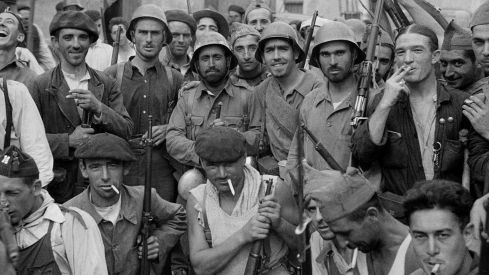
The Museu Torre Balldovina hosts until March 22 the exhibition Més enllà de les trinxeres (1936-1939). Photographs by Alec Wainman, a show that recovers, through photography, the memory of the international volunteers who came to defend the Republic and daily life in the Catalan rearguard.
Produced by the Museu d’Història de Catalunya and presented in Santa Coloma with the collaboration of the Xarxa de Museus d’Història i Monuments de Catalunya, the exhibition brings together images by Alec Wainman, a volunteer of the Unitat Mèdica Britànica who documented Catalonia at war between 1936 and 1939 with his Leica camera. A significant part of the narrative accompanying the photographs comes from the explanations of his son, John Weinman, curator of the exhibition, who has reconstructed his father's story and the context of the images from the negatives recovered and research carried out over decades.
Wainman arrived in the Spanish Republic at the end of August 1936 as a volunteer ambulance driver. In a context of war and shortage of medical personnel, his work, like that of many other volunteers, was essential to sustain medical services. His photographs show the popular mobilization, the militias that defended the Republican government, and the atmosphere of a society immersed in a convulsive historical moment.
The images also document life in cities like Barcelona, epicenter of the revolution, with scenes of streets, propaganda posters, and military training of young recruits who would end up participating in battles like the Battle of the Ebro. Among the volunteers portrayed are members of the Abraham Lincoln Battalion, as well as brigadistas of very diverse origins, which reflects the international dimension of the conflict. A significant part of the exhibition focuses on cultural and educational life during the war. Photographs of the Barcelona Book Fair of 1938 show the interest in reading and education as central values of the Republic, even in the midst of war. Other sections focus on the relationship between the land and the people. Wainman, who came to speak several State languages fluently, established great closeness with the people he photographed. His images include landscapes, scenes of rural life, and portraits of cultural figures such as the painter Joaquim Mir, captured in his daily environment.
The route also shows the work of medical teams and volunteers from all over the world to compensate for the shortage of doctors in the Republican zone. Among the protagonists are figures such as the Australian surgeon Doug Jolly, a pioneer in field surgery techniques; the doctor Reginald Saxton, documented while performing blood transfusions, or the Catalan surgeon Moisès Broggi, who recognized the importance of these international teams in extremely difficult conditions. The exhibition is also the result of a long investigation to recover 1,650 negatives that had remained lost for decades and which allow us to reconstruct, with a human and close perspective, a key period of the 20th century.
The entrance to the exhibition is free. It can be visited from Tuesday to Friday from 5 PM to 8 PM, and on weekends from 11 AM to 2 PM. An opportunity to rediscover the Civil War from a different perspective: that of the people who lived it and explained it, beyond the trenches.


