
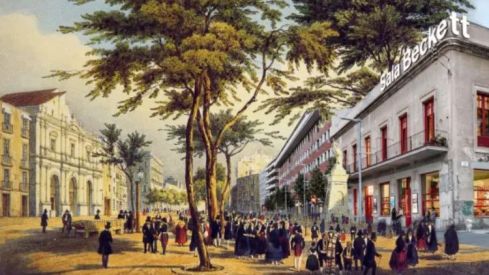
Barcelona is a city with a large number of theaters, both active and others that have already disappeared. Now, an exhibition at the Barcelona History Museum (MUHBA) invites us to discover them and learn about their evolution and, in turn, that of the city.
Barcelona: ciutat i teatre proposes a chronological journey to understand how theater has influenced the urban growth of the Catalan capital and, at the same time, how Barcelona's transformations have also conditioned its cultural life.
Theaters, a transversal axis of Barcelona
From La Rambla to Passeig de Gràcia, and from there to Avinguda del Paral·lel and the towns of the Barcelona plain. The cartography that accompanies the exhibition's journey shows how the living theatrical system of contemporary Barcelona is constituted by a succession of deposits: places where theater was established with splendor during an era and where afterwards, although it has progressively disappeared, it still survives.
And also by new spaces that have ended up disseminating the performing arts throughout the city. This history of comings and goings between theater and Barcelona is precisely the driving force of the exhibition.
From chamber and alcove theaters
In this sense, the exhibition shows everything from 17th and 18th century chamber and alcove theaters to contemporary small-format theaters. It also shows the contrasts between the theaters of the athenaeums, from their origins to cases such as the Teatre Lliure at the Cooperativa La Lleialtat, in Gràcia; the Antic Teatre at the Círculo Obrero San José, or the Sala Beckett at the Cooperativa Pau i Justícia, in Poblenou.
The exhibition also explains the scenic use of spaces such as the Llotja de Mar during the wedding of Charles III of Austria, in the 18th century, to churches reused in the mid-19th century as a result of Mendizábal's disentailment or the current space of La Perla 29, in the old Hospital de la Santa Creu. They even reveal the role that fires have played in the movements of the city's theatrical map.
Within the framework of the World Capital of Architecture
An exhibition that, in short, highlights the urban heritage of theater, a space that even today is a meeting place for citizens. The exhibition has been curated by Antoni Ramon Graells and Ivan Alcázar Serrat and can be visited until August 30.
This exhibition is part of the World Capital of Architecture, which Barcelona will host in 2026.


