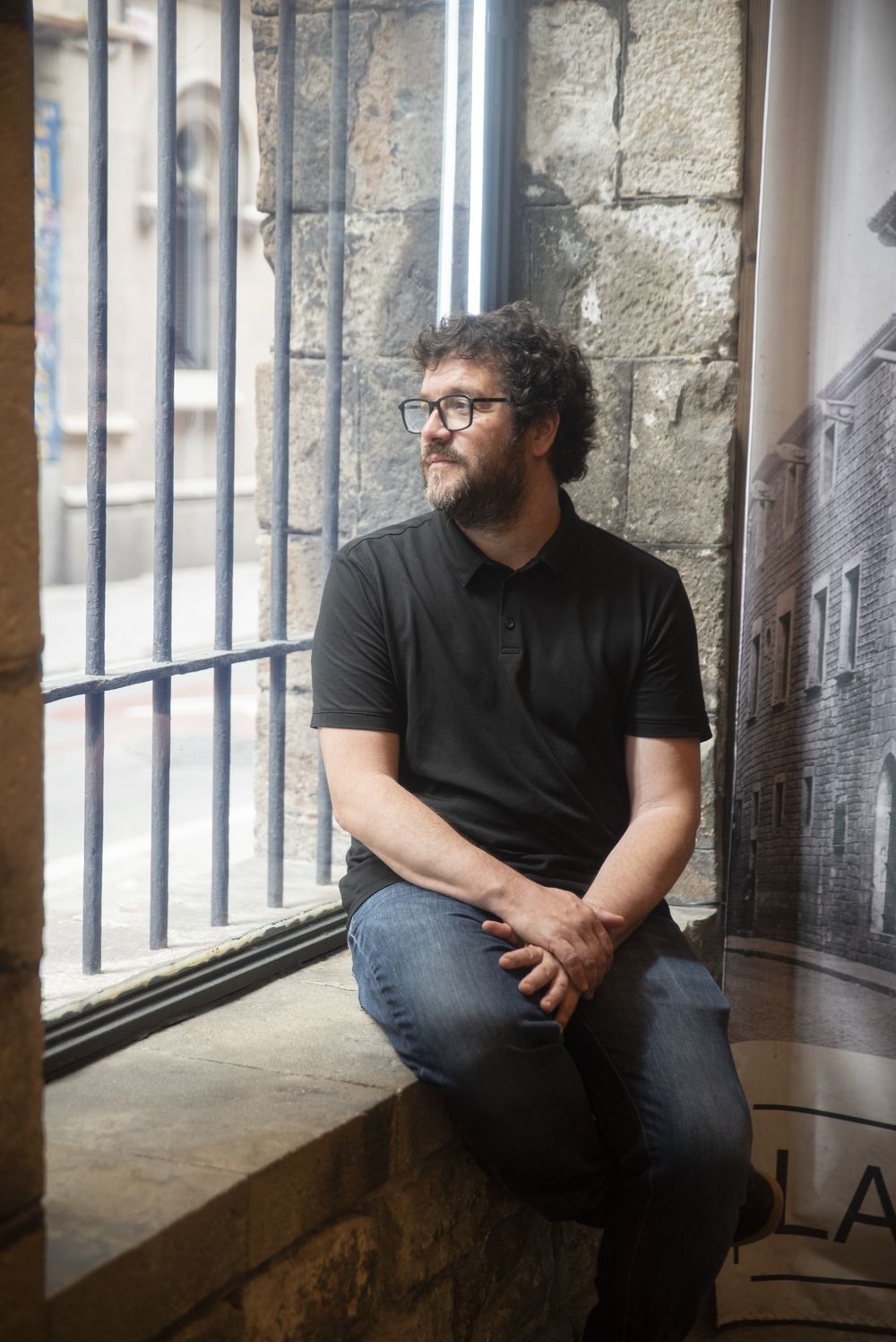
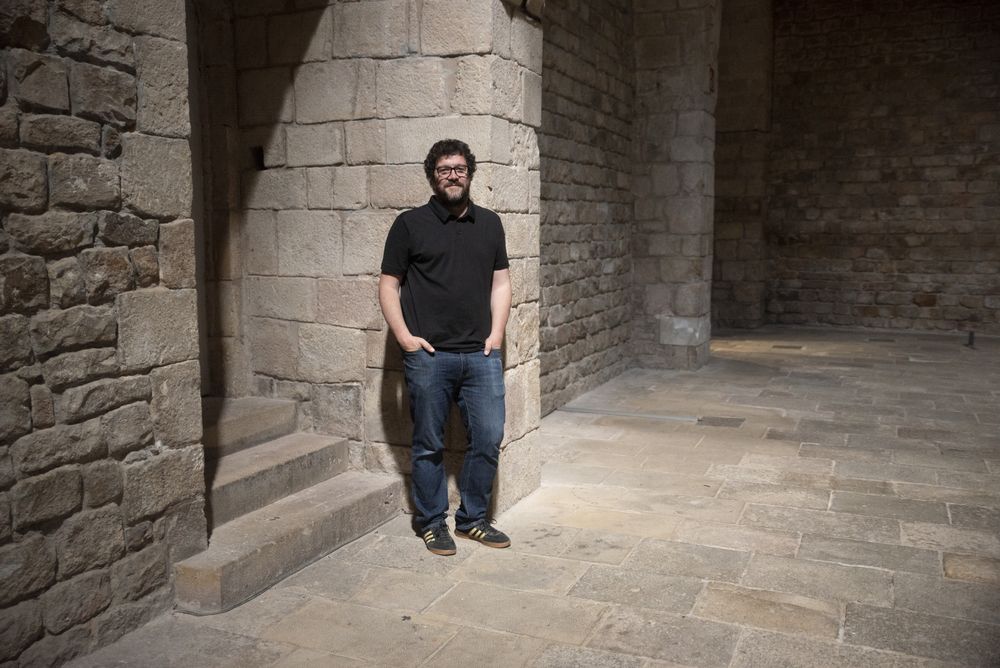
Entering La Capella is like pressing the pause button on Barcelona's television remote. The narrow sidewalk of Carrer Hospital forces you to leave behind the city's hustle and bustle to enter what was once the chapel of the old Hospital de la Santa Creu i de la Casa de Convalescència. After its restoration in 1926 by the Barcelona City Council, La Capella was designated for cultural activities. Since 1994 it has been dedicated to presenting the works of emerging artists from the city through the Barcelona Producció program of the Institute of Culture (ICUB).
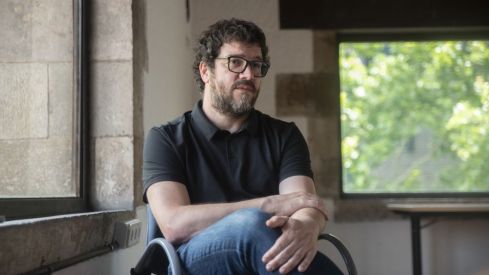
Currently, David Armengol leads the space, with a long career as a freelance curator. His works have been exhibited in various local, national, and international contemporary art venues. His connection with La Capella dates back a long way, as he served as an external collaborator of the center between 2016 and 2020. In 2021, he won the public competition opened for the first time by the Barcelona Institute of Culture to occupy the artistic direction of La Capella. We speak with him to take stock of the first three years of his mandate and to learn about the challenges that the space still has to face.
The origin of La Capella dates back to the 15th century, and one could say it has gone from being a space of religious worship to one of artistic worship. In 1926, the City Council bought the old building, reconstructed it, and later transformed it into a cultural space. History is palpable here... Does this somehow influence the cultural activity that takes place within?
Yes. I think the fact that the architecture was born with another function has given it an identity. It is very significant. For the people who work here, and for the artists who exhibit here, this legacy is an extra, an intangible element that gives identity to the space and intensifies it. Just as in the visual arts, in general, the space does not add to the content, La Capella is the complete opposite of a neutral place.
In an interview with Punt Avui, at the beginning of your term, in the summer of 2021, you said that "La Capella is not an exhibition hall." What is it, then?
I think it has always been understood as an exhibition hall, but I maintain that it is a center specializing in emerging art and also a meeting place, as we work with audiences, collaborate, and engage in dialogue with the city's artistic context.
You also said that La Capella had to adjust the concept of emerging art. Has its own definition been established?
We try to distance the concept from the label of youth and understand it based on another definition of emerging, which comes from emergency. For me, an emergency is the desire for something that needs to be done, and that can happen to you at 25 or 50 years old. Emerging art has no age limit and should be understood as contemporary art.
During your debut, you said you wanted to focus on emerging artists, but you also talked about new developments. The main one being the desire for internationalization. Do you think it is essential to have a very clear international outlook?
Internationalization will never be very strong here, but it must be possible. 80% of the exhibitions we do come from Barcelona Producció, which is a public call, and the rest are in accordance with the collaborations we have with other artists. We are doing the latter through the Programa Concèntric, which evokes the idea of concentric lines, like those generated when you throw a stone. In our case, there is a strong line, which is the city, then the territorial, the state, and the international. For the moment, we have worked with independent projects from Barcelona that have international capacity, such as Bar Project and Homesession, which are spaces that generate residencies for artists and curators, and we amplify their activity by doing exhibitions with them. We have also done an exchange with the contemporary art gallery Index Foundation, in Stockholm, because we have affinities in the way we work.
What would this projection be if we look at it on a metropolitan scale?
The metropolitan projection has to do with this definition of an art center, which leads to the understanding that La Capella owes itself to the city's context. In this sense, we have the Programa d’Estudis, which consists of free courses aimed at those interested in the visual arts. There is also the Concentric Program that we mentioned before, which focuses heavily on Barcelona, and then there is the Programa de Mediació, which is mainly related to working with the neighborhood, which is a very important first ring. A strong line that has emerged quite organically is the link with art students. La Capella is a space that I think should appeal to people from La Massana, Belles Arts, BAU, or Eina. In general, it is a space of proximity, and this is its main function in the city.
How are the ties between La Capella and El Raval forged?
This is a very important issue, and we mainly work on it through the Mediation Program. The artistic scene that comes to La Capella sees the center as if it were their home, but I think the neighborhood understands us from a distance. So, we try to have a fluid relationship with the neighborhood through content. For example, we are part of the Apadrina el teu Equipament (Sponsor Your Facility) project, by the Tot Raval Foundation, which promotes collaboration between cultural facilities and educational centers in the neighborhood to develop projects during the school year. We also have a relationship with the Associació Intercultural Diàlegs de Dona, which contributes to the social cohesion of women in El Raval, and also with the Ignasi Iglésias-Can Fabra Library. It is a constant challenge, but I think we are making progress in this regard.
La Capella must appeal to the students of La Massana, Belles Arts, BAU, or Eina
And how do you engage with the problems the neighborhood faces? Poverty, inequalities, the housing conflict, mass tourism…
We engage with difficulty because many times you are living wall to wall with situations much more complex than those that happen here inside. We have an emotional and close relationship with the Raval, but in our daily lives, we don't have transformative capacity. We wish we did. When art generates activism, a very strong and beautiful connection is created, but when the project ends, it seems the relationship also ends, but the problems continue.
Let's talk about the Raval again, but from a different perspective. You are at Carrer Hospital, where there is a strong cultural offering, you have the Teatre Romea in front and the Teatre La Biblioteca next door, which have a strong presence in the media... What has failed when it comes to gaining media attention?
I think that in general there is a problem within the industry. Contemporary art, and especially these emerging segments, are not appealing, because there are names that do not resonate, and also, it seems that the visual arts have been left out of the media. There is an idea that makes people believe that contemporary art is part of a cryptic, self-contained field and that it uses elements that are not reached or are not of interest at the media level... It is believed that we work for a very small selection and this is false. We have to work to amplify audiences because significant things happen in an art center to understand contemporaneity.
We have an emotional and close relationship with the Raval, but in our daily lives, we lack transformative capacity.
If you want to critique the media, we're interested in that too…
There's an inertia towards the macro that makes the micro, or the less spectacular, always suffer. I suppose, moreover, since there are few people dedicated to cultural journalism or art criticism, the few that exist don't sell. The media should be eager to cover these types of proposals… Some journalists have told us they were coming, and as soon as it coincided with the programming of a larger structure, they didn't.
We haven't talked about one of the other aspirations there were at the time of your debut, that of aspiring to a larger budget. Are you satisfied with the financial support that La Capella has had from the ICUB since you arrived?
There is a very positive aspect to La Capella, and that is that it has a stable and correct budget line dedicated to Barcelona Producció, but the expectation and desire for growth that we have would indeed need a more powerful financial boost, which has not yet arrived. But we've done and are doing a lot with what we have.
There are some inertias towards the macro that make the micro, or the less spectacular, always suffer.
Your term ends in mid-2025. Is there a possibility of extension?
For the moment, things are working. Right now, I'm keen and I would like to be in charge until the summer of 2026. For now, the situation is optimistic both for me and for the institution.
Does your trajectory allow you to make an initial assessment?
I can say that what I presented three years ago is what we are doing. We have worked from scratch, from a dossier that has become something real. It should be kept in mind that we are an art center with a very small team, we are four people, in addition to the jury that accompanies the artists. As an assessment, I would say that we have maintained what La Capella was historically and we have introduced some changes with which we have improved Barcelona Producció and what it means to the city. All the programs that we have launched have allowed us to understand La Capella in a more porous way and we have insisted on the function of the art center based on collaborations and network work. We are in the process of consolidating a study program called Escoles de Context which, if all goes well, will begin its third edition in October. We have also started to have a little more strength with the neighborhood and the educational centers. And, on the other hand, we have expanded the venue itself and now we do exhibitions in the lobby, at the entrance, in the old office…
Is it too early to ask what you would say to the next director of La Capella?
I would tell them that instead of contributing their personal desires, they should be as attentive as possible to understanding the context of the visual arts, which are made up of many circuits. I, in fact, am a curator and my profile is curatorial, and instead of thinking of projects to bring here, I have applied my curatorial vision to the structure of La Capella. We need to think about what the best reading is and what support we can give to the context of the visual arts in Barcelona, and that goes above personal interests.
Visual arts have been left out of the media
What do you think will be left undone?
So many things… To begin with, consolidating the relationship with the neighborhood, which I think is a job that will take years. Also, I would like those who visit La Capella to find not just an exhibition, but to participate in a whole contextual framework and a way of understanding the visual arts, and the way to do this would be, for example, by co-producing with a director or a team from another center that is interested in Barcelona. We haven't done it because we don't have sufficient financial resources and this leads us to an individualistic spirit, but co-producing would be fantastic because that way you ensure that the shows go to two places. And finally, I think that making publications would be another challenge, as it had been done historically. We want to publish less and distribute more. I think my term will end and we won't have achieved many of the ideas we have in mind…