
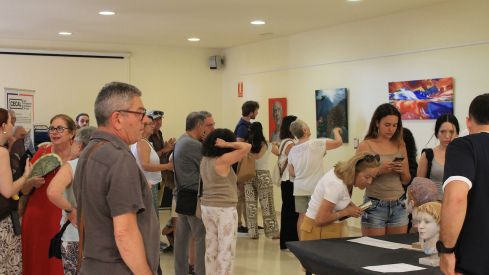
The Northern Barcelonès wants to be culturally respected. "It has reached a point where it is easier to receive support from a cultural center in Poblenou than to show your work in the city that saw you grow up." This is how forceful the president of 08 Rodalies Cultural, Daniel de Gracia, shows himself. According to his complaint, this situation has been conditioning the visual arts sector in this area of the metropolis for too long. And that is why this new entity was born: to become a meeting point for creators from Badalona, Montgat, Tiana, Sant Adrià de Besòs and Santa Coloma de Gramenet.
From these metropolitan cities, they want to promote, disseminate and defend the visual, plastic and digital arts of a territory that, they assure, has been losing spaces, opportunities and talent. "The visual ecosystem is increasingly cornered, with fewer resources and with the closure or flight of creators and entities to other territories," he explains. With all this, they want to revalue these creations and the art made in these municipalities, which share similar characteristics.
Rodalies and a shared postal code
The name of this new association deliberately refers to the railway network, and the 08 to the postal codes shared by a good part of the municipalities in the Barcelona demarcation. This is because the entity "wants to be a space for meeting, connection and connectivity between the bordering territories north of the Catalan capital," says de Gracia.
The objective is to build a stable network between artists, collectives, entities and the public that strengthens the cultural identity of this area. "To make a comparison, they would be like the D.O. of wines or oils, and we claim that of the Northern Barcelonès," he says humorously. With this new denomination, they also want these cities to stop working in isolation and join forces.
Claiming the cultural periphery
Beyond connecting, they also claim their rights. "Barcelona concentrates a good part of the country's cultural resources," a situation that the entity's leaders consider unbalanced. De Gracia says that many artists from the Northern Barcelonès "are forced to seek opportunities in the capital because in their municipalities they do not find exhibition spaces or structures that support them." They want to reverse this situation by equalizing the range of opportunities available in Barcelona compared to their territory.
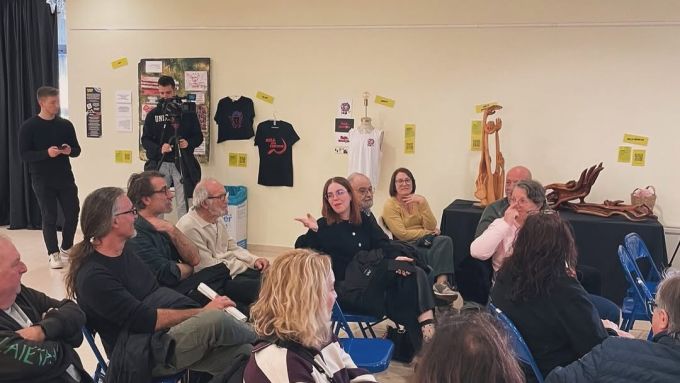
Another distinctive feature of the project is its open view on visual arts: it establishes no borders between disciplines or formats. In its exhibitions, we will see painting, sculpture, photography, installations, performance, or even digital art. This inclusive will also extends to the way of working. From the association, they defend co-productions with other collectives and alliances with social and educational entities as an essential tool to grow the project. "Experience has shown us that collaborations must be the starting point for all our projects," says the project's promoter. In addition to exhibitions, they hold workshops, talks, and awareness activities to bring art closer to the entire community.
A circuit to circulate art
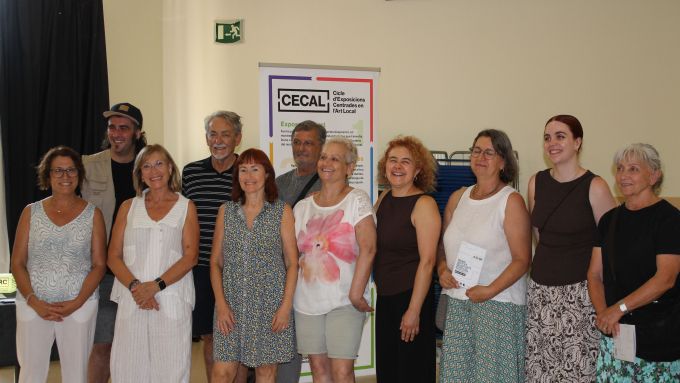
The first major initiative of 08 Rodalies Cultural is CE-CAL (Circuit of Exhibitions Focused on Local Art), a program that will circulate exhibitions among different municipalities of Barcelonès Nord. And they are not alone in this initiative, as they count on the different local entities. Each exhibition will include an inauguration, a guided visit, a poster, and a catalog. All this with the aim of professionalizing these proposals to give them visibility. In addition, each exhibition will have an independent curatorship in charge of building the exhibition narrative and selecting the participating works.
Sant Adrià de Besòs: first stop
The first exhibition of the circuit, titled Mirades, is already underway and can be seen until July 14 at the El Polidor Civic Center in Sant Adrià de Besòs. It is the result of the collaboration with the Fine Arts Group of the Badalona Museum, one of the historical entities of visual arts in the territory.
In this case, Helena Moreno Pérez has been the curator, selecting the works and artists through an open call. Although she specializes in Asian art, she has great knowledge and practice with Catalan art, as she is part of the Friends of the Museums of Catalonia. She herself, on Tuesday, July 14, will give a guided tour where she will explain the exhibition's discourse and the artists will talk about the works they have presented.
An autumn full of projects
In October, 08 Rodalies Cultural will open the second exhibition of CE-CAL, which will explain, in Badalona, the history of El Generador de Sant Adrià and Woo Street Art and Decofest de Santa Coloma. These entities "are the maximum territorial exponents of urban art and bring us closer to all the work they have done," says the president of this platform.
In November, they will hold a retrospective exhibition of the Grup d’Art els Coloristes de Santa Coloma and, finally, in December, the main event will come with an exhibition "with a luxury curator" who will have chosen the works from among more than 60 artists from the territory who submitted to the call that is open until July 15. In addition, they are also working on new projects with an eye on 2027, but they do not yet want to reveal the details. We will have to stay tuned, then, to their social media.
Culture beyond the big ones
For 08 Rodalies Cultural, the future of culture should not only be in the hands of large facilities or events. Small entities are, and must be, an essential element of the cultural fabric and machinery of the metropolitan territory. "Small entities play a fundamental role in the social survival of culture," they state.
To do this, however, they ask to reduce the excessive bureaucracy they suffer, as this is their main obstacle. Not finding artists and ideas, but overcoming the different administrative procedures. De Gracia explains it this way: "Imagine that to make a cake you had to spend more time getting the ingredients than cooking it." With this metaphor, he speaks of a bureaucracy that he considers essential, but excessively slow, and that ends up consuming a good part of the efforts of any cultural entity. Despite this problem, he assures that the illusion of building a solid artistic network in the Northern Barcelonès compensates for the difficulties they encounter. Their objective, in short, is that metropolitan creators do not always have to look to Barcelona to find opportunities, but that they can also generate them from their home, from their city and from their neighborhood.


