On June 26 of next year, it will be fifty years since the first LGBTIQ+ Pride demonstration in Spain. In Barcelona, under the call of the FAGC (Gay Liberation Front of Catalonia), some 5,000 people gathered on La Rambla with the slogan "Sexual Freedom."
These days, with the Pride demonstration as a horizon, Barcelona filmmaker Aïda Soler is preparing the filming schedule for the fiction documentary Barcelona, pending portrait, which we will be able to see on the big screen in the summer of 2027.
As the director says, the film aims to give voice and pay tribute to "all the artists, neighbors, and cultural spaces of the Barcelona that resists gentrification, the rise of the right, and forgetfulness." The documentary has a script by Marc Rosich and Soler herself, with whom we speak days after she closed the Verkami campaign with which she seeks to finance the historical research, filming, and production of the documentary.
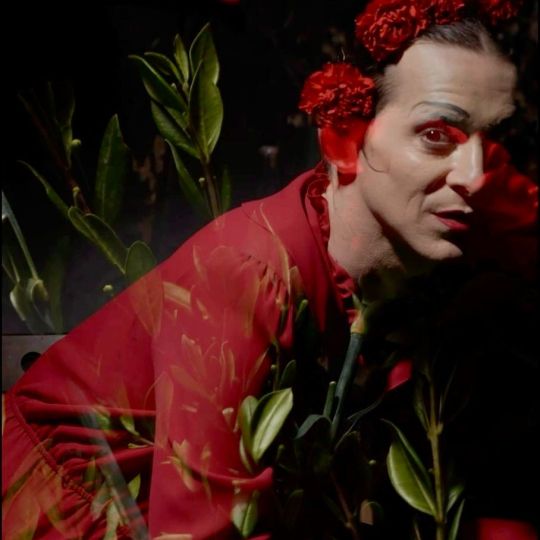
The protagonist of the film will be José Pérez Ocaña, better known as Ocaña, who was a renowned performer, artist, anarchist, and LGBTIQ+ activist in Barcelona in the seventies and eighties. He will be played by Lola Buzón, an actress from Seville. The piece will follow in the footsteps of Ocaña, who will converse with actress and performer Jèssica Pulla, "a representative of the current emerging queer scene," as the filmmaker points out. "It's an excuse to trace a living and cultural map of the transgressive Barcelona that exists today," Soler remarks.
"It's not about romanticizing the eighties"
The director is aware that audiovisuals can often make us idealize the past. "It's not about romanticizing the eighties. Counterculture entered a dark era with drugs, but it does make us see that now there is a kind of anesthetized spark that prevents us from mobilizing. The reason is that we are a precarious generation and the rise of the right does not make it easy," she reflects.
The documentary therefore wants to show that alternative culture dedicated to the LGBTIQ+ community has always existed and still exists in Barcelona. What happens is that it has been relegated to small venues and theaters. "We are there because public space is privatized and there is no dignity, there is precariousness. There is a circuit, of course, and there is audiovisual representation, RuPaul’s Drag Race exists, but it doesn't represent all of us."
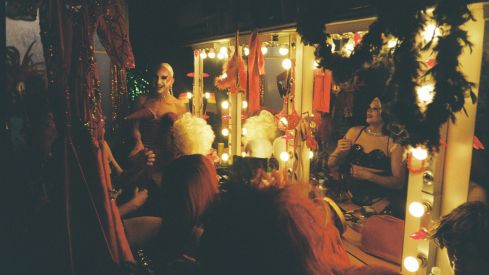
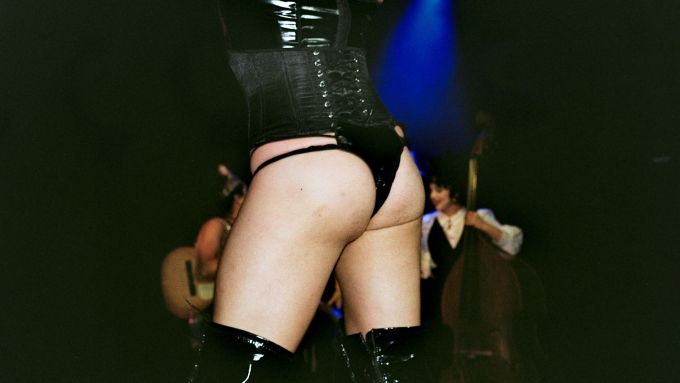
Regarding the work schedule, this spring they have already filmed quite a few scenes, but the most important work will be done this summer, when they will record several parties and performances that take place coinciding with Pride. The fictional conversation between Ocaña and Jèssica Pulla will be recorded in October. These days, therefore, they are scheduling shoots with characters from Barcelona's queer scene, especially around Paral·lel, such as Glòria Ribera, Brigitta Lamoure, Ruïnosa y las Strippers de Rahola, Kellypassa, among others. All of them will have their space in the documentary to explain the state of health of dissident culture in Barcelona.
From Park Güell to Plaça Reial: the pending archive
"In Barcelona, cabarets and transvestite shows are programmed every week, but people don't know it," points out the director. To create dissident culture, it is also necessary to know where we come from, and that is why these days, the team of Barcelona, retrat pendent shares on Instagram photos and various information about what they have called "the pending archive," that is, spaces and moments that nourished Barcelona's culture until the eighties. An example are the images of the Libertarian Conferences of Park Güell, which were held in 1977, or of Plaça Reial, which is where José Pérez Ocaña lived and where today we can find a bar named after him, Ocaña. El Molino del Paral·lel could not be missing from this collection. "The space par excellence, of dissidences; variety artists, cabaret, couplet singers and transvestites. Over the last few years it has been transformed into a space corrupted by capitalism and tourist interest," they denounce in the publication.
All this material that you can see here has been part of the documentation process of the filmmaker and the screenwriter. In fact, Soler points out that they have also consulted the Archivo Ocañí in Cantillana, the artist's town. "At some point we want to meet his brother too," she anticipates.
A tribute to Ocaña and Barcelona
Aïda Soler was born in the Sant Martí de Provençals neighborhood in 1998 and currently lives in Vallcarca. Graduated from ESCAC in 2020, she is a filmmaker specialized in Film Production and a member and creator of the audiovisual production company Injúries i Calúmnies. The idea for Barcelona, retrat pendent, as she shares, was born from a situation of "crisis" as a filmmaker. "I saw that many films were returning to their roots through the village, but I don't have a village, I have Barcelona and I wanted to discover where the city's roots are," she points out.
Seeing that Barcelona was "blurring into a tourist postcard," she thought that queer spaces were also being lost and, consequently, "havens for the LGBTIQ community." She immediately thought that the figure of Ocaña, of whom she is a big fan, allowed her to pay tribute to the legacy he left in the city and, even, in herself, because besides being a filmmaker, she is a drag king performer.
Finally, the director dreams aloud and says that she would like to premiere the documentary at a festival or at least screen it in a space like the Antic Teatre or the Teatre Arnau in front of all the artists who have collaborated in the process.