
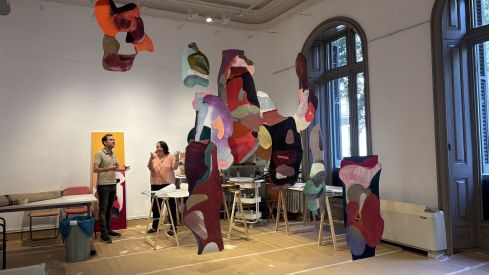
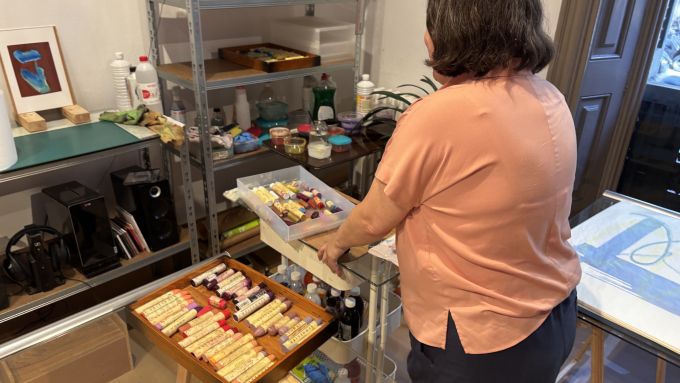
We enter one of the rooms in Casa Elizalde, in Barcelona's Eixample district, and find the artist Mercè Hernández working with oil pastels. It's a greasy technique, with vivid and striking colors. She immediately explains that this is one of her main obsessions as an artist: color. And also performance, the creative process, more than its final result.
And you might wonder what an artist is doing creating her work at Casa Elizalde?, in a place where exhibitions are usually held? Well, these days Hernández has her workshop, exceptionally, installed in this cultural facility in Barcelona, where she is conducting an experiment: an exhibition about her artistic creation process. You can see it in this space until July 18, in the exhibition Una presència incòmoda.
Color, her greatest obsession
Returning to color, she explains that, although she also uses other materials, such as inks, the pastels always win. Her process is completely intuitive: she lets herself be carried away by the first color, which marks the starting point of the work, and she never knows what will happen with the support she is working on or where it will end up.
"What I like most is the adrenaline of never knowing what will happen," she explains. A way of working that she relates to life itself. "You can have a clear idea of where you want to go, but many things don't depend on you and modify the path," she acknowledges. Her paintings are built from the relationships between colors and shapes, in a chain of events that, sometimes, can even end up destroying the work itself due to saturation.
An exhibition that shows how an exhibition is made
"The opportunity to have a solo exhibition at Casa Elizalde coincides with a moment when I am taking distance from the wall as a painter, perhaps not definitively, but I feel the need to occupy the space. As if the painting wanted to grow, free itself and didn't know where to go," reflects Hernández. That's why she believed that, in this case, her presentation letter had to be completely different from what she had done so far: "I thought it would be interesting to show the process, because what really interests me most about a work of art is the moment it is being built, all this painting that I do in situ on the definitive support and without any pre-established idea," she says.
The question was simple: what would happen if this creation process were shown live? Well, that's what has been happening these weeks at CasaElizalde, where Hernández has moved her usual workshop. A fact she considers a milestone in her artistic career: "Being able to work in a space like this is a dream. Having a workshop in the middle of the Eixample, next to Passeig de Gràcia, is impossible nowadays," she acknowledges.
There was also a desire to give visibility to an often invisible reality: that of the artist's workshop. Spaces that usually remain in the shadows and to which the public rarely has access.
The border between what is public and what is private
The proposal, however, also raised some doubts. To work, she explains, she needs her space, a certain intimacy. She wondered if she would be able to create in an open place, almost like a permanent performance, knowing that people could enter at any moment, interrupt her or ask her questions.
Finally, she decided to prioritize the visitor's interest in accessing this space and establishing direct communication: "I always work on a constantly transforming work, of an exhausting, almost inevitable mutation. This is the aspect that interests me most: the intangible, what has happened before what is ultimately seen."
The first inauguration of the exhibition: the emptiness of a room
The project began on May 20. That day, she explains, it functioned almost like an "inauguration." Attendees even helped carry furniture and personal objects into a completely empty room that, little by little, has been transformed into a workshop and exhibition of everything she has been creating these days. Now, at the end of June, there are already two main works that can be visited, and a workshop that has already begun to be tidied up. The first explores the process of creating a work. It is a sequence that shows the cumulative nature of her way of working and the constant transformation of painting.
"I saw that there were many paintings that remained buried under the one we see as spectators, and that often nothing remains of them in the final stage," she explains. From this arises the question that gives rise to the piece: Ubi sunt? To ask where these disappeared paintings have gone.
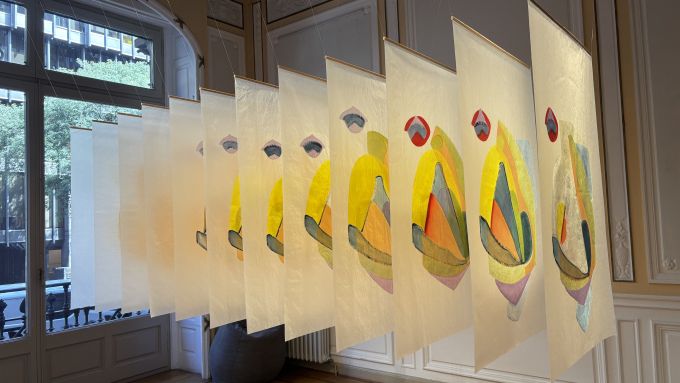
A reflection that connects with time and with the difficulty of representing it. Hernández explains that the simplest way would have been to document the process with photography or video, but that was not what interested her. She wanted the painting itself to speak of the passage of time.
The piece is constructed from memory. Without consulting previous versions, she reproduced the different stages of a work on twelve sheets. Twelve because that was how many fit on the wall of her studio. "Like in the game of telephone, each memory slightly modifies the precedent. The piece functions as a metaphor for the functioning of memory: an accumulation of memories that transform each time they are evoked. Each sheet is an original work, constructed without copying the previous one, only from memory," she reflects.
A painting that wants to leave the frame
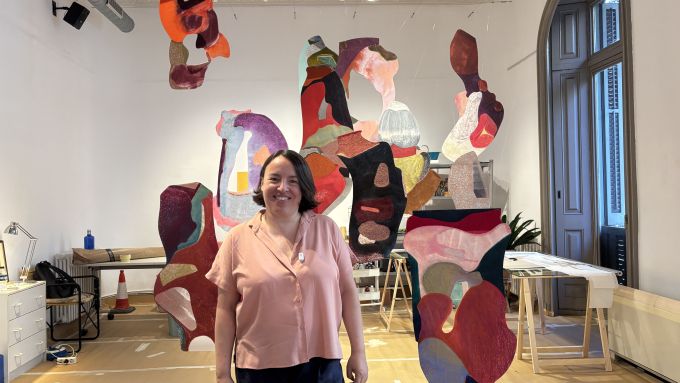
The second piece, which is where her ephemeral studio is now, is a larger installation and represents a new material exploration for the artist.
She began working with interlining, a support commonly used in the fashion world to give body to garments. Its colors, usually very saturated, also appear there. In a work constructed from successive layers, each color seems to want to show its maximum intensity before being covered by another.
The goal was to give the painting as much body as possible, almost as if it wanted to abandon its usual space. The interlining allows the paint to pass through the material and be visible on both sides. "You see perfectly what has happened. You see the entire skeleton of the work. Often the back part ends up being more interesting than the front, because it makes itself, unconsciously."
And the final result is a painting that seems to want to leave its frame and occupy its space, a bit like her, who has also wanted to leave her usual space and her comfort zone, her studio in the Freixas Building in l'Hospitalet.
An uncomfortable presence
The title of the exhibition also stems from this situation of exchange between artist and public. Hernández thought that she might be an uncomfortable presence at Elizalde, both for the institution and for the visitor, who does not expect to suddenly find the artist working in a room where there are usually exhibitions.
And after weeks with this uncomfortable presence, she acknowledges that the experiment has gone very well. "It's curious to see who dares more or less when they see I'm working, and I have to say everyone has been very polite," she says, laughing.
The objects that make her feel at home
In the ephemeral workshop she has set up, there are several objects loaded with personal meaning. Among them, a photograph of the Giants of Sitges, which she usually has in her studio in l'Hospitalet and which she considers an amulet: "Some people have a Christ. Well, I have the best giants in the world, those of Sitges." And that's because Hernández is from Sitges and heir to a lineage linked for years to the festive figures of Sitges.
There is also a plant that accompanies her wherever she goes, a vintage fan recovered from the trash, and a painting made last year that has become a new amulet. Objects that have given warmth to a space that, for her, was completely unknown.
A growing trajectory
Hernández says she has always been attracted to artistic practices. First it was dance, but also theater and music. Painting appeared during her Fine Arts studies at the University of Barcelona. From the first year, she assures, she began to paint in a very natural way, finding a language in which she felt comfortable. And that's when she began to fall in love with color, with whom she has developed a very visceral relationship.
Since then, she has participated mainly in collective exhibitions. Among the most recent is the one held last autumn at the Fundació Vila Casas. She has also exhibited at Sala Parés, among other spaces. And now she has managed to leave her studio, break her comfort zone, and show us that art is also the process, not just the final result. This idea becomes a balm in a constantly transforming world like the one we inhabit, where we often forget the value of the journey and focus solely on the arrival.


