
In the year 1850, a little girl named Blai Nadramo is shipwrecked in front of the Barcelona shipyards and arrives at a neighborhood that does not yet exist. A talkative dragonfly, the Bandarra, receives her in the orchards where one day Poble-sec will rise. One hundred seventy-five years later, both are still in the neighborhood and have not aged. "We are the memory of Poble-sec," the girl explains to Bandarra, from the Miramar viewpoint.
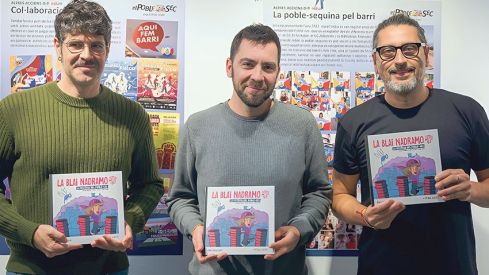
This is the story of La Blai Nadramo, the tale published by the Plataforma Orgull Poble-sequí with text by Isaac Cortés, illustrations by Edgar Ramírez and co-authorship by Jordi Lladó, who have worked on it for two years.
The book covers eighteen dated episodes, one per chapter, from the construction of the neighborhood over the old military "controversial zones" to "any given day" of 2026. Along the way, Blai and Bandarra experience the first May 1st in the Carolines field (1890), the Tragic Week (1909), the La Canadenca strike (1919), the night Bella Dorita performed at the Molino (1929), the bombings at shelter 307 (1939), the struggles of the Neighborhood Union against evictions...
"We have given this vision of Poble-sec because it is a combative neighborhood," Cortés claims. The project has received aid from the Barcelona City Council to move forward, but according to the author "it has not been enough," and he explains that Jordi Lladó "has put money from his own pocket."
The visual part by Edgar Ramírez places each chapter in a specific location of the neighborhood, collected in an initial guide map. To draw it, he walked through Poble-sec at street level, photographing every building and corner. "Now I know the neighborhood better than anyone," he comments with a laugh. The vignettes combine the narrative thread with signs that provide real data, and to reconstruct spaces that no longer exist (like the 1850 walls or the Moulin Rouge) he has worked with archive photographs, images found online and, above all, a lot of imagination.
The book is not expected to be commercialized in bookstores: it will be available in libraries and other neighborhood centers. "The book is now a testament to everything that has happened in Poble-sec," Cortés concludes. "It cannot be erased."


