
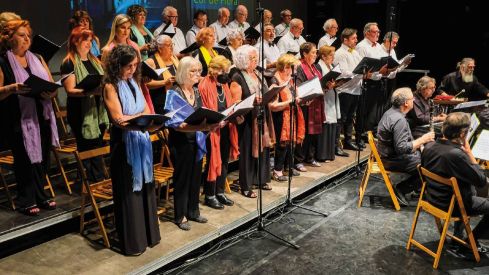
Founded in 1863, the Cor de la Flora is the entity is the oldest in the municipality and one of the historical choirs of the country, with a trajectory marked by continuity, adaptation to new times and commitment to popular culture. Its origins are framed within the movement of the Cors de Clavé, promoted by Josep Anselm Clavé in the 19th century with the aim of bringing music, culture and education closer to the popular classes. Unlike other choirs, the one from Sant Joan Despí was mostly made up of field workers, a characteristic that gives it its own identity within the choral movement.
The choir was one of the first that were constituted in Catalonia and still maintains today the link with the Federació de Cors de Clavé, of which it is a part. Since 2025 it is also federated to the Federació Catalana d'Entitats Corals, thus expanding its presence within the Catalan choral scene.
From the past to the present
Throughout more than a century and a half, the Cor de la Flora has lived through various stages, but has always known how to adapt to new times. One of the recent milestones was the celebration of the 160th anniversary, commemorated with an exhibition at the Centre Jujol-Can Negre, where its historical evolution was reviewed.
Among the usual dates on the calendar are the Caramelles, the lyrical concert of Festa Major, the autumn concert and the traditional Christmas concert. In recent years, however, the choir has expanded its presence in municipal events, collaborating with neighborhood entities and associations and participating in initiatives such as the Tres Tombs, where this year they have been standard-bearers, or the Festa Major Procession, as a novelty for this 2026.
Another highlight was the participation in the Festes de la Mercè of Barcelona in 2022, with a performance in front of the cathedral.
A heart open to everyone
The rehearsals take place every Wednesday from 8 PM to 10 PM and the entity keeps its doors open to anyone who wants to sing. El Cor de la Flora defines itself as a transgenerational and transcultural space, open to all ages and profiles. The group does not have a unique and closed style: it combines traditional pieces, especially in events like the Caramelles, with more modern repertoire. Recently, the choir has premiered "La Sardana de Sant Joan Despí", with lyrics and music by its director, Paula Forconi, a piece dedicated to the history of the municipality.
Social commitment and networked work
Beyond music, the Cor de la Flora reclaims its role as a space for meeting and cohesion. In its beginnings it was a meeting and training point for the popular classes, and in 1984 it opened its doors to women, a key step to guarantee the continuity of the entity. Currently, the choir participates in the program Voluntariat per la llengua and actively collaborates with other local entities, such as the Esbart Dansaire and various neighborhood associations. Its documentary funds, preserved in the Arxiu Municipal, bear witness to the historical weight of an entity that, more than a century and a half later, continues singing and building the city.


