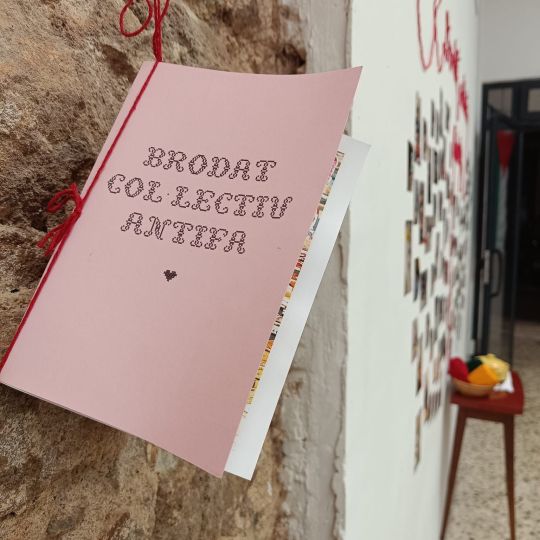
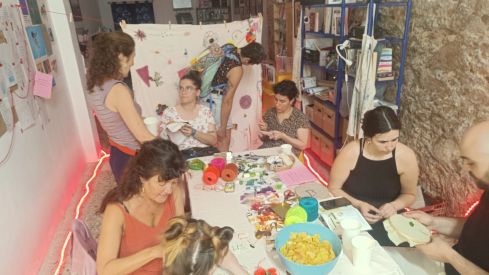
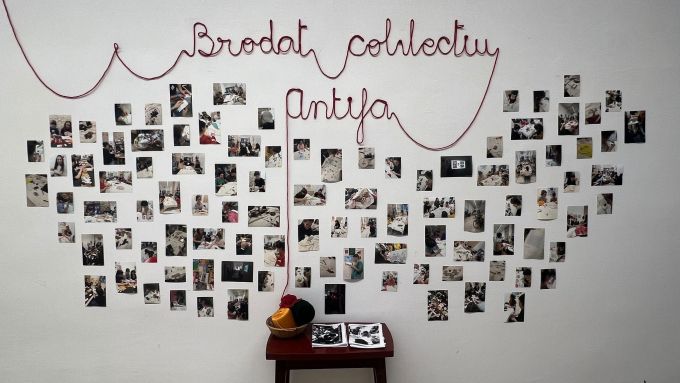
The cultural space La Cocota in the Poble-sec neighborhood of Barcelona inaugurated last Thursday, June 18, the exhibition Brodat col·lectiu antifa, the result of several months of community gatherings in which about twenty participants jointly constructed an anti-fascist imaginary through embroidery.
The initiative, coordinated by Laura López, stems from her personal experience with this artisanal technique. “When I first embroidered, I discovered a practice that allowed me to stop and concentrate. It worked very well for me and I thought that collective embroidery could be an anti-fascist artistic practice,” explains López.
Thus, from La Cocota, a space that promotes community artistic action projects, the proposal was approached from a political and collaborative perspective. Instead of organizing a conventional workshop with an expert at the helm, the participants shared knowledge and learning among themselves, regardless of their prior experience with embroidery. The workshops took place between April and June.
Involved Artists
To accompany the process, the project involved three artists linked to this discipline: Noor, promoter of the Espai Tallerets in Sants; Regina from Todavía Art; and Sele, member of the Impremta Col·lectiva de Can Batlló.
The objective was to jointly construct a visual representation of anti-fascism. The result is a collective tapestry that gathers very diverse reflections on what it means to be anti-fascist today. “We have seen that anti-fascism is broad and diverse, in contrast to fascism, which proposes a homogeneous and limited imaginary. Anti-fascism can be any practice that implies diversity, respect, and joy,” López points out.
The exhibited pieces address this idea from multiple perspectives: nature, craftsmanship, collective and individual memory, everyday objects, or even food. According to the participants, anti-fascism can be expressed in any area of daily life. Beyond the final result, which can be seen these days at La Cocota, the project has championed embroidery as a practice of resistance to the accelerated pace of daily life. “We don't know yet what will happen with the tapestry, perhaps we will continue embroidering it or it will become an itinerant tapestry,” concludes the coordinator.