
Music is not only listened to: it is also dressed, lived, felt, it defines us. Our life is completely crossed by music and everything that surrounds it. With this premise, Rock & Arte y Estética (Redbook editorial), written by Lorena Montón and Erik Oz, reviews eight decades in which rock has marked trends, attitudes, and identities.
From Elvis's pompadours to the current digital universe of K-pop, passing through the boybands, the emo fringe or the Free the nipple movement, the work connects aesthetics and social context to explain how each generation has found in music a way of being and defining itself before the world. A world that has seen how some of the fashions that were born spontaneously on the street reached the fashion runways.
“We don't just make aesthetic descriptions, we also explain what was happening on a political and social scale when these styles emerged,” explains Lorena Montón to AMIC Cultura. However, they offer an almost encyclopedic collection of the decades from the 1950s to the present, in a full-color book with images that make it a very visually attractive work.
A shared project (and very organic)
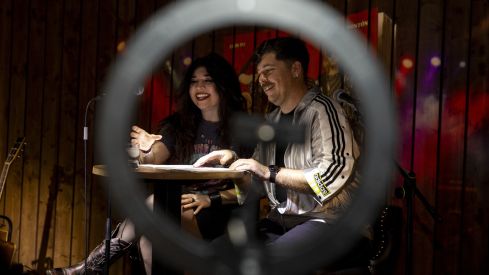
The book is born from a project by Montón with the publisher and from the complicity between her and Oz, who met in a master's degree after he made a professional turn leaving the world of fast fashion and opted for the academic world. “All alone I would not have dared, but with Lorena the stars aligned”, says to AMIC Cultura Erik Oz. For her part, Lorena Montón is a journalist specialized in music and a lecturer of the Master in Music Industry at the UB.
The creation process, they explain, has been intense, but natural, combining their friendship and work: “It has been leisure mixed with work: we already went together to events on this topic and, suddenly, all that became documentation to make a book.”
With a collaborative work system on google drive and many hours of research, they acknowledge that the project ended up being almost “like doing another master's degree”, focused on the visual culture of the aesthetic behind rock. And even though both are very different, they found in this difference a very organic way of working that was self-feeding. “We are very similar, but with very different musical tastes… Lorena likes boybands, and I like postpunk… And we already have new projects together on the table”, says Oz.
From Madonna to Rosalía: a story also recent
One of the strong points of the book is the will to reach up to the present. Although there is much bibliography about classical icons, the authors detected that there was a gap that needed to be filled: “About the aesthetics of Elvis or Bowie there is much, but from 2000 until now it was very difficult for us to find information.”
This lack of bibliography led them to do an exercise of memory and generational reflection about the 2000s, when they were very young: “More than investigating, it has been reflecting on how we lived the 2000s and how its artists, aesthetics, and discourses influenced us”. And from this analysis “surprising facts emerge that you don't realize until you do a bit of retrospect,” they acknowledge.
The book, beyond the 2000s, also gathers current phenomena such as K-pop, Billie Eilish or Rosalía, as well as the transformation of fan culture into digital communities, where fans no longer just follow their artists, but create communities with their own identity and come to mimic their idols.
More than fashion: context, rebellion and identity
Far from staying on the surface, Rock & Arte y Estética connects aesthetics with key moments of recent history. For example, the authors say that the society of the nineties was much more innocent, until 2008, with the crisis, young people returned to the streets to protest. Furthermore, this new publication also addresses how music and fashion have helped to normalize new forms of expression such as the various female canons and their hypersexualization, of friendship, of diversity and of how different sexual orientations and identities have been accepted.
With an accessible language and far from academicism, the work is intended for a generalist public. For curious people, music lovers or who feeling much interest for famous artists. There are Madonna, Lady Gaga, Michael Jackson, Gwen Stefani, My Chemical Romance or even, Björk. “Anyone who has been a teenager with musical tastes will connect with their decade”, says Montón.
In addition, the edition plays a key role: color photographs, iconic visual elements and QR codes that expand the experience with audiovisual content, as each chapter features an element, chosen as a "museum piece", that represents that era: for example, afro hair and disco music. This was the best way to convey this content, with text, but accompanied by photos, which allow reading, but also enjoying the images that appear.
A necessary book
The reception has been positive, especially among professionals in the fashion and aesthetics sector. Also in the academic world. “They have told us that it was a necessary book. Fusing music and aesthetics had never been done like this,” they affirm. Both feel that they have opened a path in this field and, in some way, they feel a bit like pioneers.
In addition, this will be their first Sant Jordi with this book, and for this reason they are already preparing hard. They will hold an official presentation at the Vapor Vell Library, specialized in music, in the Sants-Montjuïc district, on April 20 at 6:30 p.m.
On Sant Jordi's day itself, they also have two signings scheduled: at 12 p.m. at La Sonora de Gràcia and, in the afternoon, at the Redbook publishing house's stand (with a location still pending).


