
In Vila de Gràcia, there is a corner that is a space full of history. It is the Plaça de la Revolució de Setembre de 1868, popularly known simply as Plaça de la Revolució.
This Gràcia spot has changed its name several times throughout its history, a fact that reflects the different political contexts the city has gone through, from more monarchical references, to more republican ones, those related to the Democratic Sexennium and the First Spanish Republic.
Plaça de la Revolució: today
Currently, this square is a cultural and daily meeting point for the neighborhood's residents. It has a rectangular shape and is surrounded by residential buildings with ground floors and several stories, which maintain Gràcia's characteristic scale. One of the most unique elements is the presence of jacarandas, which in spring fill the space with lilac tones and create a specially recognizable atmosphere.
The Festa Major de Gràcia, on its ground
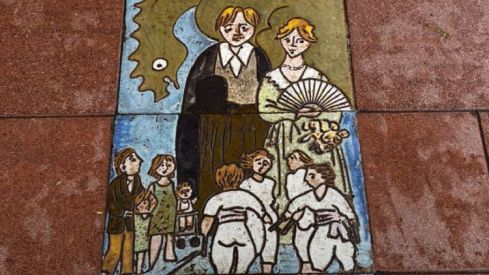
Among its most prominent elements, there is also a mosaic located on the pavement, installed during the Festa Major de Gràcia of 1997. This ceramic artwork represents the traditional game of hopscotch, but reinterpreted with festive scenes of the neighborhood. In fact, they are two large enameled ceramic panels that show the cultural richness of the main festival.
In one of the hopscotches, musicians can be seen playing on a stage in front of the bell tower of Plaça de la Vila, neighbors dancing, people decorating streets, and popular dinners. The other hopscotch represents more traditional elements of the festive procession: big-heads, stick dancers, giants, the dragon, human towers, and the coat of arms of Vila de Gràcia. An element that has already become a true emblem.
This ceramic ensemble transforms the ground of this square into an authentic visual narrative of Gràcia's popular culture, which 365 days a year is present in this corner. It is part of the participatory Inventory El mosaic del meu barri, which documents these artistic interventions in public space.
The square also has a darker past
Beyond the light provoked by seeing children play a traditional game full of popular culture, this square also hides an underground past: under the pavement, an air-raid shelter discovered in 1995 is preserved. An element that reminds us of the moments of conflict experienced in the city and adds another layer to its complex history.


