
The big ones are always separated from the small ones, and the same happens with books. "In the end, we are all in bookstores," says Ricard Plana from Males Herbes publishing house. However, before the book reaches the store, it goes through an editing process that is indeed different between publishing houses. In this article, we present five small publishing houses, whose existence has an indirect relationship with the strength of the big ones, such as Planeta, Edicions 62, or Anagrama. Mainly because they act as a counterbalance.
But what does it mean to be independent? We explain it to you through five editorials from the metropolis that you shouldn't miss.
1. Males Herbes: specializing in non-realistic literature
"American cult novels didn't exist in Catalan, and we filled that void," points out Ricard Planas, one of the driving forces behind Barcelona-based Males Herbes, along with Ramon Mas and Pau Clemente. It was founded in 2012, and after more than ten years, it maintains the same spirit: publishing non-realistic narrative, also known as speculative fiction. "It's the genre that ranges from Ray Bradbury to Gabriel García Márquez, via Kafka," Planas details.
When asked about the key to his success, he highlights having consolidated a brand that is already very visible in libraries and bookstores, but, above all, he explains that it's about "building community." And what does that mean exactly? It means creating reading clubs, presentations, social media outreach, and staying in touch with booksellers. The key is knowing what the reader wants: "You have to be part of a network, but there's also the aspect of making a proposal that no one else is making and having people accept it."
2. Saldonar: journalism, narrative, and poetry
"An independent publishing house relies on the judgment of an editor, takes the utmost care with the quality of the edition, and controls the quality of the texts and the relationship with the author and translators," comments Francesc Gil, director of Saldonar and the Associació Llegir en Català, from the other end of the phone. Another characteristic of independent publishing houses is that they have few employees, as is the case with Saldonar, where Gil and his son Octavi work, who mainly handles translation tasks. "We can explain anything about our books because we've been involved in the entire process, there are no missteps," he explains.
Gil founded it in 2010 and since then has followed the same formula as Males Herbes, offering a personal touch: "We are very much on the street to hear what people think." As he explains, it's a very vocational job with which few people get rich: "If I can talk today it's because I have all my bills paid... You can make a decent living, but you know you're working with a small structure, whereas in a large publishing house they have four departments.
"In addition to his work at Saldonar, in 2013 he founded Llegir en Català, an association that brings together independent Catalan publishers such as Les Hores, l’Agulla Daurada, l’Avenç, and Raig Verd, among others. The publisher thought this was the way to "exchange internal information, help each other with covers, or find translators." He also says that this way they present themselves together at renowned literary events like La Setmana del Llibre en Català and produce catalogs of new releases: "Alone, they won't pay attention to us, but if a few of us present ourselves, it's easier to capture the press's attention, because you have to consider that we are competing with the breakfast that Planeta or Random House might offer," points out the founder
3. Descontrol: books of "transformation and social revolution"
Located in Can Batlló, in the Sants neighborhood of Barcelona, Descontrol is a publishing house and printing press that since 2011 has understood books as "weapons of knowledge." As they explain, the selection and editing of books follows the criterion of creating a collection that promotes "historical memory, transformation, and social revolution.
"Its peculiarity is that it is printed in one of the workshops at the Can Batlló complex, at Descontrol Impremta. There, every year, they produce the book that has won the Premi Descontrol. These are novels or short stories that are utopias "that allow us to imagine worlds based on social and ecological justice."
4. Virus: cooperative project for the editing and distribution of social books
Based in the Raval neighborhood since 1991, Virus selects and publishes books on social topics such as historical memory, ecology, feminism, critical pedagogy, urbanism, or reflections on struggles and social movements.
Furthermore, they defend specialized and local bookstores as the only sales space. This is why, when they were founded, they created their own distributor, far from "the fast-consumption market."
5. Mai Més: “Openly geeky in Catalan”
It is an editorial with "one foot in the metropolitan area and the other in Empordà", as explained by Sergio Pérez, who is in charge of Mai Més along with Judit Terradellas.
This project was born in 2019 out of the interest these two publishing professionals had in fantasy and science fiction literature: "We saw it as an aberration that openly *geeky* literature wasn't being published in Catalan." Five years have passed, and they already have seventy books for sale. Furthermore, it was crucial for them to promote literature of this genre written by women, as they saw that "there was a deficit." "We are achieving this," they celebrate.
Unlike other publishers, they work online and distribution is handled by Les Punxes.
Where can I buy these books?
Many independent and specialized bookstores in the metropolis fill their shelves with books on LGTBI, feminist, anti-capitalist, travel, or children's and young adult literature themes.
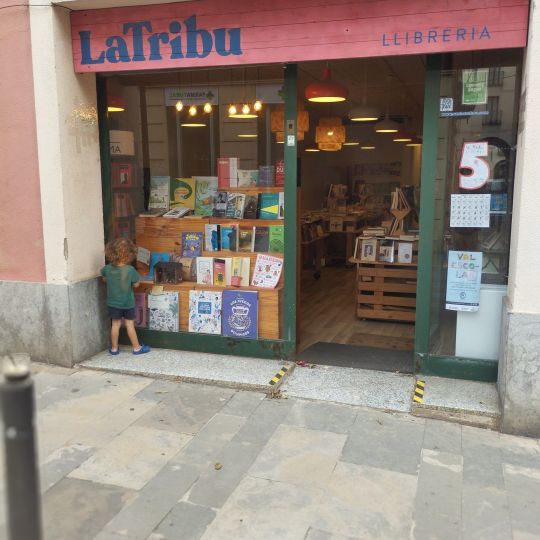
One of them is La Tribu, an independent bookstore and cooperative located in the Sant Andreu neighborhood, where they sell books from many of the mentioned publishers and also from others like Periscopi, Altra Editorial, or Raig Verd. It was founded six years ago and, as one of the partners, Marc Pons, explains, it filled a business gap: "We wanted a bookstore that was also a cultural center where activities related to books could take place, and Sant Andreu didn't have any other besides the library."
As they say, the reception was very positive from the start: "It must be said that the people of Sant Andreu are very local, and this makes things easier because, compared to other neighborhoods in Barcelona, they have a strong integration of local businesses." From La Tribu, they value the work of independent publishers and specifically highlight that there are increasingly more imprints for children's literature within independent publishing houses. Raig Verd has the young imprint Indòmita and L’Atra Editorial has Altra Tribu. "In the end, they are creating the readers of tomorrow," they explain.