
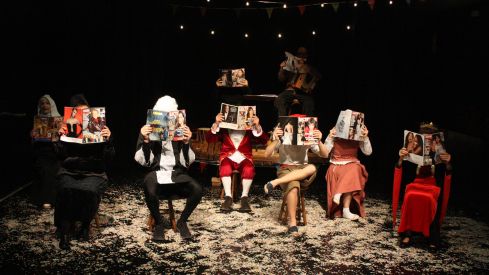
Summarizing the year with satires and current figures to discuss what has happened in a town (or the world, in general). During the Christmas holidays, in Santa Coloma de Gramenet, La Colmena theatre presents Santa Comèdia, a new production that revives and updates the tradition of "balls parlats" (spoken dances), one of the most unique forms of Catalan popular theatre.
In this context, Santa Comèdia is born as a proposal inheriting this tradition, but with a contemporary and satirical outlook, following the model of emblematic shows like Tarragona's Dames i vells. Thus, La Colmena has constructed a theatrical farce in its work that will offer an ironic review of the year's news "in theatrical terms," as stated by the company's director, Joan Fernández.
The work is structured like a scenic diary, with sections ranging from local and international news to politics, economics, culture, sports, or gossip, interspersed with musical and dance numbers. The show also focuses on the creation of archetypes inspired by Italian commedia dell’arte, street performances, and improvisation.
The play can be enjoyed at the La Colmena performance space, starting on St. Stephen's Day, between December 26th and 30th, and from January 2nd to 4th, starting at 7 PM. A proposal that connects tradition and the present, recovering the value of popular theater as a collective tool and shared celebration.
The Revival of Spoken Dances
The show is inspired by spoken dances. That is to say, stage performances of medieval origin, where music, dance, and choreography coexist with dramaturgy and text, and which had strong historical roots, especially in the regions of Tarragona. Spoken dances experienced their moment of greatest splendor during the Middle Ages and the modern era, but changes in the festive model throughout the 20th century led to their progressive disappearance.
Despite this, some towns kept the flame alive, and with the recovery of popular festivals during the Transition, these theatrical expressions returned to occupy a prominent place in parades, processions, and festive processions.
With this new work, La Colmena reclaims spoken dances as living heritage and demonstrates that popular culture continues to be a suitable space for explaining, with humor and wit, the world around us.


