The Fabra i Coats Centre d’Art Contemporani has premiered a new direction and does so with two exhibitions that, without explicitly seeking it, speak of the female body, work, and memory. Until April 12, 2026, LALIRIO by Fuentesal Arenillas (curated by Clàudia Elies) and Strawberry Fields, a video creation winner of the 11th edition of the Julia Montilla Video Creation Award, coexist in the renovated factory building of Sant Andreu de Palomar and demonstrate that poetry and protest can coexist under the same roof. An immersion that visitors can now also do accompanied by experts on guided tours. The next one: this Sunday at 12 noon (no prior registration required).
LALIRIO: a backbone of breathable fabric
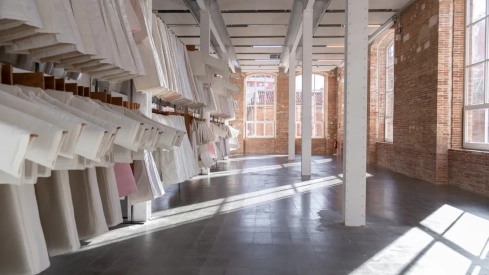
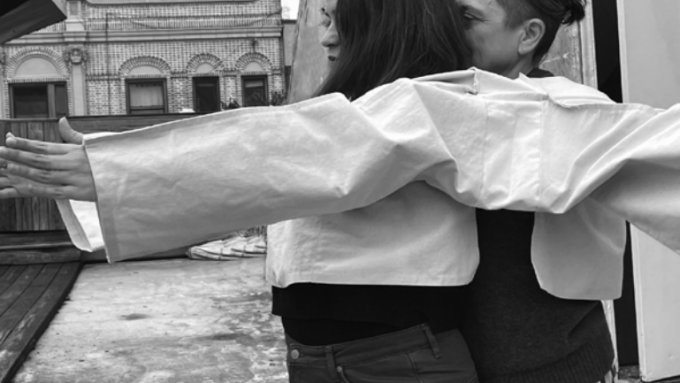
When the public enters the exhibition space, they are greeted on the ground floor by Carrusel, an installation that the curator and director of the Contemporary Art Centre, Clàudia Elies, defines as "a correspondence between two artists." Its origin lies in a curious correspondence: the artists Fuentesal Arenillas and Itziar Okariz decided, instead of sending letters, to exchange pieces of clothing that responded to specific desires: "I want trousers that can be used by two people," "I want a jacket that I can wear, but that is big enough to wear with someone else," explains the director. The result is an accumulation of jackets, shirts, and trousers hanging between the pillars like a large textile spine, in dialogue with the old thread factory.
On the first floor, in contrast, lies *Imaginaria i Caracolas*, the new production created expressly for the space. Seventy wooden frames hold imprints, stains, and traces from the artists' workshops, with the intervention of artist LUCE adding another layer of memory. Caracolas starts from the same patterns as Carrusel, but transforms into shapes that "stretch, rest, and disappear," as if in constant repetition.In this sense, the title LALIRIO has a double meaning. On the one hand, it responds to "the star who wanders from place to place" and, at the same time, refers to the sea lily, the flower that "leaves the day and dies at night," Elies explains in relation to this constant repetition. Despite the tactile curiosity that all these fabrics might awaken, the center reminds visitors that they cannot be touched: "It is simply visual and spatial."
Strawberry Fields: The Strawberry as a Mirror of Continued Colonialism
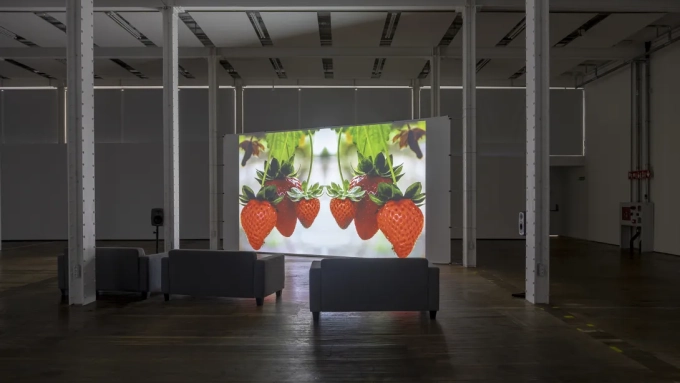
Now in the black box and looping for 65 minutes, Julia Montilla (Barcelona, 1970) takes the viewer to the plastic greenhouses of Huelva. The title refers to the Beatles, "living is easy with eyes closed," and presents looking as a political act. The video combines poetic images of the greenhouses with the reality of the seasonal workers, mostly migrant women. "The majority who pick these strawberries are women," Elies recalls.
In this video-documentary, Montilla draws a line between Spain's colonial past and current extractivism: "Now it's the embodiment of a migrant figure from countries like Morocco or Eastern Europe, but in the past there were also these displacements from southern territories to other places." In parallel, he highlights the artist's portrayal of opaque working conditions and abuses. Instead of explicitly stating them, the film opts to suggest them. A choice that, moreover, had to take into account the protagonists' confidentiality: "It was very difficult to film them, the objective was to preserve their safety, which is why they don't appear in the first person," explains the director.The film's aesthetic is beautiful and unsettling at the same time: "They are very poetic images, which at first glance might not embody this harshness, but then you see the harshness little by little, without it being too jarring," Elies emphasizes. In fact, you can enter halfway through the screening and understand it, but the complete experience is what reveals all the layers.
One space, two complementary voices
Clàudia Elies, who will take over as director of the center in May 2025, wants the public to leave with a clear idea from their visit to the space: "That they see that this center is now starting a new cycle, that very diverse things will happen here, that we have space for poetry, for beauty, for this piece of fabric that becomes sculpture and dialogues with the past, but that at the same time we also have space to address current issues." From the outset, the commitment is clear: two exhibitions that start from the female body. LALIRIO, with the body that dresses, moves, and remembers, and in Strawberry Fields, with the body that works, suffers, and is silenced.


