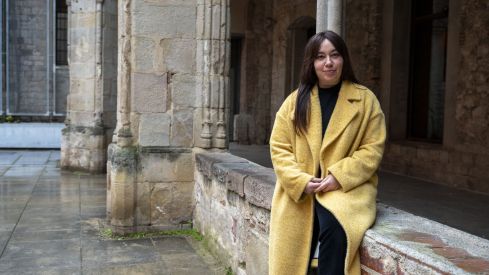
Lorena Ruiz Pellicero (Sant Boi, 1991) is an artist who, as she herself explains, relates to the world through visual experience. This serves her to be a builder of images and videos that become artistic creations, where there is often a strong load of irony or absurdity. In fact, perhaps to understand the current world it is very necessary to resort to an absurd way of looking at things.
“My name is Lorena Ruiz Pellicero and I'm afraid of going blind.” This is the first sentence that appears in your website's biography. Where does this fear come from?
Well, the truth is I don't know. When they ask you the typical question to know what you're afraid of, I've always thought of going blind. Because if you die, well, that's it, but to stay in this world without the visual part in the oculocentric planet we live in...
How has this fear influenced your artistic career?
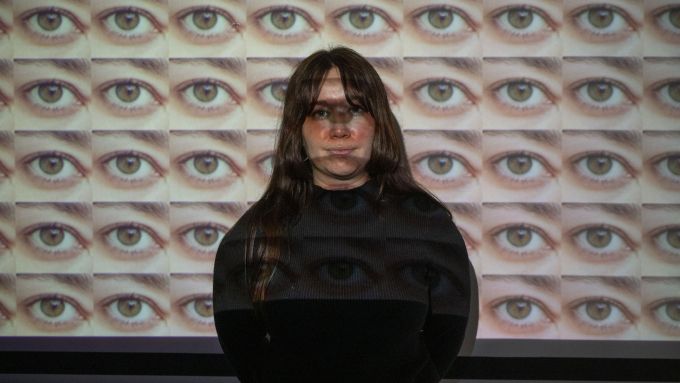
I have been discovering it little by little and, as you do things, you see that there are some themes that repeat a lot. I have always had this interest in vision, both physiologically and at a more conceptual level. And since I am very interested in the idea of visual fatigue, I have thought a lot about this; about the sensation of never seeing well, because I have myopia. Noticing that I don't focus due to astigmatism, floating flies... When I'm stressed or spend a lot of time in front of the computer, I see worse.
You work mainly with photography and video art. How would you define what you do?
I am interested in the way we look at the world and I use visual elements of the image to talk about the image itself. You focus a lot on everyday objects. It may seem simple, but it requires effort. Yes, it's going into the detail of things. It's trying to observe from another point of view. Rethink images. I am more interested in the part of thinking about the image than showing it.
The process.
Exactly. All the reflection that can be behind an image.
Making visual poetry, in a world of images like the one we live in, can it be more complicated than at other times?
I don't know if it's easier or more difficult, but it does require more attention.
At a time when attention we are losing it...
Visual fatigue is a new shared visual language. Focusing on details is the opposite of what we are now used to doing.
“Friends from Madrid see Barcelona's civic centers as something amazing”
And you find yourself, as happens to many people, with the problem of lack of concentration?
Yes, it happens to me a lot. We are constantly agitated, and that's why, when I create, I try to make manual sketches to focus on the thought and be outside the image to end up producing one, which is a bit paradoxical.
That's why you carry a notebook full of drawings...
Yes, I always work from sketches. It's my way of imagining the things I want to create.
Now that we talk about visual poetry, in Catalonia there have been great names like Joan Salvat-Papasseit or Joan Brossa. Do they inspire you?
Perhaps more at the beginning of my career than now. When I started, Brossa was one of the artists from here who marked me the most, with his ideas of transforming objects so that they have a double meaning. Or how to explain something very complex in a very simple way. And another inspiration was the photographer Chema Madoz.
And from this initial stage you have been evolving.
Yes, I have moved away from the flat, printed, and rectangular image and now I play with breaking it both physically and digitally. I am very interested in this idea of glitch and error at a time like the present, where images are shared and re-shared and lose quality.
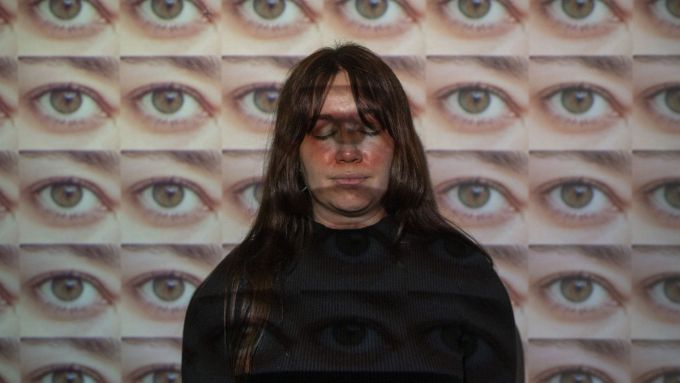
![Lorena Ruiz's eyes. Photo: Joanna Chichelnitzky[/caption]](/uploads/s1/44/19/9/260205-lorenaruiz-12_38_680x383.jpeg "Lorena Ruiz's eyes. Photo: Joanna Chichelnitzky[/caption]")
In this first part of your career, in 2015 you went to live in Madrid to study. In your adaptation process you started to photograph everyday objects.
Yes. When I went to Madrid it was to study the master's in photography, and it was the first time I went to live in a big city, as I lived in Sant Boi. I walked a lot, because I do that when I need to think, and seeing things on the street gave me ideas. The inspiration made me start seeing places on the street as if they were rooms in a house, and then I took household objects and placed them on the street. In the end, all objects are human creations and have a strong cultural and customary load. And they also say a lot about people's social class.
A little later, in 2017, you do the project Esto (y no eso, ni aquello) inspired by The Treachery of Images by René Magritte. To what extent can the meaning of an image be manipulated?
It seemed interesting to me to relate this way of Magritte's doing with photography, because we know that painting is not really real, but comes from imagination. On the other hand, photography is a slice of reality, although now it's not really like that either, as demonstrated by the theories, for example, of Joan Fontcuberta. Therefore, what I have done is play with the idea of whether the photo is a photo.
“To create you need to be bored”
Deconstruct photography.
Yes. What I liked about photography was manipulating the idea of photography itself.
In the project Fora you opted, during the pandemic, for video art. The projections you made represented longed-for verbs during covid, such as breathing, speaking, going out or traveling. Did you have an explosion of creativity?
Well, it was a life change, because I had left Madrid to travel for a few months, but the pandemic started and I returned to Sant Boi, to my parents' house. It was a time with few things to do, and I already intended to dedicate more time to art, since until then I was working as a graphic editor. It was an experimental moment with the camera and, when it was possible to go out into the street, I started to create.
Let's talk for a moment about your job as a graphic editor at El País. What is it like to work in such an important place?
It was quite intense.
A creative job, but I imagine at a very high pace and with stress.
Paper is slower, but the web is different. I was more on the web, but also on the paper newspaper and in magazines. On a daily basis I had to review all the images that arrived from the agencies, which were about 10,000 or 15,000, and I saw them in small: images, images, images... And they were either political things or misfortunes. Trump, Trump, Trump; war, war, war, and some small good thing in between, like an endangered animal had been recovered. This was very mentally demanding and I noticed that I was becoming insensitive to images. It worried me, because I was eight hours seeing these types of images I'm telling you about and choosing them, because many cannot be published, but you do see them. Very strong images. I wanted to get out of there because of the mental load this entailed.
“It is very important to ensure that culture exists outside Barcelona, where there is an excess of offer”
And you decide to change jobs.
Yes. Let's see, there was a part I liked, being very informed and up to date on everything, but I also saw that it wasn't my passion. I wanted to be an artist, but I had never thrown myself into it, because it's not easy. And in this new life as an artist, you discover that boredom is fundamental. Something that wasn't possible at El País, I suppose... Yes. To create, you need to be bored. For me, the days I was telling you about being in Sant Boi during the pandemic were very productive, and I experienced a process similar to Madrid's with objects. Since I hadn't lived in Sant Boi for a long time, during the hours of the pandemic when one could go out, I started observing a lot.
You rediscover your city.
Correct. I saw spaces that provoked something in me...
Although you now live in Barcelona, what does Sant Boi represent for you in the creative field? How has it influenced you?
The fact of focusing on everyday and daily things is very much from Sant Boi. In the end, when I was little, there were no cinemas or museums. I had no access to art. And I am also an only child, and I used to play at imagining things that don't exist and being creative from what we all have.
You just said it: in Sant Boi you didn't have a cultural offer to start discovering things. Do you think Barcelona casts a shadow culturally?
Yes, that happens. But now, Sant Boi, for example, has changed a lot. It has nothing to do with the nineties. There's a museum, cinema, many activities... And cultural events are held there that try to bring people from Barcelona to the periphery. Or what l'Hospitalet does, which also attracts people. This is very important: to ensure that culture exists outside Barcelona, where there is an excess of offer. I love Barcelona, but sometimes I also think that during the week I would like to live in the countryside and come here from time to time. And I end up not having time to pay attention to most things.
And in cultural matters, it is very difficult for Barcelonians to go to metropolitan cities. Perhaps because of this great offer they already find in Barcelona.
Yes, there is this conception that they are places that are very far away, when with public transport it is not like that. I live in La Font de la Guatlla, in Montjuïc, and in 15 minutes I can be by bus in Sant Boi, El Prat or L'Hospitalet. Sometimes it costs more to get to the Arc de Triomf. There is this thing that leaving Barcelona seems like going to the beyond. And the same happens in reverse... I tell people from Sant Boi that I am doing an exhibition in Barcelona and they see it as far away, when it is half an hour away.
Now that we are talking about metropolitan identities, in the 2021 project Flag, Shield, Anthem you referred to these three things. You did it to abandon the elements of differentiation they generate. Don't you like flags, shields and anthems?
I have never carried a flag of any kind, although I can understand them. One thing are the flags that unite, like LGTBI or things related to feminism and pacifism. But as for nationalism, which I repeat, I can understand the demands of the different sides, I see an exclusionary idea that makes differentiations between one another. Personally, it brings me nothing. And, furthermore, many flags in Europe come from monarchies or ancient kingdoms that I believe do not represent most of us. Then there are the flags that come from revolutions or from having emerged from colonialism. These make more sense, but in Europe they are inherited from imperialisms that, today, whom do they represent? And the same with shields and anthems. These are things that feel very alien to me or to the people I know.
Historically, art has also served to reinforce national identities, but I understand that you precisely see it as a way of diluting very powerful historical realities.
Yes, and I believe it is important to see this from humor, something I always try to do. I don't want to insult or make anyone feel bad, but rather try to make us all know how to laugh at ourselves. And using kitchen or cleaning objects to create new symbols is a way of saying that everyone can feel more represented by a mop than by a flag.
And in 2024, with Echo de menos las pantallas, you travel to the future, and with a video installation you speak of the nostalgia we will feel for screens, because our eyes will have already merged with the devices. Do you think this scenario will happen?
It's a bit apocalyptic, but we are going in this direction. We already live in the search for immersion in the image and, in the end, the human being has always sought extensions of the eye. The trend is to make devices less visible until they cease to exist, because the physical device bothers us. This arose from the final master's project, which investigated extensions of the eye and how technological devices change the way we look.
![The artist from Sant Boi, in the space where she works. Photo: Joanna Chichelnitzky[/caption]](/uploads/s1/44/25/6/260205-lorenaruiz-62_38_680x383.jpeg "The artist from Sant Boi, in the space where she works. Photo: Joanna Chichelnitzky[/caption]")
And do you think this evolution can end up creating more docile and manipulable people?
Nowadays it is already difficult to know if what we see through screens is real or not. Therefore, imagine this through the eye if we end up removing the screens. This is what I propose.
And all this in a scenario where AI advances at great speed. You have used it in the project I, Who Cannot See The Sky. What tools do you think it provides you to continue developing your artistic career?
I am especially interested in how we try to make AI understand us humans. In this work I ask the AI how it would see a starry sky if it could see it, and the text of the work is what the AI told me. [In summary, the AI said that it would not see it, but would calculate it and that, even if it had no eyes, it would understand its immensity]. The objective was to reflect on technological consciousness. At an artistic level, for example to create images, it does not interest me, because in my case precisely what I do is create them myself.
And is it a threat to your work?
No. I understand the concern, because there are many processes that can be automated, but in the end people also went crazy when Photoshop came out. AI cannot be present in the physical world.
“I am especially interested in how we try to make AI understand us humans”
Your latest project is In the Blink of any Eye, a video installation to make an immersive journey through the concept of blinking. Blinking, which is the way we process the world, is something we do less because of screens. It seems incredible what technology causes...
This was at a time when I noticed my eyes drying out from being in front of the computer for so long, and it ended up causing me tics. I researched blinking and saw how necessary it is at a cognitive level, because the brain needs to process what we see. And we are at a point where we not only don't blink, but we jump from one thing to another.
We are at the Convent de Sant Agustí because you have just started a residency there. What does what you are doing consist of?
The project also has a lot to do with blinking and its death. In fact, it is called The death of blinking and gives continuity to the other. Now they are physical installations with interaction elements, with programming and sensors, and I build objects that will appear in the installation. I will recreate an office with tables and computers and each person's objects, and I talk, starting from the syndrome that in ophthalmology is called Computer vision syndrome, about the effects caused by looking at the screen all the time, such as headaches, dry eyes... Then I turn it around and call it Human vision syndrome, to say that the computer is tired of us and that machines react when a person enters the office, and they get stressed because they have to work.
Beyond all these projects, I wanted to ask you about residencies. You have done them in Barcelona and abroad. Here you have been through Piramidón, Fabra i Coats, Casa R.A.R.O. and Convent de Sant Agustí. Is it a good city to develop an artistic career?
I think so, but it requires time. Not only in the sense of living there, but being part of the artistic community. In recent years, as a result of the residencies, I have met many artists or cultural agents who have opened opportunities for me and have helped me improve my knowledge. And that is very important, whether here or in any other city. Being part of what is happening and helping each other. Because in the artistic world, perhaps because I have been lucky, I feel that here there is a beautiful collective accompaniment. Other people have told me that in other cities it is not like that, that there is more competitiveness.
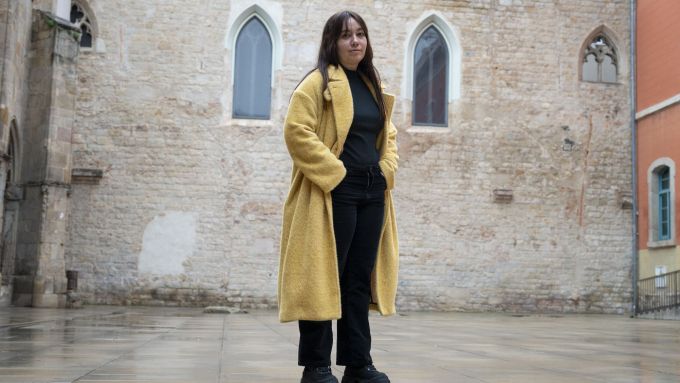
![Lorena Ruiz's artistic gaze is very focused on everyday objects. Photo: Joanna Chichelnitzky[/caption]](/uploads/s1/44/27/5/260205-lorenaruiz-29_38_680x383.jpeg "Lorena Ruiz's artistic gaze is very focused on everyday objects. Photo: Joanna Chichelnitzky[/caption]")
Besides the artistic spaces that do residencies, in Barcelona, civic centers also play a role. You have done projects at the one in Guinardó and at Can Basté, in Nou Barris. Are they valued enough?
No. Friends I have in Madrid, for example, see the civic centers of Barcelona as something flipping. They tell me that we have a public cultural fabric that has residencies, exhibitions, grants, workspaces... In fact, this is a whole issue: finding a space that you don't have to rent. It is very valuable and it doesn't exist everywhere.
You have also stepped into schools within the framework of projects like the Espais C program, from the Suñol Foundation, which seeks to normalize artistic creation in classrooms. You did it in Ciutat Meridiana, in Nou Barris, one of the points of the city that suffers most social problems. What do you find there? How do you live it?
I was not used to being in this neighborhood, because it is very far. It is not an area where you go for a walk. I had never worked with children, and I have been lucky that there is a lot of motivation both at school and among the children. I took on the project thinking that, if I as a child had had an artist at school, it would have been very good. And there is something that takes me to Sant Boi; that reminds me of this neighborhood cohesion where you get on the bus and everyone knows each other and greets each other. It's like a mini city inside the city. There is a beautiful community and the children are seen happy and they like the project. I see that they are grateful that I am there.


