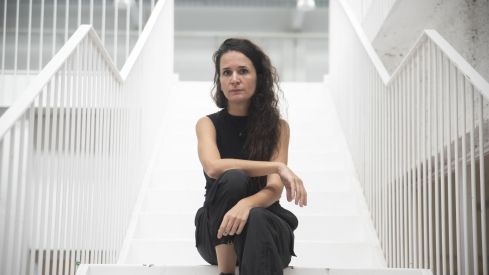
Mónica Rikić (Barcelona, 1986) is an electronic artist and creative programmer, but non-digital objects are fundamental to her work in creating interactive creations, robotic installations, and handcrafted electronic devices. Her main goal is to develop alternative technologies, and she seems to be succeeding. In 2021, she received the National Culture Award for excellence and innovation in her techno-artistic projects.
I wanted to start by asking you what an electronic artist is, as that partially defines you.
For me, it's an artist who uses electronic devices to do their work. I could easily say digital artist, but when you say that, people think you work with a screen. Making this distinction helps me emphasize the idea that I work with technology, but outside of the screen.
And the question has a second part. What does it mean to be a creative programmer? Does it define you too?
It's a widely known term for people who work with code, but in a creative way. Working with computer software for creative and not necessarily productive applications. When you start programming, you realize it's a very creative task, just as I believe scientists and mathematicians also have to be very creative. If we talk about artistic practices with a non-productive intention, the idea of creativity emerges.
But you come from the world of Fine Arts. Is that why you are essentially an artist?
All my training, whether technological or not, is artistic, except for a master's degree in philosophy. I learned programming with a master's degree in digital arts. Art is also a way to learn technology. I suppose the definition would be that I am an artist because I get paid for my work as an artist [smiles].
Your artistic creations are digital, made with technology, but combined with non-digital objects. Is this because you don't believe in 100% digital art?
I don't believe in entirely digital art, but first it was a matter of mastering the technique. I didn't know how to make sculptures and I used to work with objects, and I started with objects that already existed. And when I took my first steps with digital manufacturing machines, I began creating new ones from materials. I like the idea of the symbolic charge that everyday objects and materials have, in order to create these bridges between technology and the non-technological world for an audience not necessarily specialized in technology.
What is the reason for not believing in 100% digital art?
I've had constructive discussions about whether what is digital only works on screen or also outside of it. We are surrounded by digital things that are not on a screen, like robots. We don't exist only in the physical world or only in the digital one.
Precisely, you say you're interested in electronics because it has a manual component. Are you looking for the counterbalance that something manual can offer to the technological and digital part of your work?
I think with my hands. That's something sculptors experience a lot. Some people define my practice as sculpture, and I'm very comfortable with that. I really like to say that I do creative robotics and also artisanal electronics because I'm interested in emphasizing the idea of creating new objects. We believe that technology can only happen in the industrial sphere because that's how the capitalist system works, but artisanal or handmade technology exists and is a political and conceptual choice in my practice.
It's a more humanistic view of technology.
I actually have quite a few problems with the word humanistic, because if we make a distinction between humanism and technology, we remove technology from what is human, and I believe that technology cannot exist without humans, because it is their creation. Because, if it's not humanistic, what is it? This way, we also lower it to the level of saying that not only engineers can do it, but witches can too, if, for example, we talk about cyberfeminism.
You explain that the main interest of your art is to create technological artifacts that fuse technology and philosophy with a critical perspective that leads us to collective thought and discussion. Therefore, your work is political. Yes. In the end, all art is a positioning of the artist towards certain things. Especially political in the sense of breaking down universalized narratives we have around technology and returning to the idea of being producers of our environment.
Besides being an artist, you are a professor, a researcher… Do you think you live life in the fast lane?
I think I have undiagnosed hyperactivity [laughs]. Now that everyone is talking about ADHD and everyone is self-diagnosing… I’ve always been very restless. I live life in the fast lane because it motivates me and makes me happy, even though it’s sometimes hard to make people understand, but if I don’t have a thousand things going on at once, I can’t concentrate.
I was asking you that because on occasion you've said that with your works, which have a very important technological component, you try to reduce the speed at which the world is going. The paradox of this is that technology is the main reason why we are accelerating…
Yes, one thing is that I live life at a fast pace because I like to do many things. But I believe that the general speed at which everything is going reduces critical thinking, especially regarding things we don't know. If we go fast, we tend more towards reaction than reflection. The proposal to relate to technology in a slower, non-productive way is to say that, within this speed, we can do non-productive things. Social networks, for example, started with the aim of connecting people and entertainment, and they have ended up being machines for self-exploitation and production
You've been focusing a lot on artificial intelligence for some time now. You've said you're interested in it "because it's like replicating human thought, something that seems completely impossible to me. That opinion would surely generate a lot of debate depending on where you say it, right?
It's impossible because, which human? Human thought as a general idea is impossible, starting with the fact that ways of thinking vary depending on cultures and there are a lot of neurodiversities. What is being reproduced is a way of thinking that has been defined with easily reproducible parameters about how the algorithmic machine works, which above all respond to a white Western perspective based on the values of labor chains. And the human mind isn't just about what happens in the brain. Women, for example, when we have premenstrual syndrome, our way of thinking varies significantly from when we don't. How do you simulate that?
In the case of art, can we say that artistic creations will always come from humans?
I use a lot of non-human tools, and non-human things have been used to make art, like animals. But behind it, there's always a human mind… You're talking about generative artificial intelligence now, which is a part of artificial intelligence. The kind that generates images.
When we experience a strong emotion, we notice it in our bodies, and I don't know how a machine could experience that
Is art with zero human intervention possible with artificial intelligence?
With technology, there is no zero human intervention. Artistic creation is a human need to interpret the world in a specific way. For a machine to freely choose to create art… Simon Colton, a British expert in the field, says that to ask ourselves if a machine can be creative on its own, we must question the conditions of that machine's existence. And, once it exists, then it could decide what artistic things it would want to do. In the end, art has a cultural attribution by consensus, like robots or religious crosses.
Can we therefore say that, at its core, AI is an instrument, like others, in the artistic creation process? Like a paintbrush, but with many more possibilities.
Yes, I believe so. Just as it is also used in science.
You studied contemporary philosophy because you say you are interested in what cannot be computed about the human mind. Is what cannot be computed precisely what makes us superior to machines?
It's not a matter of superiority or inferiority, but rather we should talk more about capabilities. Things like art are not computable, but neither are emotions. When you have an aesthetic experience or feel a strong emotion, we notice it in our bodies, and I don't know how a machine could experience that. We are different.
It only happens in movies.
[Laughs]. Yes, in movies there's also Narnia.
If technology overwhelms us with infinite scrolling and we are absorbed by it in our free time, then it is a problem
Regarding the social impact of technology, which is one of the issues that concerns you, you've said that we need to start by looking at the technologies that have already affected us. I wanted to use Google Maps as an example. Is it making us less intelligent?
It depends on how people use it... It also empowers us, expands our capabilities, and makes things easier, because for example, maybe you're not afraid to go to places and you go further. Everything has its pros and cons. Technology expands us greatly in a positive way, but its convenience makes us lazier. But the most interesting thing is the facilities it provides us, and the time we free up can be used to discover things. If technology, on the other hand, overwhelms us with infinite scrolling and we are absorbed by it in our free time, then it's a problem.
Months ago, 30 university professors surveyed in the United States said that fewer and fewer students are capable of reading a book.
But this is the fault of attention. But does technology cause this attention deficit? That's another story, it's a topic to be discussed separately. The design of the interfaces of some tools we use, especially those on mobile phones, should be regulated. We need to set limits and talk about who holds all this power. The problem with social networks is their design to capture attention for sales and consumption purposes. The fact that people lack attention is also a political stance by large companies. The more distracted they make you, the more they can capture you because you don't think, you can't read a book... This will be like smoking, which used to be allowed everywhere, and then it was seen that it had to be regulated. Above all, large companies need to be regulated. Now, for example, no one questions that Spotify costs 12 euros, when at the beginning it was five. They hook you like that and pay musicians very little. And they make you believe they are essential, and then they have all the control
Speaking of which, and to conclude, we must refer to the algorithm. Does it take away our freedom?
Yes, I suppose so… It’s a tool for social control. And nobody knows how to regulate it or control it, nor is there any interest in knowing how it works. Much more transparency is needed.


