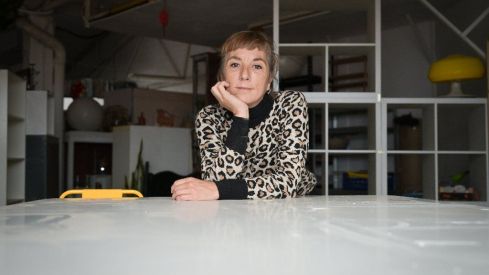
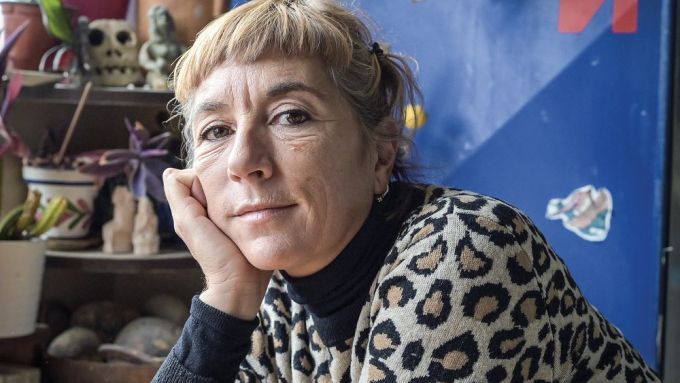
Upon entering the artistic temple that Nevenka Pavic has in the Freixas building in the Santa Eulàlia neighborhood of L'Hospitalet, La Gloria Factoría de Arte, it becomes evident that art is her life and that she does not separate her personal life from her work. The top floor of this old industrial building offers magnificent views mixed with an almost sepulchral silence that is only interrupted each time a train passes on a track, located right next to it, which divides the city into two realities. This Chilean multidisciplinary artist, on the other hand, manages to unite people and neighborhoods with the art of mosaic.
We are at Gloria Factoría de Arte, in the Santa Eulàlia neighborhood of L'Hospitalet. What exactly is this space?
This is a non-profit association of which I am the president, and from here we manage different community projects, mainly through ceramics and mosaics.
You explained in a video that it was born out of the need for different artists who needed a space to be able to work together.
Yes. In the beginning, the association was created as a place where different artists came together to have the infrastructure we needed, especially because a craft like ceramics requires a lot of machinery. And it was also open to other disciplines. But now I'm taking the step to link the space with the association and with the community projects we do.
In fact, we could say that coworking was almost invented here, as you started in 2001 and at that time this word practically didn't exist…
Yes, and it was something I was already doing in Chile. I was already sharing spaces. And when I came here, I thought about replicating the same idea.
When you entered here, you've explained it many times, there was nothing. Now, precisely, there are many things. It looks like a sanctuary…
It's a kind of museum or a sanctuary where we create. And it has a whole history of people who have passed through. It tells a life and art trajectory.
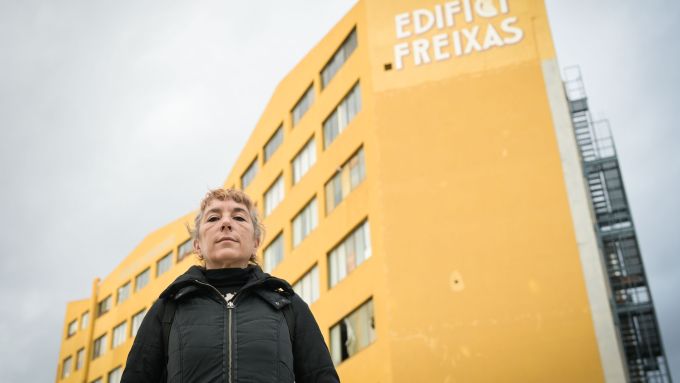
You explained that in 2000, when you arrived here, you were just passing through, and you stayed because you found this place. What did you see as special about it?
I was looking for a space to share in Chile, but I couldn't find one because everything was very expensive. And then I came on a trip and found it here. I took the plunge, even though it meant starting from scratch.
And what did it convey to you at first?
What I liked most were these views and the light it has, because it was the first thing I missed when I came to Barcelona. I was used to large, bright spaces, and suddenly everything was damp, dark, Gothic… And that it was very close to everything, beyond it being in another city.
Initially, your idea must have been to settle in Barcelona and not in L'Hospitalet.
I came to visit someone who had a workshop here, and that's how I ended up discovering the Freixas building. And since I came from a very big city, Santiago de Chile, I thought: "This is next to Barcelona, it's 20 minutes away by bike." And public transport links are good.
Sometimes we put up mental barriers about distances here…
Exactly. At first, I found that very amusing. The neighbourhood you've always known, the friend you've always had… A very closed circle. But when you move, you see other things, you can have new opportunities…
At first, when I arrived here, I found the whole "lifelong neighborhood friend, lifelong friend" thing quite amusing... A very closed circle
Let's move on to your work. You have a long career as a multidisciplinary artist and have described your work as an ethnographic journey. What leads you to create art based on the customs and traditions of peoples?
When I studied for my degree in Art in Chile, they always showed us things from abroad. But at one point in my career, I rebelled against all that and decided to do the opposite: look towards local cultures, our roots… I started with the material I worked with, ceramics, and earth. And as I traveled, I picked up influences from different places. You realize that in different local cultures there are things that resemble each other, and that's how you end up speaking a universal language.
A local perspective to project universal themes.
Exactly. In the nineties, when I was studying, they always made us look outwards, but they were very classic things that were sometimes already obsolete in Europe. But in the 'third world' they were sold as if they were the absolute avant-garde. And they weren't.
You've done painting, sculpture, and artifacts, you're also a ceramicist, and for many years now you've been very focused on mosaic. You're a versatile artist in continuous evolution.
I'm very restless and I like to learn new things. Within art, I've always had the need for challenges. And all this while hoping people can recognize my work, that it continues to be Nevenka Pavic, but that the evolution is visible.
Your career is marked by a back and forth of travel, but at the same time you've been here for many years, putting down roots. You combine a nomadic part with one that isn't.
In the end, we all look for those roots, that sense of having a place. And when you work with ceramics, which requires infrastructure, at some point you have to choose a place to settle. I've done that here and I feel very comfortable. And the kind of work I'm doing allows me to contribute something to the community as an artist and as a human being. I feel the need for my art to foster change for a better society, one that stops being a consumer object, that we stop thinking about selling works as the primary way to make a living from our art… And I think I'm achieving that.
Now that we're talking about roots, you've been in L'Hospitalet for 24 years, in this studio in Santa Eulàlia. What does this neighborhood and this city represent to you?
It's a reflection of my history and that of many other people who have left their roots to settle in another city and another country with different customs. I've learned to adapt, to integrate, and to be an actor who contributes to the community, and I do it through art. L'Hospitalet was a city that first received Spanish immigration and then international immigration. And Santa Eulàlia is a neighborhood where you can contribute things, because there's a need for it.
With mosaics, I am reclaiming a tradition that, after Gaudí, has not had a contemporary legacy
Speaking of this community-focused approach, you've said that when you create murals, you like people to help you. Artists don't do that very often…
I know of certain projects that were done this way and have inspired me to replicate them here, especially with the mosaic technique, which has a great tradition in Catalan culture. And this allows us to reclaim a tradition that, after Gaudí, hasn't had a more contemporary legacy. I believe we have this mission with Gaudí's work. And, on the other hand, mosaic itself is already a style, with all the little pieces coming together, which has an element of collaboration.
Surely trencadís is the best artistic medium for working in a place that stands out for its multiculturalism.
Exactly. I always say that mosaic is the metaphor for all these broken pieces that on their own say nothing, but when united can produce a wonderful result. Visually, but also from a human point of view because of the bonds that are generated.
Putting the artistic side aside for a moment, when we talk about neighborhoods with a lot of immigration, we separate natives from outsiders, but we don't talk much about the relationships between the new communities… Are you also interested in creating links between, for example, a Moroccan and a Colombian?
Yes. And here it's important to understand that each culture is different and has its customs. This is necessary, and through the mosaic, we can make different cultures relate to each other. And break down stigmas. The mosaic is a good way to create respect, curiosity for others, and bonds through art… And we've also worked with other groups. In the case of the work at Parc del Pont de Matacavalls, we worked with patients from the Benito Meni Mental Health Center, and it was very beautiful. The experience was wonderful. And in the end, you see that if you give people a tool to empower themselves, they can evolve and overcome problems that traditional methods don't achieve.
How do you gauge if all this work you do is successful?
Well, it has an incredible snowball effect. You see how, in a project, more and more people want to join and are delighted with the result, with the work team... And also how they learn, how they relax, and how they step out of their comfort zone and set themselves challenges. In the end, the best part is the affection and gratitude of the people who participate. And what they do stays in the street and people can see it.
The fact that the work is in the street and not in an enclosed space is important.
Yes, absolutely. Because the people who have been part of the work feel like active agents of change and see that what they do is useful.
Gentrification is on the agenda. L'Hospitalet has been subject to speculation for years
I asked you that because you say art is intrinsically linked to your life. You don't separate it. And that makes you question the meaning of the art you create. What is that meaning?
Well, now I find more meaning in it than ever, because when you study, they make you think that the path to success is selling, but there are many others. If you don't sell at the level you produce, you just keep accumulating decorative objects. And when I was about 40, I reevaluated and decided to dedicate myself more to public and community art to democratize it and make it accessible to people. And hopefully, these people can also be part of this transformation and the creative process. All of this makes more sense. I told myself: "I've already had the career I was supposed to have. I've won awards, done residencies, received grants... Now it's time for something else."
Returning to L'Hospitalet, in recent years this city has grown culturally, attracting artists from Barcelona, there's the Cultural District... How do you see this growth? You are an example of an artist involved in the city, but I don't know if this new wave of artists has a local perspective...
Gentrification is happening everywhere and there are few spaces left. L'Hospitalet has been subject to speculation for years. Everything has its good and bad sides. I try not to let it affect me as an artist and to be consistent, which is why I'm concerned with doing the work I do and not with having an exhibition at Tecla Sala.
Following L'Hospitalet, one of your works is La Santa Estació (2018), an artistic project in mosaic format across 15 columns supported by the City Council. In this case, it's evident that the work managed to improve a rather ugly and problematic urban space.
The point is that there's now a trend for community projects, for transformation... For me, it was important that the project transformed in a way that wasn't something nobody understood, but rather I was inspired by universal references like love or death, as well as Gaudí, Santa Eulàlia... It was a big challenge and the first step to demonstrating that through mosaic we can transform spaces with joint work, although in this case we're not talking about community work like others I've done. It was a specific commission from the City Council in which I did everything and then a team helped me. Many volunteers supported me. Many people came.
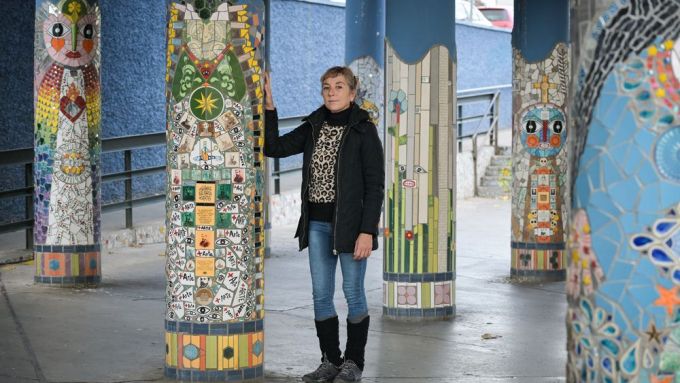
In this work, you used Gaudí's trencadís technique, which we briefly discussed earlier. How did you learn it? When did Gaudí appear in your life?
I am self-taught in mosaic. Throughout my artistic life, I had been doing things related to it, but very little. In 2014, I went to a mosaic festival in Chile and met artists who were doing community projects, and that's when I realized that no one in Barcelona was doing mosaic. I started doing it, and the first thing I did was for La Escocesa in Barcelona in the same year, 2014, when they were having a mural festival. Following that reflection, I began to focus more on Gaudí's work, because I liked it, I had visited Park Güell... But not much more. I started looking at it with different eyes, and the ceramic craft I do also works very well with trencadís. And I began to be inspired by him and Jujol to champion their figures, who have always remained somewhat anonymous.
It's truly surprising that Gaudí's legacy isn't being followed with much more vigor.
Yes… There are a couple of workshops, but they are focused on the hobby, on tourists, on activities… It's very surprising, because all over the world there are incredible projects involving mosaics. In Chile, for example, a lot of public works are being done with mosaics. There was an outstanding debt to say: "Many people come to see Gaudí's work, so how can it be that no one is continuing his legacy?".
In fact, your way of working at La Santa Estació was very Gaudí-esque. You used discarded materials. Gaudí used rejected pieces from the Pujol i Bausis factory in Esplugues…
When I did this project, as I always do a lot of research, I had watched several documentaries about Gaudí so that the whole work would have coherence. What interests me a lot about Gaudí is that he was a visionary and that he already reused elements, leftovers from other factories… And I have always been like that in my work and in my life. And that’s why it seemed coherent to me to do it this way. Also because there was a small budget.
I've always leaned more towards the periphery than to being where everyone is
You managed to involve Ceràmica Sot, the workshop that makes the official Gaudí souvenirs…
Yes, a family workshop in Gràcia. Someone who knew them managed to get me the offcuts from the pieces that didn't turn out right. For me, they were an incredible treasure.
Following up on the trencadís and L'Hospitalet, in 2020 you led the creation of a small collective mosaic on a public planter in front of La Palmera bar, a meeting point in the Santa Eulàlia neighborhood. Was the choice of location to highlight a space that is a social epicenter?
I had been seeing that awful planter for 20 years and had some students who wanted to learn the mural technique. And it occurred to me to ask the City Council if we could do the mural there. We are always there at that bar.
Following the neighborhoods, in Les Planes, next to La Florida, from La Gloria Factoría de Arte you directed a work created by the local women's collective Mujeres Brillantes. What most catches your attention about the reactions of people who can get involved in such a project?
It was a very beautiful experience, because for them it was a challenge to do something that might seem complicated for older people. But we found a way so that everyone, beyond problems with vision or arthritis, for example, could make pieces for the mural. And I set the guidelines.
You also did the mural La Torrassa Florida, at the La Torrassa metro station. Was the message here to reclaim a public space that people often don't fully make their own?
This was a passageway where no one stopped. It was very ugly. Now, with this transformation, people stop, look at it, touch it, linger for a while… And it allows everyone passing by to also participate by adding a small piece.
Here rents start at between 1,000 and 1,500 euros. And you say, 'but I'm in L'Hospitalet!'
Speaking of places, the cultural world often refers to the periphery, a word that can lead to many interpretations. In an interview, you explained how the official side of art was tiring you and also said: "I am on the periphery." What does that mean to you?
I've always leaned more towards the periphery than being where everyone else is. Especially in my early years here, I felt very much on the periphery because I worked in Barcelona but lived in L'Hospitalet. When I talked about this periphery, it seemed like I was from another planet, because nobody wanted to come here. In Paris, you see the periphery, which is much larger, and people move around. I had a contradiction because I liked to say I lived on the periphery with all its benefits, because it's a pleasant periphery. In 20 minutes you can go to the center, buy materials…
One of the goals of the periphery, from a social progress perspective, should be to stop being the periphery?
Well… There’s an inevitable evolution that will make the periphery stop being so at some point. We’re already seeing it here. It stops being so when rents start costing between 1,000 and 1,500 euros, like in the center of Barcelona. And you say, “But I’m in L’Hospitalet!”. Right next door, they’re now selling luxury apartments in front of an industrial building… Things that don’t make sense. But I’ve always considered myself to be from the periphery on all levels.


