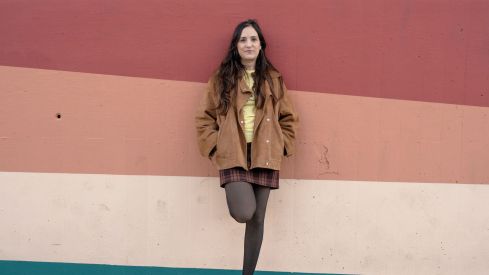
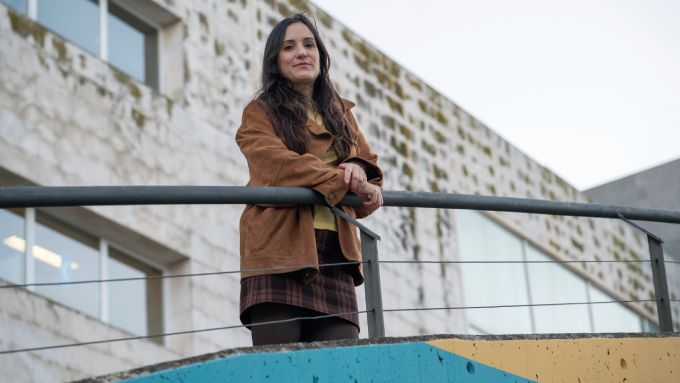
Noelia Ramírez (Esplugues, 1982) works as a writer in the Culture section of El País. She also co-directs the podcast Amiga date cuenta, with Begoña Gómez. With her and other writers, she published Neorrancios in 2022, a book about the dangers of false nostalgia. Ramírez now releases Nadie me esperaba aquí. Apuntes sobre el desclasamiento, a reconciliation with her origins in the Esplugues neighborhood of Can Vidalet. We meet in the library where she prepared for the sele, at La Bòbila, on the blurry border with L'Hospitalet. And it is that Ramírez feels comfortable in these no-man's-lands: "There is nothing written, you can transform them".
Nadie me esperaba aquí condenses many debates, but the theme that stands out above all is the concept of shame, and how it has helped you make the transition towards the esteem of your origins. However, there are many people who live camouflaged their whole lives, denying what they are and where they come from. It must be tiring, that...
You are in a perpetual state of alert that yes, it is very tiring. The fact that you want to appear to be something you are not keeps you thinking all the time that you will be caught. When I made the change I felt lighter. It is an exercise in honesty with yourself.
Today there is a resurgence of origins linked to identity. In the case at hand, in fact, there is a certain 'cultural appropriation' by people who boast of a past, let's say of the neighborhood, that they did not live. Do you think this can distort the claim of the periphery?
Now there are many writers and people of culture, tourists of precariousness, who pretend not to have a bourgeois origin, or who pretend to be poor when they are not. Yes, there is a danger of to what extent the market wants you only when you are authentic, when it seems that you can only be the writer who only writes about the neighborhood, even though you can write about many other things.
The pigeonholing for your origins is another of the phenomena you analyze in the book.
I know people from the neighborhood who work in the cultural world and who don't get ahead because of their class. They don't like it, and that must be respected. But the periphery is in fashion. And for the media, you have to be either the girl from the outskirts with nerve, very exuberant, or assimilated to the system. It seems they can only accept you being one way or another. There are no intermediate spaces.
You, on the other hand, feel comfortable in a border zone, in the limbo you speak of in the book...
These non-places that are so liked on the Internet, and I am a child of the Internet, have always fascinated me because they are zones where nothing is written: you can transform them.
But, often, when you are neither in one trench nor in another, you end up getting it from all sides...
Well, I am not in favor of being a lukewarm person. There are situations, as is happening right now politically and socially, in which we cannot afford to be lukewarm. The problem is when they ask you to be in a very defined way. It has reached a point where you have to have a very marked purity. This happens a lot in feminism and in politicized and left-wing people. They ask us to be coherent all the time. We can also be incoherent, but politically you have to be clear about where you want to go.
If we talk about the past, we have to do it about the word xarnego, an insult that has become a label of pride. In the book you argue that you don't quite understand this concept until "someone from outside" your environment tells it to you.
It is a word that is a bit scary to pronounce if you work in the world of journalism or culture. If you claim it, why you claim it. If you don't claim it, why you don't claim it. Look what happened to Eduard Sola at the Gaudí Awards...
In the book you make your own Brigitte Vasallo's quote that says the time has come for "xarnega life" in which you understand that you will never speak Catalan like "them", or that you will never fit into their "us", understood as an essentialist reality. How did you experience this moment?
When they called me xarnega for the first time, the reaction was to think: "But I'm from here! You mean my parents are...".
“Work has become our identity and it seems that this pays for everything”
To defend yourself, in the book you allege that you even won the School Floral Games in a language, Catalan, which was not the one spoken at your home.
Of course! Why are they telling me this?, I thought. That word [xarnego] is not yet completely overcome, because there are many people who think that we say xarnego when we mean poverty. And no, there is a Spanish identity factor that still influences it, and if we have not overcome this wound, which is not healed, I don't know what will happen with the new insults that exist with current immigration, such as the *mena*... Then you see that your 'xarnego' parents and relatives fall into the same thing they suffered. Everything works thanks to the mechanisms of the far-right, which now seduces people who at one time suffered racism.
However, fleeing this essentialism can lead you to another similar one that fuels a false nostalgia for a past that was very hard and not at all idyllic.
Of course. One of the things I don't like about Ana Iris Simón and her *Feria* is this embellishment and nostalgia for the past. It's her story and she tells it as she has to tell it, but it doesn't seem to me that life was better before. The lives of our parents are also marked. In the village, if people had a dissident sexual identity, they had to leave. They were hells, and the neighborhood can also be a hell for a person who is not part of this epic-pride of the neighborhood class.
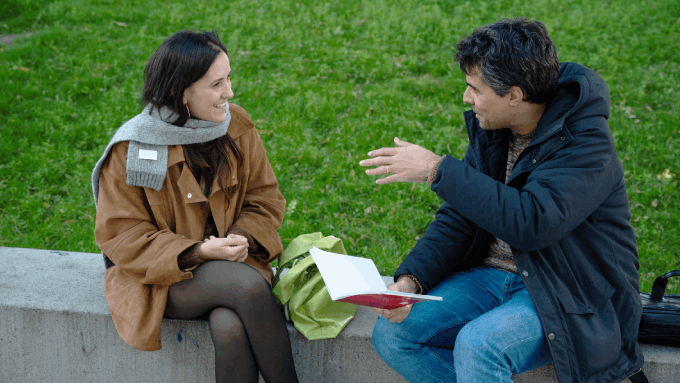
The Sant Boi writer Kiko Amat told us in an interview that he fled from these self-congratulatory stories of the periphery that ignore the existence of the corresponding "sons of bitches"...
It cannot be denied that in our origins there is also sexism, racism, transphobia and sons of bitches that surround us... Right now it happens more than ever. When I say that the class journey is round trip, I don't mean that what was there was better. I say that I have fled from here, that I have hidden all this because everything I found dazzled me and I wanted to be like what I saw, but that later I have realized that from where I came from there is my good essence and that I can get things from it. It is a path of transformation, not that my origin is better.
On the other hand, there is a certain exoticization of the periphery...
Now there are stories about girls and boys from the periphery who are writing that say "look how smart the girls from the green blocks turned out to be", and they expect us to be complacent with all this, but now it is being problematized. That I am here does not mean that everything is wonderful.
Those desires to progress are personified in the encyclopedia that your parents bought you, a very clear memory that you capture in a passage of your book.
The encyclopedia on the dining room shelf was a promise of the future. Every house had one. It was a social marker. The encyclopedia was the offering your parents made you so you wouldn't be like them. They wanted the best for you: to work sitting down and to go to work in your own clothes. That was success for them, but now the social elevator is broken. There is a lack of class consciousness, thinking that vocation should have given us everything. Work has become our identity and it seems that this pays for everything.
To finish, Jordi Amat recently told us in an interview that metropolitan identity does not exist. What do you think?
We are very good friends, but he is very annoying, Jordi! [laughs]. He is a person from the Eixample. Jordi, when the whole Casa Orsola issue happened, wrote a column saying that Barcelona's identity was the Eixample, and I said, no, Barcelona's identity is in the Raval. It is the neighborhood where everything converged, where there was everything that was bubbling in the city and its essence was there. The first neighborhood to suffer gentrification was the Raval. Look, I have a friend from Asturias who was amazed because we went to see Maria Jaume at the Cornellà festival and people from Barcelona didn't go, when her concert at Apolo was full. It's only 10 minutes by train! They find it hard to come.
What is your relationship with Can Vidalet now?
Me, who now lives in Gràcia, sometimes it's also hard for me to come to Can Vidalet, because you get used to things. My family from the neighborhood tells me I'm hard to see. The neighborhood is about visiting family and friends, and those things. I do really like, yes, the Prat festivals. All the DJs you were paying to see at Apolo in Barcelona were playing for free in Prat. There's also La Capsa and its programming, which is wonderful. And, then, the chat I'm having now with Montse Santolino [on January 23rd at La Bòbila, as part of the Narratives Perifèriques cycle, where she presented her book], who is the best, who is really here and does everything from here. I'm basically an expat, I'm expatriated! [laughs].
How do you see the neighborhood?
I see that there is a lot of racism. I talk with relatives and I hear comments that I don't like at all and they annoy me. I am the party pooper of the family. How can you say that? What amnesia you all have, I tell them. But I see the neighborhood the same, very alive, much more than Gràcia. On Sundays, if my aunt makes me migas and I come to the neighborhood to her house, there is always a commotion in the street. You go to Gràcia on a Sunday afternoon and, if you are not in a square, there is no one. And that is scary. It's like Sarrià: if on a Sunday afternoon there is no crowd, there are no shouts, that silence... This people is hiding something [laughs].


