
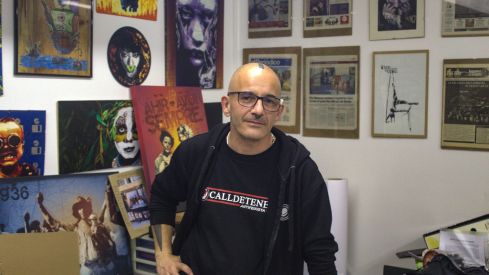
If you have passed through Rambla Guipúscoa, by the market or by the commercial axis of the neighborhood, you have probably seen his work without knowing it. Roc Blackblock is a muralist, a resident of Clot since 2002, and has been making walls speak for 27 years. This year, his reflections and his murals jump from the street to paper: Pol·len Editorial will publish his first book this autumn.
Many neighbors know you for your work, but perhaps they don't know who is behind it. Who is Roc?
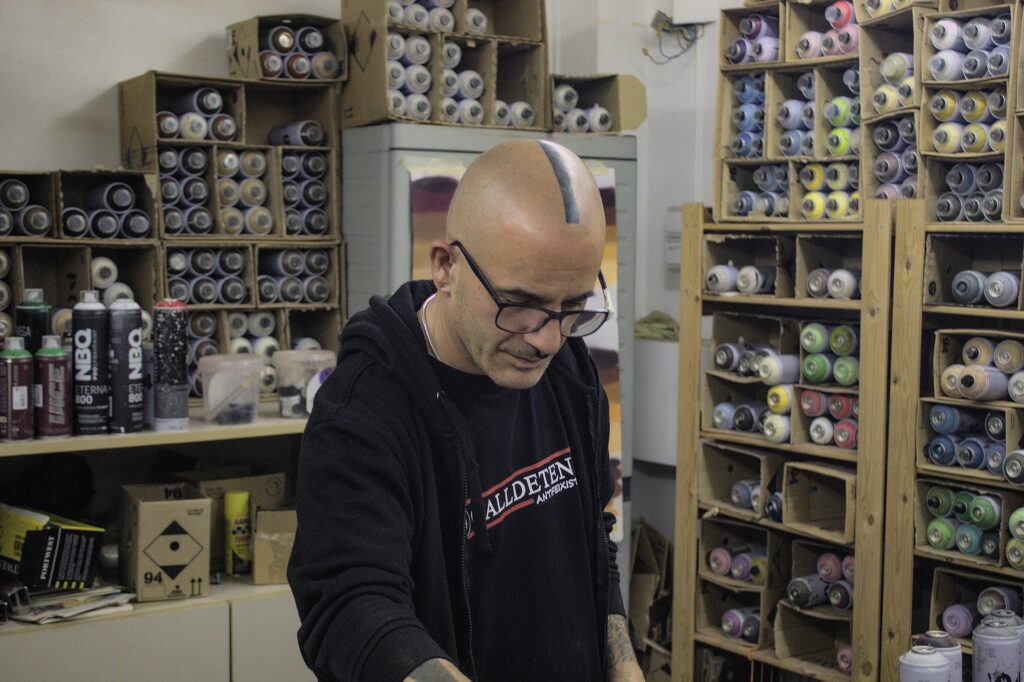
R.B: Roc Blackblock is the public persona, my professional facet; what my mother and my daughters call me is another story. The label with which I feel most comfortable to define what I do is "muralist": I paint murals, not graffiti, not because I think they are bad, but because it is another discipline. It all started in 1999, when I lived at the Centre Social Okupat l'Hamsa, in Sants. I was studying illustration and I met a graffiti writer in class whom I invited to paint in that space. From that moment on, I got hooked on sprays. As an active member of the occupation movement, graffiti became a tool for political and social participation. For almost ten years I have been trying to maintain a balance between the militant and professional facets.
-You grew up in Eixample, but you end up in Clot. How is that understood?
R.B: I lived in the heart of Eixample, in the area of Pau Claris with Aragó. I didn't have a neighborhood experience: there was no square to meet friends nor a local school that allowed me to get to know the neighbors. That's why I went to live in the center of Sants. In 2002, with the birth of my daughter, living in an occupied space and raising a child became incompatible, and we came to Clot. Paradoxically, I am not from Clot nor is my partner, but my daughters are, and their paternal and maternal grandparents too. The big trigger for us to settle down was when my daughters entered Dovella school. This becomes a neighborhood coexistence space: you meet diverse families, we join the AMPA... Since then, with each passing year, the roots deepen.
-The wall on Rambla Guipúscoa is the one you have closest to home. Does it have any special significance?
R.B: Yes, and it's a coincidence that has always amused me. When I was a teenager, that wall had a mural of solidarity with the Sahrawi people; it wasn't mine, but I took it with me engraved. The turns of life have made me end up living 100 meters from that wall, and that it is the place where I go down to paint when indignation overcomes me. The mural of Netanyahu as a war criminal, for example, I painted with one of those impulses.
-And it was precisely that mural that caused one of the most talked-about episodes: a man took a plane from Israel to come to Clot to cover it.
R.B: The mural was intact for almost six months. Around Christmas, my phone starts ringing: they've attacked it. When I arrive, that same day it was already covered. On social media, we detect that there is an Israeli artist who has published a video explaining that he came three days to Barcelona expressly to combat the pro-Palestinian narrative in the streets. He had stood in front of my mural, had covered it with a portrait of Netanyahu crowned as king, and had recorded everything. That same day, the mural was covered again, and the next day he returns to Clot and makes another quick one. That one didn't last either: the neighbors covered it instantly. And he, in his videos, victimizes himself and goes so far as to say that Clot is an Islamized neighborhood. The most interesting thing of all is what that episode reveals about the neighborhood. When I was painting the new mural, some neighbors stopped me to explain that they had seen the Israeli paint and that they had approached him to tell him that what was happening in Palestine was a genocide. For almost four months, the mural remains intact. This is no longer about my mural: it's how we position ourselves as a neighborhood.
-Lately you've been seen in the neighborhood's shops, painting shutters.
R.B: It's a project by the Eix Comercial that has been done in many neighborhoods of Barcelona, in which an artist was assigned per zone. I asked to stay in Clot, and so it has been. The great difficulty has been adapting to the merchants' schedules, but it has been worth it. Talking with my mother about the project, I told her I was painting the pastry shop La Palma, and she explained to me that my great-grandmother had started buying there, and that since then, generation after generation, the Christmas nougats always came from there. Painting a place like that and discovering that it is part of your own history... is one of the moments that make this job special.
-The Pla Endreça tries to separate "the good ones" (muralists with permission) from "the bad ones" (graffiti artists without). You have always moved in both worlds.
R.B: I move with one foot on each side. A large part of the projects I do are commissioned by the Barcelona City Council itself, by municipalities throughout the territory, by memorialist entities. But there are projects that I paint in public spaces without permission, and I feel legitimized to do so. The dichotomy posed by the Pla Endreça is very false: there are murals made without permission that, if people didn't know, no one could distinguish from those that have it. I see it as a sanitizing policy, of turning the street into a totally aseptic and controlled space.
-Do you think there is a persecution of protest murals?
R.B: If I apply the rule of "think badly and you'll be right", it seems like a great coincidence that painting a mural criticizing tourism 200 meters from Parc Güell costs you 10 urban guards and a criminal complaint instead of a fine. And the mural of the Emeritus King in defense of Pablo Hasél, in the Parc de les Tres Xemeneies, disappeared covered by the cleaning brigade after 12 hours. Censorship in its purest state.
-You have a memory mural project, the Murs de Bitàcola, which goes far beyond the protest mural.
R.B: The pandemic stopped all my projects, and it was during that forced pause that I identified a common thread in my work: the work on memory. I built a project that gathered everything: finding a historical episode of the area where I will paint, illustrating it at the place where it happened, and adding a QR code so that whoever stops there can delve deeper with information, photographs, and documents. The buckets demonstration, the La Canadenca strike... A way to make the public space explain its own past.
-When you explain the memory of a neighborhood that is not yours, is there a risk of doing it as a "tourist"?
R.B: I wouldn't say there's a risk, it's an inevitable fact. I am aware that I am always an outsider, which is why I impose a rule on myself: to prioritize the community's criteria. Sometimes an image is artistically more powerful but the other has a much superior emotional and historical charge. When in doubt, I go with what the neighbors want.
-Is dedicating oneself fully to muralism a luxury?
R.B: It's a luxury and a battle at the same time. I feel privileged to work at what I like, but when at 6:30 in the morning you load the van to go paint 10 hours straight, you don't feel any privilege, you feel you are exercising the right we should all have, which is to have a profession that fulfills you. What is really difficult is doing it without putting your art at the service of the market. My challenge is to have found projects that do not generate any ideological conflict for me: I can continue doing things for Palestine, for memory, for everything I believe in, and I can live from that.
-Do you have any projects underway?
R.B: I am finalizing the editing of a book that, if all goes well, will be released with Pol·len Editorial towards autumn. It is an eminently graphic and photographic volume that compiles 27 years of murals, experiences, and reflections, structured into four thematic chapters: the city, social movements, memory, and public space. I didn't want to make an autobiographical book; it is rather a reflection on everything I have learned by painting. While I was painting, I was adding pages.
****
Twenty-seven years of walls, of fines, of sprays and of neighborhood. From occupied social centers to municipal commissions, from maquis to militiamen, from lizards on Entença street to Netanyahu on Rambla Guipúscoa. All of this has been settling, mural after mural, until becoming a book. In autumn, Pol·len Editorial will publish it. It will be the first time that Roc's work will fit between two covers, but surely it will not be the last time we see it on the walls


