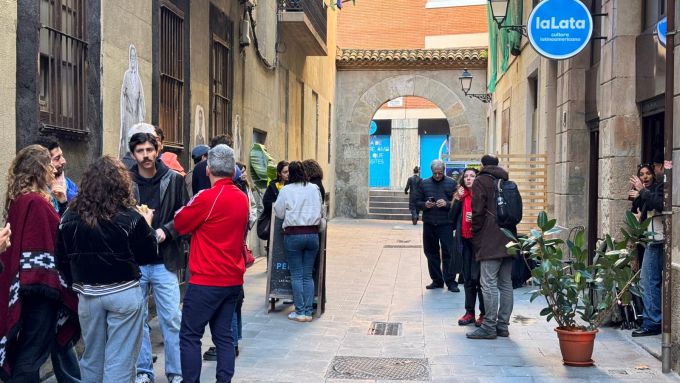
Gustavo Caletti has lived in the Poblenou neighborhood for five years. He left Argentina to dedicate himself to culture and today he does so with his participation in La Escocesa as a resident artist and, for two years, as director of the bookstore La Lata, formerly known as Lata Peinada, which is located at number 10 Carrer de la Verge, next to Plaça d’Universitat, at the entrance to the Raval.
“The location of the premises has a labyrinthine quality like those of Borges,” says Caletti. For Jorge Luis Borges, the labyrinth was a metaphor representing the infinite and chaos of the universe. Far from this entanglement, the bookstore directed by Caletti seems to have found its place in the city’s cultural fabric. The key, he points out, are the various independent Latin American publishers that have joined forces to create a catalog of books that, were it not for them, would be difficult to find in the city. An important piece has been the incorporation, a year and a half ago, of the entity Transit Projectes, which handles the curatorship of the project. The Latin American team is made up of about twenty booksellers and editors, and the Barcelona team consists of three workers, in addition to Caletti.
Books that cross the Atlantic
It all started seven years ago when “a strong Latin community in Barcelona” realized that there was no bookstore specializing in authors from the other side of the ocean. Once the store opened in Barcelona, they began, as Caletti points out, to make books cross the Atlantic: “It takes months until we have the book. It’s artisanal work: we search with the publishers there, build the catalog, travel, and bring them.”
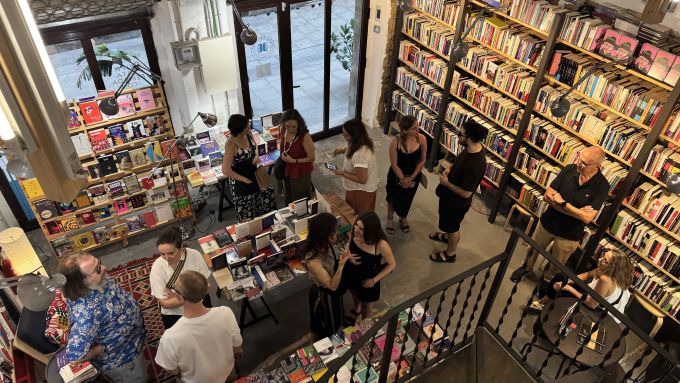
In La Lata’s catalog, there is space for all kinds of genres: narrative, poetry, essay, philosophy, children’s literature, biographies, comics, among others. They are not closed to any, as for them it is essential to promote the space as a “center for critical thinking and a critical meeting point for Latin Americans and interested Barcelonians.”
One of the most special corners of the store is that of the “jewels,” as they refer to them, which are all first editions of Latin American classics that they find at fairs and bring to Barcelona. “It’s not the conventional job of ordering books from a supplier, it’s a job done with love and commitment,” reflects the director.
The state of health of neighborhood bookstores
Often, within the bookselling sector, it is said that the future of local bookstores in Barcelona hangs by a thread due to market concentration, rising costs, and changing reading habits, among other reasons. What is La Lata's assessment of this? "In Barcelona there is a double discourse: there is a desire to stimulate neighborhood commerce because it has to do with identity, but there are not enough financing systems," criticizes Caletti, who champions local commerce: "How can Barcelona be the European Capital of Local Commerce if many neighborhood businesses are closing?"
The director defends not only the human factor of local bookstores, but also the catalog of titles that goes beyond bestsellers. "In a specialized bookstore you will find many more genre books than at El Corte Inglés. When a bookstore leaves, titles that will not return are gone," he laments. Furthermore, he believes that there is no shortage of readers. There are, above all, he says, "because of the library system," which he considers "impressive and a world model."
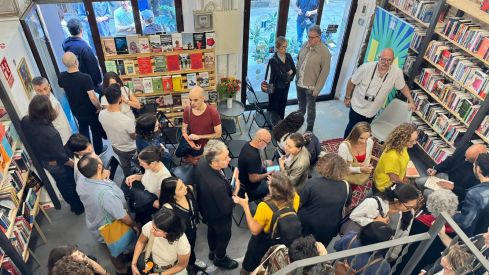
Despite the possible difficulties of the sector, La Lata is in a sweet spot. These days they are preparing the seventh edition of the Latin American Literature Festival in Barcelona, which will take place from September 25 to 27 at the bookstore, inside and outside on the street, where every year they organize talks and presentations. This year's theme is Memory in the Present and refers to various dictatorships on the continent, with a special focus on the fifty years since the coup d'état in Argentina. In a few days they will publish the full program, but the director anticipates that they will feature renowned authors such as the Argentinians Alan Pauls and Rodrigo Fresán or the Peruvian Santiago Roncagliolo.