
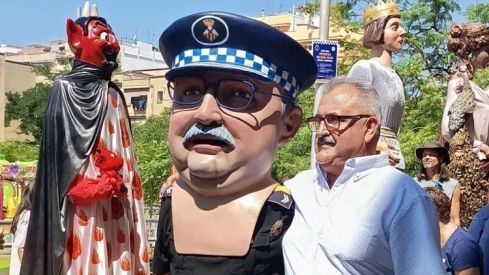
When a parade of the Capgrossos de la Florida goes through the streets of l'Hospitalet, not only festive figures parade. The memory of a neighborhood, the people who have marked its history, and a way of understanding popular Catalan culture as a tool for cohesion, identity, and coexistence also walk there. "We are a welcoming neighborhood and the 'capgrossos' are a tool for integration into popular Catalan culture," explains Inma Martos, secretary of the group, to AMIC Cultura.
This 2026, the Cultural Recreational Association (ACR) Capgrossos de la Florida celebrates 25 years of its trajectory. Although the entity was officially constituted in 2001, its origins date back to 1989, when the Florida Festival Commission promoted the construction of the first 'capgrossos'. Very special 'capgrossos', because, unlike many of those that can be seen throughout the country, these reproduce the faces of very well-known people from the neighborhood and the city.
Origins linked to the neighborhood movement
The initiative to create 'capgrossos' with faces recognized by the neighbors came from Dolores Ruiz, then president of the Florida Festival Commission, with the aim of giving life to the commission's logo and, at the same time, paying homage to people closely linked to the neighborhood and the city.
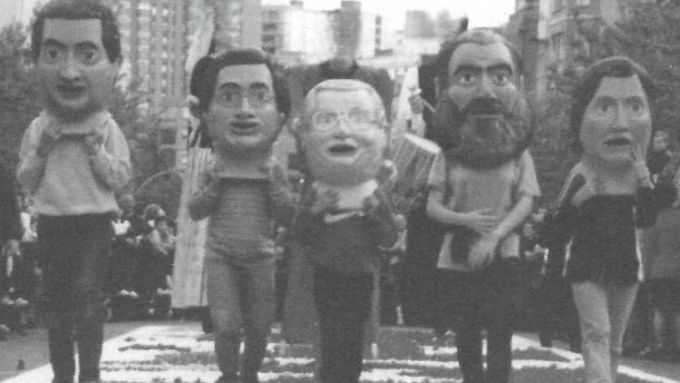
The first four 'capgrossos' represented Joan Ignasi Pujana, the first democratic mayor of l'Hospitalet; Joan Saura, a resident of Florida and future counselor of the Generalitat; Ana Díaz, a historic neighborhood activist, and Antoni Albesa, known as El Maño, the first president of the Festival Commission, among others. The figures were created by the artist Àlex Jodar with students from the workshop of the Florida Culture Classroom.
That first collection was expanded with eight 'capgrossos' donated by the fairground workers of l'Hospitalet, which had been used in fair attractions. During those years, the figures mainly came out thanks to the involvement of the members of the Festival Commission and the children of the Florida Leisure Center.
Later, in 1999, the 'capgrossos' were entrusted to a group of families linked to the AMPA of the Menéndez Pidal School to ensure their continuity. From that group, the current Cultural Recreational Association Capgrossos de la Florida would be born.
A living heritage that keeps growing
"Currently we have more than twenty big-heads," explains the president of the entity, Dionís Arnabat. Since its constitution, the group has not stopped incorporating new characters.
In 2001, the popular Jabuguito, a friendly pig inspired by the group's logo, was added. In 2003, the big-heads of Dolores Ruiz and José Vicente Muñoz arrived; in 2008, the first giantess of the neighborhood, Pataslargas, dedicated to Nemesio Martínez, was premiered; and in 2009, a curious find ended up becoming a new figure: a big-head abandoned in the trash was restored and renamed Cap de Colla.
In 2011, coinciding with the tenth anniversary of the entity, the big-heads dedicated to Mario Sanz and Celestino Corbacho were presented. That same year, the Capgrossos de la Florida recovered a tradition almost disappeared in the city: the celebration of the Man of the Noses, an activity that they have organized every year since then jointly with the Festival Commission of districts IV and V. A big-head that only comes out one day a year: December 31st. The rest of the days, they keep it very well guarded.
A controversial presentation
In 2016, coinciding with the fifteenth anniversary of the association, a new giantess dedicated to the city was presented. Dressed in attire inspired by the 1920s, the figure incorporated the symbols of bread, salt, and cypress as a sign of welcome and had the face of Núria Marín, the first mayoress of l'Hospitalet, "in homage to the role of women in the history of the city," say the association. Its presentation generated considerable controversy, especially among opposition groups, due to the giantess's personalism. From the entity, however, they continue to downplay the criticism and recall that among their figures "there are politicians of all colors," says Martos.
Sergeant Tomàs, the latest incorporation
This year, coinciding with the 25th anniversary, the group has presented a new big-head dedicated to Sergeant Tomàs of the Urban Guard. "He is the one who cuts off the streets when we do the parades and he is always by the people's side. In Santa Eulàlia, in the Center... Everyone knows him. The day we presented the big-head, people came out into the street to greet him," explains the president of the entity. A sergeant who has just retired, and who already has someone to relieve him during the traditional parades.
Much more than parading
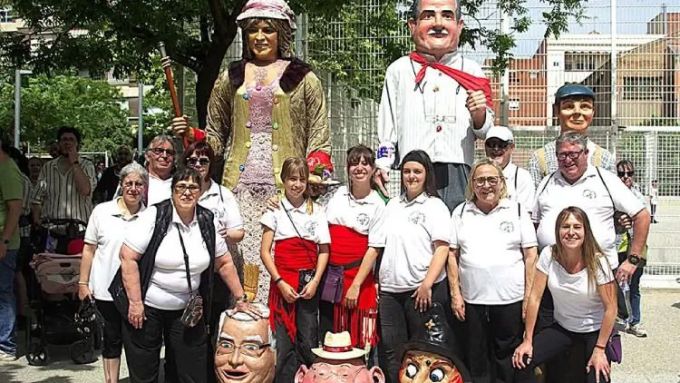
In addition to participating in parades, main festivals, and school activities, the Capgrossos de la Florida also organize some of the most emblematic events on the neighborhood's festive calendar. Among their activities, the floral carpet they create every year for Sant Jordi stands out, as does the annual gathering of "capgrossos" during the Festes de la Florida (always on the first Saturday of July) and their participation in the Trobada de Colles Geganteres del Baix Llobregat. In this event, the "capgrossos" also perform an essential function: they act as "points," marking references so that the "geganters" (giant carriers) can orient themselves during choreographed dances. For Inma Martos, this link with local history is precisely what makes the group unique within the panorama of Catalan popular culture.
"The giants weigh a lot and the 'geganters' have a very small field of vision. We open the way for them and make their job easier," Arnabat recounts. They perform the same function during parades. With the "geganters," they explain, they maintain a very close relationship: "The 'capgrossos' have always opened the way for the large figures, moving the public aside and guiding them along the route," adds the president. And if there's anyone they have a special connection with, it's the little ones. "Some of them light up; others cry... but, in general, both children and adults really enjoy the 'capgrossos' and the games they play," he celebrates.
Perhaps thanks to these figures, today's children will grow up knowing who all these people were who contributed to building the neighborhood and the city of l'Hospitalet. Because behind every "capgròs" in La Florida, there is not only a caricature, but also a story, a memory, a struggle, and, ultimately, a piece of the neighborhood's collective memory.


