
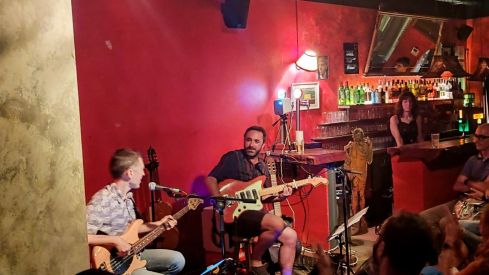
The Barcelona City Council announced a few days ago that it will allocate one million euros to strengthen the sustainability of small-format live music venues. We explained it a few days ago in Cultura B.
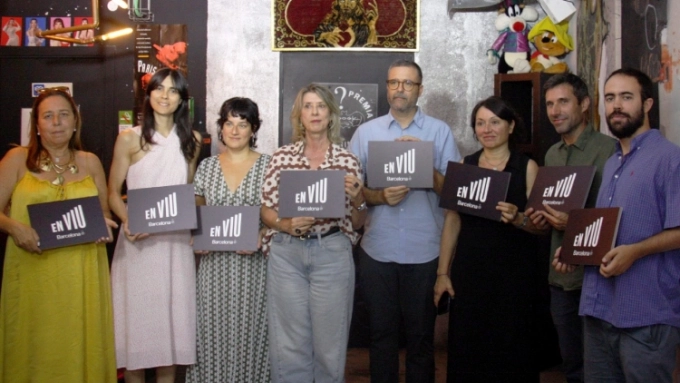
The new program En Viu BCN, promoted by the Night Office and the Barcelona Institute of Culture (ICUB), foresees direct subsidies of up to 8,000 euros for these spaces. These aids can be requested starting this October and will be resolved, according to the City Council, during the first quarter of 2027.
In parallel, the Barcelona city council has also announced the creation of a recognition seal for live music venues.
This announcement comes a few weeks after the municipal government also approved another demand from the sector: the extension of the closing time for spaces with a Live Culture license. A modification that has not yet come into force, but which would allow these venues to close at 1 am, instead of at 11 pm, as until now. In addition, the maximum capacity would also be extended from 150 to 200 people, provided that the technical conditions of each venue allow it.
The fragility of small venues
These municipal initiatives come at a time when the fragility for the live music venue circuit continues to grow, as some closures have shown. The most recent case is that of La Deskomunal, which this year announced that it will close its doors at the end of the year after denouncing the wear and tear caused by "inspections, complaints, fines, limitations, pandemics, subsistence economy and lack of generational change," they explained in AMIC Cultura.
But this is not an isolated case. In recent years, other Barcelona venues have also publicly warned of their situation, such as Sala Bóveda, which denounced the difficulties arising from conflicts with acoustic regulations.
In this context, the two measures have been positively received by the sector, albeit with nuances. The venues consulted agree that any step that contributes to their viability is welcome, but they also point out that the main challenges continue to be the regulation of licenses and the economic sustainability of the spaces.
One of the venues that would directly benefit from the change in opening hours is Heliogàbal, in Gràcia. Its manager, Albert Pijuan Badia, explains that the reform is not yet a reality. "The ICUB has been working on it since the beginning of the mandate, but it is not yet approved. We hope that it can be moved forward before the next elections," he points out.
Regarding capacity, Pijuan reminds that the increase in capacity will not be automatic because it will depend on the technical characteristics of each space. "Each venue has a determined capacity according to its square meters, the width of the doors, and the emergency exits," he explains.
"There is a comparative disadvantage with restaurants"
In the case of Heliogàbal, however, the main problem is the opening hours. "Venues like ours largely live off bar revenue, and if at midnight you have to kick out people who came to a concert, you don't have room to generate the necessary resources," says Pijuan. He explains that the current model hinders the economic viability of small-format spaces with reduced capacities.
The manager of Heliogàbal believes there is "a comparative disadvantage" with respect to other nightlife activities. "In Barcelona, you can be in a bar at two in the morning eating some patatas bravas or having a coffee, but you can't listen to live music in a cultural space," he laments. In this sense, he denounces that while catering establishments can extend their activity until three in the morning, live music venues have to close much earlier. For this reason, he positively values the municipal government's willingness to extend opening hours, but insists that it is not enough. "It's a step in the right direction, but it's still insufficient. A deeper reform is still pending so that these spaces have their own place and stop depending on regulations designed for nightclubs," he maintains.
At the same time, Pijuan believes that an adequate framework must be created to guarantee the future of these spaces, because otherwise "we run the risk of continuing to lose live music venues". In this regard, he demands that they be able to work with more appropriate hours and that the City Council flexibilize the licensing regime. "Small venues are closing because they cannot afford the costs and, at the same time, new ones are not opening because the City Council does not give them a license," he denounces. According to him, this is one of the causes that contribute to the delicate situation the sector is experiencing and, in his opinion, highlights the need for regulation adapted to live music spaces.
However, from Heliogàbal they insist that subsidies do not solve the underlying structural problem. "The underlying debate is not about subsidies. The most important thing continues to be the issue of licenses," defends its owner. According to him, Heliogàbal assumes significant fixed expenses, including nearly 20,000 euros annually in rent, in addition to the salaries of a dozen professionals and collaborators, including sound technicians, communication managers, graphic design, and other profiles that make the venue's activity possible. In his opinion, what would really allow them to be more self-sufficient would be to have regulation adapted to live music spaces. "What we need is to be able to work in adequate conditions and with regulation that recognizes our reality. If this is achieved, we will manage to move forward. Aid is positive, but the real change comes from solving the problem of licenses."
"It's good news"
From the Upload venue, Víctor Asensio also celebrates the announced measures, although in their case they do not directly affect them because they have another type of license. "Any measure aimed at making operating conditions more flexible, either by increasing capacity or activity hours, as well as any initiative that facilitates the programming of live music, is good news for both the music scene and the city in general," he states.
Regarding the program En Viu BCN, Asensio believes that subsidies can contribute to the sustainability of small venues and, consequently, favor greater professionalization of the sector. He also highlights that the aid is granted directly and not under a competitive bidding regime, as he considers that this "provides security and certainty to the sector" by being based on objective criteria, such as having the corresponding license, accrediting more than 40 annual concerts, or having a capacity equal to or less than 250 people.
Upload meets these requirements because it programs more than 300 performances each year, but Asensio believes that the impact will be especially significant in smaller venues. "Being a fixed-amount aid, its impact is proportionally greater in these spaces," he points out. Asensio adds that Barcelona has seen the closure of emblematic small-format venues in recent years and that others have warned of their vulnerable situation, which is why he believes that the aid "will be very well received by the sector" and can contribute to strengthening the live music fabric.
"8,000 is not a very large injection"
From Gràcia Territori Sonor, its head, Aleix Salvans, also views the initiative favorably, although he relativizes the economic scope of the aid. In his case, we are not talking about a specific venue, but about a project that organizes a festival in different parts of the city, such as LEM. "It doesn't directly affect us, but it is true that 8,000 euros is not a very large injection," he notes. He recalls that many venues have to face very high investments to adapt to regulations, especially regarding acoustics. "If you want to soundproof a venue, it's little," he summarizes.
At Heliogàbal, Pijuan also calls for prudence until the call for applications becomes a reality. "Subsidies are always welcome, but right now we are talking about a future proposal. They have not yet been approved, nor do we know the definitive bases," he states. Despite this, he acknowledges that any support will be positive in a context where venues continue to disappear. "We don't know if they will arrive in time to reverse this trend, but, if they are eventually applied, they will mean an improvement for the spaces that still resist," he summarizes.


