
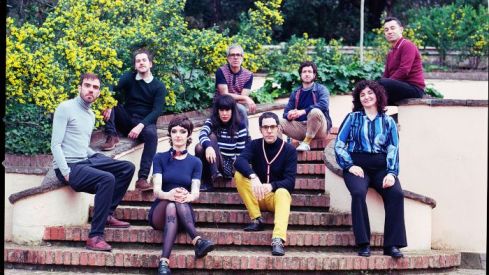
“Our music simulates the old marquees, and is open to everyone,” says the singer and songwriter of La Rauxa, Laura del Pino, to AMIC Cultura, when asked what they do and what audience they target. This is a declaration of intent from a musical group originating in Sant Boi de Llobregat that seeks to be a meeting point for nostalgics of sixties music and a starting point for new audiences they want to create.
They do all this with nine musicians on stage and a powerful brass section. “We make music with a rather eclectic component, but with a common thread,” explains Del Pino. This thread stretches from pop, garage, and Northern Soul to Nova Cançó and the most festive song of the era they want to commemorate.
Between Nova Cançó and pop
La Rauxa was born a couple of years ago with the aim of recovering and reinterpreting the spirit of Catalan groups and artists from the 60s and 70s from a contemporary perspective and with a class perspective. They draw from the solemnity of Nova Cançó, but also from its more playful side, that of ie-ié pop and home-grown soul.
The references they work with are clear: from Guillermina Motta and Lita Torelló to Els Dracs, Tony Vilaplana, Pau Riba or Núria Feliu, among others. A whole musical universe that they want to keep alive and not be forgotten by new generations and end up in a drawer.
‘De bon començament’ (From a good start)
The group already has its first album, fresh out of the oven: De bon començament. A work they have presented all at once. There are no singles. There is an album of 13 songs designed to be listened to whole, calmly, like someone sitting at a table without haste. They make it clear why they haven't released any previews, as other current groups usually do. “We want to reclaim the experience of listening to an album from start to finish to break with consumption dynamics, immediacy, and not be slaves to an algorithm,” they explain. If you listen to them, you will find a sixties and seventies aesthetic, but one that talks about issues affecting our current society, such as the touristification of our country.
It is a self-produced and self-published work that, for now, can be listened to on digital platforms and will later have a vinyl edition; you will have to keep an eye on their social media.
Image, memory and good food
The La Rauxa project does not end with the music we listen to or the aesthetics we see in its musicians. The graphic part of the album, by Joan Manel Pérez, also plays a key role with an aesthetic that mixes modernism and tradition, with imagery inspired by compilations by the ethnologist and folklorist Joan Amades.
"These are covers that advocate good food, good wine and a predilection for sitting down to eat," he explains about the design. A way to reinforce the idea of popular culture understood as a shared, everyday and festive space at the same time.
Sant Boi, periphery and pride
One of the pieces from the debut album, Havanera del Baix Llobregat, stems from a clear desire: to reclaim the periphery of Barcelona. "Things also happen in Sant Boi... And it needs to be reclaimed and explained, that not everything ends in the Catalan capital," explains Del Pino.
The group has its core in Sant Boi de Llobregat, a city that is also a rehearsal and meeting space. "Sant Boi is much more than a dormitory city next to Barcelona," they insist, focusing on the need to recognize the cultural life of the margins.
A band with two energies
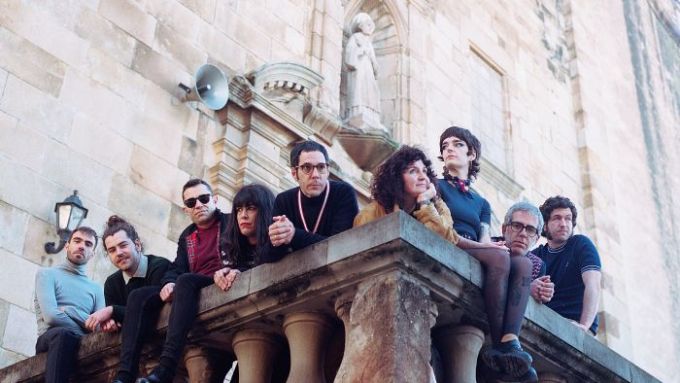
"We are nine members plus the technician," says the singer. But beyond the number, La Rauxa is defined by a constant duality: the most festive "rauxa" and the "seny" that seeps into its lyrics.
Laura explains that they are very happy with how everything is progressing since they presented their first album last month at Cal Ninyo in Sant Boi and thanks the group for everything they are achieving, especially Leo, who she says has helped her a lot to organize her ideas and bring this project that is starting to walk to fruition.
Concert at l'Albareda
This Friday, June 12, at 8 p.m., La Rauxa will perform at the Centre Cultural l'Albareda, with free admission. It will be a good opportunity to get to know this emerging Sant Boi group, which will also perform at the Tingladu in Vilanova i la Geltrú, among others. All this to understand that "rauxa" needs "seny" and "seny" needs "rauxa": a duality that this group embraces and champions.


