How little could architect Elisa Olivé imagine when she landed in Poble-sec in 2022 that this Barcelona neighborhood would end up being her obsession. "I wondered how it could be that I didn't know a neighborhood that at first seemed like the 'far west' to me," Olivé begins. As she explains, she got to know it thanks to a rehabilitation project of a property on Roser Street. Thus, as she says, she discovered "a neighborhood with many modernist buildings that were never demolished because speculation must not have been interested in the area."
The discoveries were not only architectural, but she also met her new neighbor, Àngels Gómez, a true Poble-sec native and researcher at the Poble-sec Historical Research Center (CERHISEC). Their mutual passion for Poble-sec encouraged them to embark on a photographic and historical project of which now, after four years, they are the curators. It is the photography exhibition Mirades del Poble-sec (Views of Poble-sec) and can be visited at the Albareda Cultural Center until June 25.
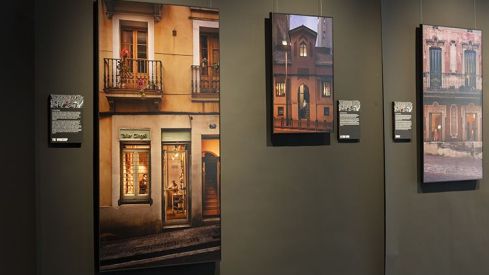
The exhibition, held within the framework of Barcelona World Capital of Architecture, shows, through about twenty images by the Italian photographer and visual artist Francesco Pergolesi, the 'heroes' of the neighborhood: merchants and locals who keep the social fabric alive in a globalized society. The exhibition disseminates the richness of Poble-sec at the foot of Montjuïc. Mirades del Poble-sec features graphic design by Marta Elias Arija and the collaboration of architect Matthieu Virolleaud.
How do urban planning and residents interact?
It all started years ago with an artistic program by the Goethe Institute that invites artists to do a project in a European city. Thus, Olivé, who wanted to make a portrait of her new neighborhood, invited Pergolesi to Barcelona, who had specialized for years in photographing neighborhood 'heroes'. In fact, this artist had already done similar work in the Gothic Quarter. This time, the curators' commission was clear: they wanted to focus on the inhabitants of Poble-sec to see how they interacted with urban planning. In addition, the two of them did a study of all the shops in the neighborhood that are more than fifty years old, which they asked Pergolesi to portray. In the exhibition, in fact, all these establishments are located on a giant map of Poble-sec.
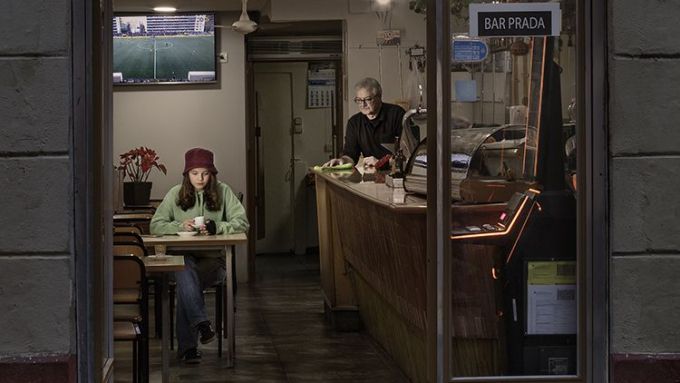
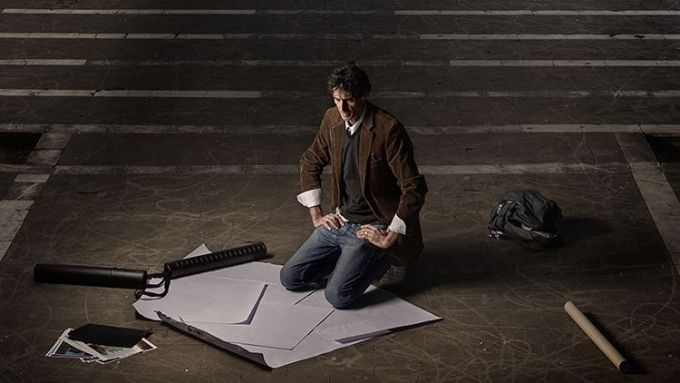
In addition, Pergolesi's images are characterized by a strong theatrical aesthetic: each photo contains a real story. An example of this is a photograph of a girl at Bar Prada who, according to the curators, wants to imitate a painting by the American painter Edward Hopper. In another photograph, we see a boy crouching on the ground, drawing the tiles with a pencil. All images were taken between January and March 2025, during the artist's stay in the city.
Apart from the photos, history plays a relevant role in the exhibition, as we find a video showing the historical evolution of the neighborhood. With this audiovisual piece, for example, the public will understand why the images are mostly vertical. "He does it because the buildings of Poble-sec are. Montjuïc is practically new; all that was a militarized zone until the 19th century. Since it was born under these restrictions, tall buildings could not be built," concludes the CERHISEC researcher.
Parallel activities
The exhibition includes several talks, such as the one on June 17 at 6:30 p.m., which will revolve around the urbanistic birth of Poble-sec, where one will see firsthand how the neighborhood has evolved, the differences between the four neighborhoods that make up the current Poble-sec, and the origin of some of the neighborhood's names will be discussed, including a new theory about the name of Poble-sec.
Also, on June 26 at 11 a.m., Àngels Gómez, from CERHISEC, will guide attendees on the itinerary L'Eixample de Santa Madrona, the first Eixample of Barcelona. The central point of the meeting will be the Eixample de Santa Madrona, which was the first Eixample of Barcelona to be urbanized. The tour will allow participants to learn about some testimonies from that era, understand the morphology of its streets, discover some of the characters behind the first constructions, and learn about the predominant tastes and interests at the end of the 19th century.
Hours: Monday to Friday from 9 a.m. to 2 p.m. and from 4 p.m. to 9:30 p.m., and Saturdays from 4 p.m. to 9:30 p.m.