
Barcelona's Casa Montjuïc has hosted this week Fonograma, a conference that since 2022 seeks to address the current situation of recorded music in Catalonia. An event that aims to promote the creation and development of the phonographic industry through the promotion of culture and technology in the sector.
During several sessions, with round tables and presentations with artists, producers and industry professionals, Fonograma has once again opened a space for reflection on the present and future of local music. And, above all, on how it is created, distributed and, especially, how it reaches the public at a time when visibility is increasingly conditioned by algorithms.
Viral or invisible: between art, anxiety and the algorithm economy
One of the central events of the conference was the round table held on June 17 under the title Viral or invisible: between art, anxiety and the algorithm economy, which featured the participation of four professionals with extensive experience in this battle.
The conversation, introduced by the philosopher, playwright and cultural communicator Leo Espluga, began with an essential question: what does it mean to listen to music today? A complicated question to answer, but one that served to open the debate. It seems that the traditional relationship between artist, work and public has changed profoundly. The artist creates music, but the public no longer just listens: they also receive content, follow a digital identity and participate in an ecosystem where the work is often conditioned by its ability to circulate.
The contradiction of our times
Just before the event began, Cultura B spoke with Espluga to discuss this issue. The young philosopher was emphatic and explained that the objective is to address "this contradiction we all have today: to make our work reach people without losing quality due to how we communicate it." "In a process of such digital acceleration, especially in art, which always needs context, we find ourselves with a totally decontextualizing force and many times, trying to reach people, we end up causing the opposite," he said. As a philosopher, he calls for a return to origins and to ask why we make music: to define what we do and what meaning what we create has.
Espluga demands that artists have a context, that they purify what music means, what listening means, and what the audience means, to avoid confusions that could harm them in the long term and to understand the contradictions of the current system. From philosophy, he defends that "knowledge has nothing to do with information, but with an emotional process. Thought, he says, has to do with maieutics, not with having a closed definition. More information does not necessarily mean more knowledge," he says when asked about the impact of AI in the creative world.
![Artists and music industry professionals have debated at Fonograma about the impact of algorithms, virality, and the pressure of social media on artistic creation. Photo courtesy[/caption]](/uploads/s1/47/94/0/03-fonograma-ciutat_38_680x383.jpeg "Artists and music industry professionals have debated at Fonograma about the impact of algorithms, virality, and the pressure of social media on artistic creation. Photo courtesy[/caption]")
Back to the round table
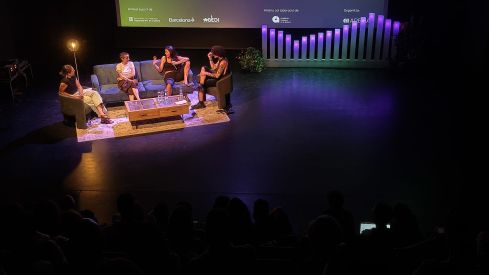
The table, moderated by cultural journalist and political scientist Clara Narvión, featured reflections from artists Zahara and from Colomenca Queralt Lahoz, who shared their experiences on the pressure of social media, the constant need to generate content, and the difficulty of sustaining an artistic career within this system. They did so in a relaxed atmosphere, on a sofa, as if it were a conversation between friends, an atmosphere that allowed the participants to open up and explain how they live this reality, without the pressure they often feel when interviewed by major media outlets.
"Love and hate" with social media
Singer Queralt Lahoz defined her relationship with social media as a relationship of "love and hate." On the one hand, she acknowledged that they allow reaching a wider audience and building communities; on the other hand, she believes that they force artists to be permanently attentive to a changing system.
"Every year the rules change," she lamented. The existence of the algorithm implies having to constantly feed it: publish, maintain presence, think strategies. A demand that conflicts with the nature of artistic work. The question that hovered over the conversation was clear: to what extent can a musician dedicate themselves to creating if they also have to act as a content creator, digital manager, and manager of their own brand?
From the MySpace community to current social networks
For her part, Zahara recalled her beginnings on MySpace, when social networks were smaller, more communal spaces. "It was a friendly place where community was created," she says. The transformation of that model to the current digital ecosystem generates a certain sadness for her.
According to the artist, today a musical career inevitably involves a significant part of marketing and communication. An intense job that often isn't gratifying because, when something works, it's hard to know to what extent it's the artist's doing or the algorithm's.
Zahara also explained how this reality has modified her way of understanding social media. Before, she simply explained what had happened on stage, but now she sees that this is not enough, and in this sense, she acknowledges that she has lost naturalness on her networks and now has a team that advises her.
When the algorithm decides who exists
One of the big debates of the session was the feeling that the current music industry does not play by the same rules for everyone. Virality, participants pointed out, has become an important currency. Digital marketing campaigns and positioning strategies can determine which artists reach the public and which remain invisible.
The question is not only whether the music is good, but whether it has enough capacity to be detected by a system that prioritizes speed, repetition, and immediate impact. And this makes the world of music tend towards homogenization. In all this debate, Espluga pointed out that, in the battle against the mainstream, "you always lose, and if you win it's because you are no longer yourself." Nevertheless, he defended the need to maintain confidence in the possibility that a work finds its audience, and to explore new spaces, such as music stores, to find alternatives to the Internet and escape these current dynamics.
![Between the need to connect with the public and the risk of becoming content creators, Zahara and Queralt Lahoz have reflected on the new challenges of music in the digital age. Photo courtesy[/caption]](/uploads/s1/47/95/8/07-fonograma-ciutat_38_680x383.jpeg "Between the need to connect with the public and the risk of becoming content creators, Zahara and Queralt Lahoz have reflected on the new challenges of music in the digital age. Photo courtesy[/caption]")
The problem of confusing the artist with the character
One of the most interesting points of the conversation was the reflection on what kind of audience the current musical ecosystem is generating. According to Espluga, there is an increasing risk of creating an identification with the artist rather than with their work: "The public follows a personality, a narrative or a digital presence, but does not necessarily listen to the music." This implies, according to the philosopher, a loss of the cultural sphere: the disappearance of spaces for mediation, criticism, and interpretation that helped give meaning to works.
The moderator also pointed out that negative criticism today is often replaced by silence. Not talking about an artist can end up being perceived as a worse response than a bad review. In this sense, there is fear. A fear that hovered over the entire room: the dictatorship of reels, and how some media outlets have been hijacked by these dynamics, also to exist, to position themselves in this viral environment.
The fear of expressing opinions and the disappearance of music criticism
The proliferation of short content and formats designed for social networks has led to fewer and fewer artists wanting to participate in long interviews or spaces for reflection. For several reasons. The first is the fear that only out-of-context fragments of these interviews will circulate, go viral, and end up generating hatred or biased interpretations of what they really wanted to express.
Another reason is that today artists can reach the public directly through their own platforms. But this also raises a question: what is lost when independent spaces for analysis and criticism disappear? How can the media face this situation if fewer and fewer artists are willing to grant interviews for fear of the consequences their words may have?
For now, there is no clear answer. The two singers did acknowledge that, although there is journalism that does not always do a good job, there are also media outlets that continue to commit to rigor and context. Perhaps therein lies one of the keys to the issue.
A new inequality based on visibility
At the end of the talk, the reason why art is currently catering to algorithms was discussed. The answer is very simple: for economic reasons. What we don't see on the Internet, it is very difficult for it to exist, for it to have a business model.
Festival programming based on the number of followers or digital impact generates, according to the participants, a new class difference within music: artists with more resources can invest in viralization and positioning campaigns, while others depend almost exclusively on the value of their work.
Given this panorama, the participants advocated for the need to recover alternative spaces: record stores, local communities, and circuits outside the purely digital logic. In this sense, Lahoz, from Coloma, pointed out that she is very proud to be of humble origin and, as she says, from one of the best cities in the world, Santa Coloma de Gramenet. The artist recalled how she started playing in small spaces in the city, where she herself hung her posters, and where a community was built around music, something that is now difficult to find. "Before we had a very street-based community, but technology has defeated us," she pointed out.
Putting music back at the center
After a good while of conversation, the last question: what can an artist starting today do? And here the answer is not easy, as both artists recognized that their beginnings were very different from the reality that emerging artists live now. Lahoz argued that social media is a useful tool to make their work known, if they know where they want to go and what their proposal is.
For her part, Zahara claimed that the most essential part of it all is making music. And here she added a very interesting point, that everyone sees the shining part of their profession, but that often the public does not always value the work that is behind it all.
The two artists recognized that today the rules have changed, and that they have adapted to them, but that we must ask ourselves how we can put music back at the center. For now, there is no single answer.


