
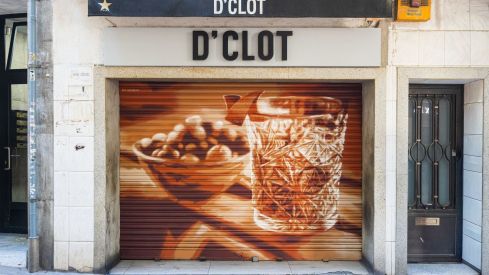
At a time when e-commerce continues to gain ground and many commercial streets see their shutters close permanently, a project is being rolled out in Barcelona that bets on the exact opposite: making visible, reclaiming, and dignifying small businesses through urban art.
This is an initiative of the Barcelona City Council, organized by the Barcelona Creativity & Design Foundation, with the artistic coordination and execution of Rebobinart. The project involves artistic interventions in 10 districts of the city to transform 170 shutters into small pieces of urban art linked to local commerce.
Neighborhood commerce as a shared narrative
Marc Garcia, director and founder of Rebobinart, explains how this project was born: “We received the proposal and launched an open call that received applications from 70 local artists.” Of these, 10 have been selected, who are already working on the pieces to finish them soon.
All of this is part of a project that seeks to make local and proximity commerce visible to encourage citizens to change their consumption habits. “Local commerce gives you something that the internet cannot: knowledge, conversation, trust, and quality. It’s not the same to buy a bicycle at a neighborhood shop as to do it without any human contact,” says Garcia.
“Touring the city as an urban art route”
The project extends across 10 districts of Barcelona and plans to paint about 170 shutters of local businesses. Different artists participate in each area, with the aim of reaching many points of the city.
There are districts with very defined axes and others more fragmented. “When the project is complete, the city can be toured as an urban art and neighborhood commerce route,” says Garcia, adding: “Some businesses, like those in Clot, can be done on foot; others, like those in Les Corts, will have to be visited by bicycle due to the dispersion of their businesses.”
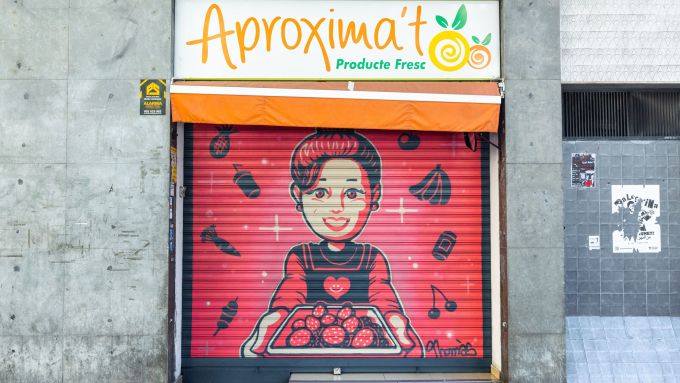
Different styles to tell the story of the same city
These are the artists and their assigned areas: Roc Blackblock has painted those of Eix Clot; Jalón de Aquiles, those of Eix Fabra i Virrei; Emily Eldridge, those of Cor d’Horta; Guillem Font, those of Gràcia; Carolina Bagnato, those of La Marina; Axe Colours (Adrià Bosch), Comerç Divers in Eixample; Daniel Thomás, those of Som Sant Antoni; A2zeta (Martí i Jan), those of Sarrià; Albert Peinado, those of Les Corts; Irene López, those of Ciutat Vella and Gemma Fontanals, those of Sant Andreu.
All of them have put their art, style and essence into each business they intervene in. There are more graphic proposals, others more pictorial and some with a more symbolic or narrative, even naive, tone.
“In Gràcia, for example, there are shutters that relate the business to natural elements like plants. Each district has its own history,” explains Garcia.
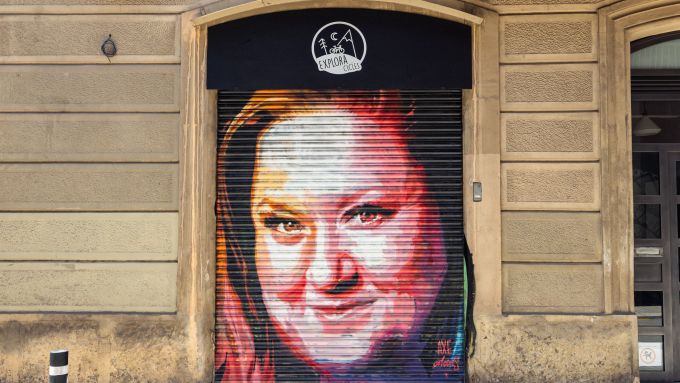
Roc Blackblock and El Clot: a neighborhood he knows very well
One of the participating artists is Roc Blackblock, who has painted the shutters of El Clot. His testimony provides a more intimate look at the creative process and the relationship with the neighborhood. “I’ve been coming to this neighborhood for 25 years,” he explains.
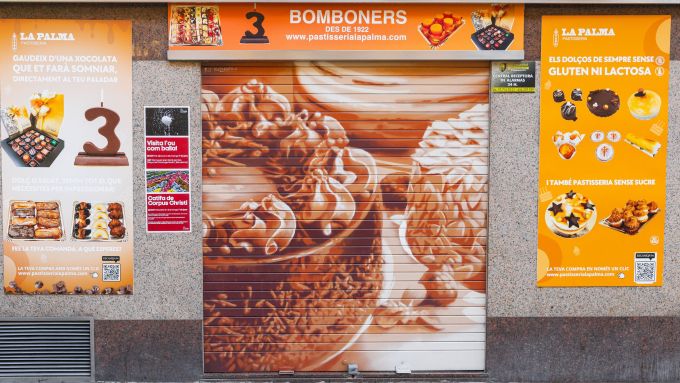
“I chose to work with a common thread: the same color palette and central images where the materials and products of the shops appear. I wanted there to be unity, but also for each business to be recognizable by its most characteristic elements,” he details.
The process, however, has not been simple. The interventions had to be done at very specific times, when the businesses are closed, often on Sundays. “It has been a demanding project. I have worked many Sundays and also intensely during Holy Week. But it has been a pleasure,” says the artist.
Commerce, memory and living heritage
For Blackblock, the project connects with a dimension that goes beyond painting. “Commerce is heritage of the city and the Country. It is living memory,” he states.
A reading can also be made about the current business model and our current consumption habits: “We are victims and executioners of digital shopping. But it does not give by far the same treatment or the same quality as local commerce,” says the artist.
In his case, the relationship with the shops also has a personal layer, as he knows very well many of those he has been able to paint: "My great-grandmother used to buy at La Palma pastry shop. They would go there for nougat. This connects you with a history that is not just yours." And this makes him feel very proud, because he has been able to touch on a different theme from what he normally works on: historical memory, and he has been able to contribute his grain of sand to strengthen the commercial fabric of El Clot.
He is currently in Montjuïc painting a mural dedicated to the International Brigades, and he already has a good list of new commissions to do, and that, he says, is very gratifying.
A project that is much more than a mural
In short, what is being built in Barcelona this year is much more than an artistic intervention: it is a way of re-reading the city through its shops, its stories, and the people who make them possible. When the 170 shutters are finished, the city will have paid tribute to some of its most emblematic shops and will have beautified some shutters that we will be able to enjoy when they are down, not because they have had to close, but because they are resting. A well-deserved rest, because today, raising a shutter is quite a feat that now has a work of art to remind citizens of it.


