The Barcelona neighborhood of Ciutat Meridiana (Nou Barris), at the foot of Collserola, became a few days ago, for a few hours, the setting for an educational and artistic project that seeks to rethink the perspective its young people have on their most immediate environment.
The Institut Escola Mestre Morera, located in this neighborhood with a long tradition of neighborhood mobilization, hosted last May 19 a photographic outing with the 2nd year ESO students within the framework of the program Fora de Reserves, promoted by ICUB, the Barcelona Education Consortium and MACBA, which connects contemporary artistic practices with educational centers in the city.
“Going out into the street changes their perspective”
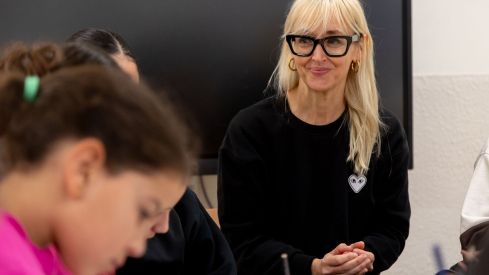
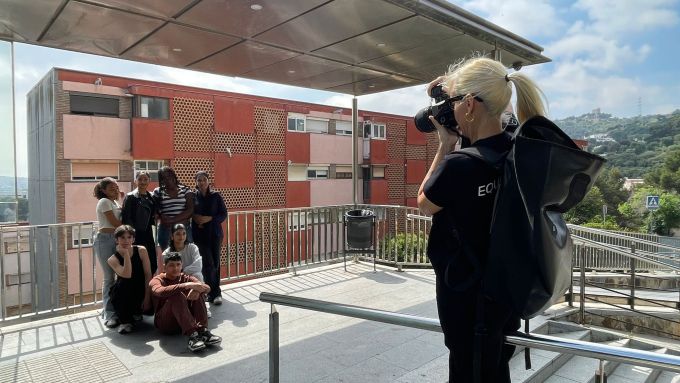
The workshop started in Plaça Roja and ended in Plaça Verda, with groups of students who, little by little, explored the urban space through photography and the gaze of contemporary art.
Daniel Jimbert, pedagogical coordinator and Geography and History teacher at Institut Escola Mestre Morera, evaluated the experience very positively at the end of the day: “I expected the students to be shyer, but they got enthusiastic about the cameras and the workshop. They even encouraged themselves to take the photos themselves”.
Jimbert also highlighted the educational meaning of the activity: “In the end, what we do with Fora de Reserves is bring art closer to the school so that students can also be artists”. And he added: “For them, their neighborhood is a purely habitable space, and it is necessary to give it a new meaning, to re-signify the spaces that are part of their daily lives”. An outing that is very well received these days at the end of the school year: “Doing activities like this in the street, especially at this time of year, activates them a lot. It is not only a teaching experience, it is also a vital experience”.
A journey guided by an artist
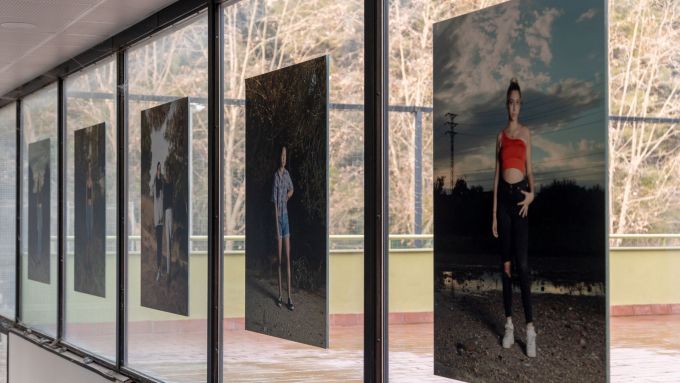
Tanit Plana has been the guest artist in this edition of the project at this educational center. Her presence at the center has not been punctual: her works have been part of the daily space of the institute for days and, as she herself explains, this generates a progressive and non-exceptional relationship with the students: “My works are at the entrance of the institute, and this means that every day, when entering and leaving, they see them. It is not an isolated thing, but integrated into their daily lives”.
In this context, the center hosts the series Púber (2020), a work in which Plana explores adolescence and its sociocultural practices. The photographer places adolescents from diverse social contexts in areas of the city of Barcelona and portrays them looking directly at the camera.
Plana explains that the portraits of Púber were made during the pandemic and are individual, but that in no case was she very interested in this collective reading. “We always present ourselves individually, and here it is about opening another way of representing ourselves,” says the artist. And she adds a key idea about working with young people: “Working with young people is essential. It is creating together, thinking together, without a specific purpose, simply as a way of doing and sharing.”
Within the framework of the program Fora de Reserves, these images function not only as an exhibited work, but also as a pedagogical device: as a way to open questions about how one's own and collective gaze is constructed during adolescence.
Looking at the neighborhood as heritage
From MACBA, Isaac Sanjuan, Education coordinator of the museum and of the program Fora de Reserves, highlights the heritage dimension of the project: “It has been a very beautiful workshop because it allows looking at the environment from a heritage perspective. The squares, for example, have been key: the background of the photographs allows the people of the neighborhood to immediately recognize where they were taken.”
Sanjuan also values the naturalness of the artist's presence: “Her presence has been very natural. There is no idea of the artist as someone inaccessible, but as someone close, who shares processes and questions with the students.” In this sense, he considers that “the fact of coexisting with an artist's work makes things happen. It generates connections, and it made perfect sense for Tanit to accompany them through the neighborhood.”
Seeing the neighborhood with other eyes
The students have also experienced this change of perspective. Cristal, Alexandra, and Adam explain that, at first, they were embarrassed, but that they quickly felt more comfortable with the cameras.
“We took photos in the Red and Green square, at the popemobile… We have been able to discover our streets,” Adam explained. “I hadn't realized there are such beautiful places to take photos,” he added.
They also agree that seeing the works exhibited at the center has served as inspiration for them: “Now, more than being models, we have enjoyed taking the photos ourselves”. And they conclude with an idea that is central to this project: “It depends on how you look at a place, you can see it as beautiful or not. Now in Ciutat Meridiana we will look at it differently”.
A program that connects school, museum and city
The program Fora de Reserves has reached its fourth edition and is based on three main axes: bringing contemporary artists closer to educational centers, giving value to the everyday spaces of the neighborhoods and linking these processes with the heritage and collections of MACBA.
Sanjuan explains that the selection of works for this edition also responds to the museum's 30th anniversary collection, with the aim of giving the same relevance to the pieces that live in the institutes as to those exhibited in the museum. And after the success of this last edition, they are already thinking about a fifth one, that continues to bring art closer to all educational centers in Barcelona to ensure that students can let their imagination fly and ensure that art impacts their daily lives.


