
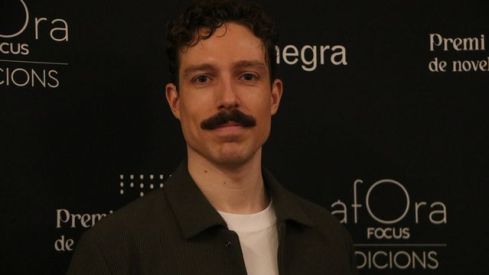
Coinciding with the festivities of Barcelona's winter patron saint, the winner of the fourth edition of the Santa Eulàlia novel prize of Barcelona has been announced: Roger Bastida (l’Hospitalet de Llobregat, 1990), with his novel, which is both historical and profoundly contemporary, in terms of form, Passeig de Gràcia.

Convened by Comanegra and Àfora Focus Edicions and endowed with €25,000 and a bronze sculpture by Antoni Camarasa, it is the best-remunerated independent publishing house prize in the country. It was conceived with the aim of encouraging the creation of novels that not only stood out for their formal quality, but also had the ability to enhance Barcelona, adding layers of history to the usual perception and establishing the character it has preserved throughout all its transformations in a time when, as a consequence of mass tourism and immigration, it is often difficult to define what is its own. The jury —composed of Francesco Ardolino, Alba Cayón, Jordi González, Enric H. March and Laura Tejada— has described this year's novel as the impeccable realization of what they imagined when they started the competition; the decision was made by absolute unanimity. Alba Cayón, editor at Comanegra and member of the jury, highlights "the audacity of focusing the work on such an emblematic and well-studied area of Barcelona" without the popularity of the setting overshadowing it with common imaginaries; its "balance between pure fiction and the inclusion of well-selected archival materials"; the effort of historical recreation that is not at odds with a contemporary point of view and the capacity it demonstrates to link the whole to the main current debates of the city; the integration of historical figures, as well as cultural and artistic icons of the city, without ever falling into clichés; and, last but vital, Roger Bastida's mastery in handling the language of the era "keeping it fresh, alive and natural for today's reader".
After three editions with awardees from one generation —Lluís-Anton Baulenas, 1958; Sylvia Lagarda-Mata, 1961; Maria Carme Roca, 1955—, Roger Bastida, only thirty-five years old, joins them as a representative of the younger generations. A graduate in Art History with the lifestyles of 1900 as his area of specialization, straddling the 19th and 20th centuries, he works in the Madrid audiovisual world as a historical consultant for series such as La Templanza, Ena, la reina Victoria Eugenia, or Sira. He confesses the weight of his profession in the elements that take prominence when he writes: after all, a historical consultant is responsible for the invisible aspects of the television world. The minutiae of setting in period dramas only take center stage if they betray the credibility of a scene; the rest of the time, the specific ink with which a document was signed, the makeup of a young woman, the origin of the marble of a bust are eliminated from our considerations. Thus, Roger Bastida's historical novel is not dominated by the prominent and well-known figures from textbooks, nor by the treaties we now preserve behind glass in museums, but by the teeming masses that made up 97% of the population and which historiography, due to the complications of archiving the fabric of existences with much less written record, forgets. Without ignoring the weight of money and the authority of the bourgeois and noble classes in the city's movements, Passeig de Gràcia delves into aspects of that time, typical of 'minor lives,' which allow us to contrast ourselves with them because they tread on our same ground: the economy of the working class, housing, the unnoticed human actions that open the doors to the great remembered actions of other people and which are what resemble us. The resurrection of these silent lives makes us realize how most of us alive today will never have breathed, in the hands of future historiography, and how many chances of the past have constituted us, to what extent our probabilities of not being here to relate to the universes around us were high. Making us glimpse ourselves simultaneously from the past and from the future, therefore, Passeig de Gràcia de-automatizes the routines of the present.
So that old voices are not drowned out, Roger Bastida distances himself from himself to write: he collects letters from other times, press clippings, the alien details that are objectifiable and that therefore make it difficult to lead the story down the paths of personal ideology. He harshly criticizes the recent tendency to put contemporary moral values into the mouths of past subjectivities, when one of the great riches of historical novels is having to confront the historical relativity of what seemed universal, timeless to us. Without a doubt, his firmness on this point helps the overall effect of going out into the familiar streets of the city, after reading Passeig de Gràcia, and colliding with the perception that Barcelona has been indefinitely altered.
Any competition that has a territory as its axis forces the question: why, out of the neighborhoods and streets of the territory in question —Barcelona—, choose Passeig de Gràcia? Unlike Las Ramblas, it is a space not yet lost to Barcelonians; a space for strolling for pleasure, suitable for contemplating which elements remain or die there over the ages. Furthermore, it offers a feast of materials to the writer: classes from the three extremes, aristocracy, bourgeoisie, and the working class, mix there; it unifies the tourist route, foreign, the cosmopolitan reality, with the artistic, historical, the most local. Roger Bastida's ability to induce movement in Passeig de Gràcia, an appearance that transforms according to the authorities who occupy it, has led Fèlix Riera, editor of Àfora Focus Edicions, to describe the book as "a biography of power".
Its formal composition is one of the most notable aspects of the winning novel. Instead of adopting the almost archival, cold narrative style that frequently characterizes historical genre works, Passeig de Gràcia elaborates descriptions flooded with emotion, with the internal experience of the characters. It returns architecture and landscapes to their splendor not as they are portrayed, perennial, a photographic image, but as they would remain in memory if one of us had known them then and they were no longer there, or they were no longer there as we loved them. In other words, in the description of emblematic buildings, it interweaves architectural materiality with the architecture of human interiority.
His desire to achieve "a work of 2025" is key. Bastida does not seek to elaborate a past that would remain static from any angle of view and historical society; he wants to build a novel that, simply by the type of formal tools he uses, turns out to be contemporary, unmistakable. These formal tools are those of a narrative structure that contains within itself the relationship between the individual and the world of our days: fragmented, diverse, stimulating in its lack of direct response and unity. It is what Riera has described as the "trencadís materiality," a multitude of gazes of former living beings is intuited through scattered fragments of archive, like broken pieces, which in isolation would not be significant but which Bastida's ordered art makes revealing with respect to the whole, of the life plots he fabricates by fitting together lost pieces of other stories that did happen. His is a novel of re-signification of the document. Far from limiting the horizons of the work, this particular method of treating the past makes a double reading possible: to begin with the classic, linear one, which follows the pleasure of the plot; then, the modern one, inspired by play and challenge, which rescues the public from the old position as a passive receiver and grants them the rights of an interlocutor —and of a second creator, in their hermeneutic role—.
It is the author's first non-linear novel, and, as some members of the jury commented upon finishing, it will probably be the work with which he will make the leap to new leagues.


