
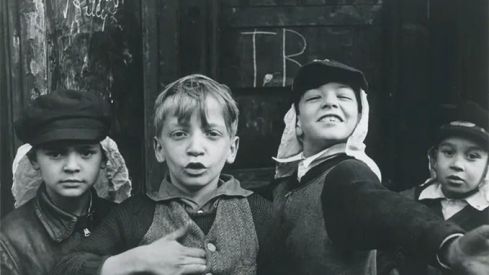
The KBr Photography Centre in Barcelona is hosting an exhibition by Helen Levitt (1913-2009), an American photographer from the New York neighborhood of Brooklyn, until February 1. In her work, set in the late 1930s, she reflects the effects of the Great Depression in her hometown. Levitt captures the daily lives of New York's poorest children, from a realistic perspective with the street as the protagonist. "The photographer remains to continue wandering the streets, like a flâneuse of her time, and persists in exploring the minimal and hidden gesture within the urban scenography," states Paula Borràs in her article in Núvol. The New Yorker was one of the first women to forge a path in photography.

At the same center, Irina Cervelló, Abril Coudougnan, Patrick Martin, and Bernat Erra explain how photography can be a tool for exploring personal connections, territory, and the formation of shared identities and memories. Cervelló, in Opac, investigates the cultural, environmental, and economic implications of the petrochemical company Solvay in Martorell. Coudougnan, in Tous les maux mots sont inventé, presents her personal photographic archive, images taken over six years. Martin, on the other hand, encourages reflection on the myths that shape collective memory in Looking for George. Finally, the exhibition concludes with Erra's Fe d’errata, in which the author analyzes the construction of a collective identity through religious and Catholic imagery. KBr hosts the exhibition until February 1st.
On the other hand, the Disseny Hub Barcelona is exhibiting photographs by Barcelona native Isabel Steva Hernández collected in the graphic book Colita. Antifémina. The work is considered the first openly feminist project of the Transition, signed by Colita and Maria Aurèlia Capmany. Despite this, the publisher quickly withdrew it from the market, and the book became a critical and activist publication. After some time, Colita herself and Francesc Polop, director of her archive and curator of the exhibition, revived the project. Antifemina showcases the figures of two intellectual women who fought to dignify being a woman. "The exhibition serves as a reminder and brings us today to a reality that is not old, but continues to be relevant," argues Polop. The center is hosting the exhibition until January 25.
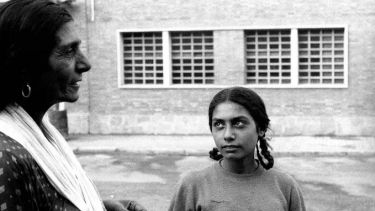
On the other hand, the Barcelona Photographic Archive (AFB) presents a retrospective exhibition of the Barcelona photographer Cèsar Malet (1940 – 2015). The aim is to promote the quality of his work to the general public. "The first thing that stands out is the modernity of Malet's aesthetic, which is not limited to his more personal works, but which he also boldly practices in advertising photography, where he uses compositions, framing, and graphic ideas far removed from the usual practice of those years," highlights Josep Maria Cortina in AMIC Cultura. The author stood out for fashion photography in Catalonia during the sixties. The exhibition can be visited until May 24, 2026.
The Esquerra de l’Eixample-Agustí Centelles Library is hosting the exhibition Nice to meet you by Barcelona-based photographer Txema Salvans. The exhibition celebrates the twentieth anniversary of the photographer's first book, in which he conveys a love for life and photography. Salvans chooses vibrant settings such as holidays, birthdays, or weddings to complete a family album of different people, times, and places. “My protagonist is the landscape; human figures do not have a central role in the images because I wanted to distance myself from them to focus on the context. But their presence is essential because it is what gives a tragic dimension to the narrative,” explains the photographer. The exhibition can be visited until January 25.

You still have time to see three unmissable exhibitions at La Virreina Centre de la Imatge. Amidst mountains that appear and disappear, between photographs and sketches, La muntanya anàloga can be visited until February 15th at La Virreina. Based on fragments from the photographic work of Luigi Ghirri (Scandiano, 1943 – Roncocesi, 1992) and the series Muntanyes encantades by Michelangelo Antonioni (Ferrara, 1912 – Rome, 2007), Frederic Montornès establishes a dialogue between both artists through some forty pieces where the mountain is the common element. The exhibition's curator, Frederic Montornès, driven by his fascination with Antonioni, identified the connection between the two through their work with fragments and intuitions, stating that "neither of them is obsessed with explaining anything." Thus, La muntanya anàloga is not a destination or a definitive image, but a space for reflection and discovery.
Until March 1st, artist Paloma Polo presents the exhibition 'The Return of the Gaze. The Political Task of Narrating' at La Virreina Centre de la Imatge, a collection of twelve projects from 2010 to the present. Paloma Polo (Madrid, 1983) is a multidisciplinary researcher and artist who dedicates her audiovisual and research work to exploring historical events and discourses. Now, she arrives at La Virreina to present the first retrospective of her work. Polo's exhibition reminds us that narrating is always a political act and that our desire to understand must be accompanied by the courage to question what has been given to us as truth. To not take historical narrative as dogma, but to deconstruct it with our current gaze. Because only those who dare to doubt can, ultimately, begin to see
Also until March 1st, you can see at the Virreina a major retrospective exhibition on the cinema of Trinh T. Minh-ha curated by Manuel Borja Villel. This filmmaker, writer, literary critic, and composer is one of the leading voices in experimental ethnographic cinema and a crucial figure in feminism. Born in Hanoi in 1952, she has developed her career at the University of Berkeley, and embodies to the fullest the commonplaces we associate with the far-left cultural theory typical of California in the second half of the 20th century. "However, at a time when many of these clichés are being questioned, Trinh returns you to the radical and fertile origins of the deconstructionist project, making you see how it had and still has a profound meaning that escapes many of the epigones who have adopted theory as their own without the internal tension that animates it," says Joan Burdeus in AMIC Cultura.
On Monday, January 19, Foto Colectania will open the exhibition El vagabindo de Valparaíso, by Sergio Larrain (1931–2012), a unique figure in 20th-century photography. A member of the Magnum Photos agency, he developed a profoundly personal body of work, marked by a free, poetic, and enigmatic gaze on street photography. Through shadows, reflections, and unconventional framing, Larrain transformed everyday scenes into images of great visual and emotional intensity, where human presence and urban solitude occupy a central place. The exhibition at Foto Colectania brings together nearly 80 photographs taken in Chile, with special attention to the Valparaíso series, the author's most extensive and celebrated project. Developed between the late 1950s and mid-1960s, this series explores the Chilean port through its hills, staircases, shadows, and inhabitants, shaping an urban landscape experienced from proximity and daily life. The work culminated in the book Valparaíso, published in 1991 with a text by Pablo Neruda, which has since become a fundamental reference in the field of the photobook.


