

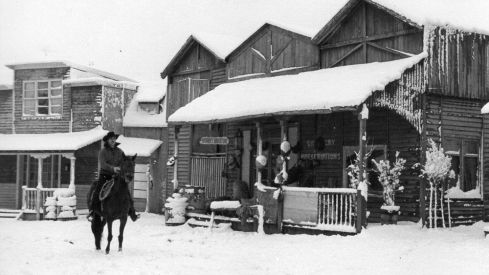
Today it's hard to imagine, but for almost ten years Esplugues de Llobregat was a regular setting for galloping horses, blank shots and duels in full sun. Everything happened in Esplugas City, an immense cinematographic village built in 1964 by the Balcázar brothers that hosted dozens of productions and turned the city into an unexpected benchmark for the most popular genre of the moment: spaghetti western. Today nothing remains but the memory and a commemorative plaque, but its history continues to fascinate cinephiles and neighbors.
The origin of a celluloid dream
In the early sixties, the western was experiencing a second youth thanks to European cinema. Sergio Leone's success with For a Fistful of Dollars had opened the door to a new genre, the Mediterranean western, cheaper and with its own aesthetic. The brothers Alfonso, Francisco and Jaime Jesús Balcázar, who already had filming and dubbing studios in Esplugues, decided to bet big on it.
In 1964 they commissioned set designer Juan Alberto Soler to build an entire village on the land near the cemetery. The result: 10,000 square meters of sets, with three main streets, about forty wooden and stone buildings, and even a Mexican-themed area. Nothing was missing: saloon, church, barbershop, blacksmith, prison, bank, sheriff's office and gallows. Everything designed so that the cameras would not capture antennas or chimneys from the real world.
The filmings: cowboys in Esplugues
The first film was Pistoleros de Arizona (1964). In less than a decade, Esplugas City hosted the filming of nearly 70 movies. Key names of the genre passed through there, such as Giuliano Gemma, Klaus Kinski, Fernando Sancho, Francisco Rabal or Juan Luis Galiardo, alongside American stars like Audie Murphy or Broderick Crawford.
The neighbors remember those years as a time of movement and work: many worked there as extras or technicians. In fact, the writer and researcher Eduardo Conejero, who this 2026 publishes De profesión: duros. Actores de reparto y especialistas de otra época, a book where he delves into that period, explains that the filmings breathed a spontaneity unthinkable today. “The stage manager could appear as a Confederate soldier, or the director of a film could appear dancing in a scene as a killer dancer,” he recounts. In short, Esplugues literally became a setting for European cinema, sharing prominence with Almeria or Hoyo de Manzanares.
The decline and a film ending
But the western trend began to run out in the late sixties. In addition, the construction of the B-23 highway forced the expropriation of the land and the relocation of the village a few meters further.
The Balcázar, in an attempt to keep the village and its history alive, imagined converting Esplugas City into a Far West theme park. In fact, they even obtained all the necessary authorizations, but the arrival of a stranger in 1972 doomed the project: the Francoist Minister of Information and Tourism, Alfredo Sánchez Bella, upon seeing the sets from the road, commented that it looked like a collection of shacks that needed to be eliminated, as they “gave a bad image” at the entrance to Barcelona. Be that as it may, political pressure hastened its disappearance.
“It was a mistake,” assures Conejero, regretting the loss of such an important part of the history of Catalan cinema: “In Almeria, for example, they preserve one of the western villages and it’s incredible.”
Before the machines demolished the village, the producers decided to shoot one last film there: Le llamaban Calamidad. The climax of the film included the destruction of the village, and so it was: a good part of the real sets were set on fire and blown up with explosives. The flames seen on screen were, in fact, the definitive farewell of Esplugas City.
The memory of a Catalan Far West
After the disappearance of the village, the memory of Esplugas City became diluted. For years, many residents didn't even know that, on the outskirts of the municipality, a small-scale Hollywood had existed.
Over time, however, the legacy has been reclaimed. In 2014, coinciding with its 50th anniversary, Esplugues dedicated exhibitions, screenings, and popular activities to it. In 2017, the City Council placed a commemorative plaque in one of the municipality's parks, and in 2019 the documentary Goodbye Ringo, by Pere Marzo, recovered the voices of technicians, actors, and specialists who worked there, winning the audience award at the Sitges Festival.
Another gesture of remembrance arrives every September: during the Festa Major d’Esplugues, one of its most historic streets transforms into the setting for the “Esplugas City” craft market. The historic center fills with craft stalls and gastronomic products, all under a western aesthetic that brings character and originality to the festival, keeping alive the memory of that Esplugues Far West.
Precisely, this renewed interest is what led Conejero to investigate it more deeply. After publishing in 2024 Perros callejeros. Una película irrepetible, the author discovered that several secondary actors of the film had been specialists in Esplugas City: “The daughter of one of them showed me some photographs and that fascinated me. I live more than a hundred kilometers away, but even so it impressed me that Western films had been shot so close by”. From there began a real detective task to locate actors, specialists and family members, reconstructing an oral memory that now crystallizes in his new book.
Today, of the old Esplugas City only a palm tree remains that marked the entrance of the enclosure and, above all, the memory. But for some years, Esplugues de Llobregat was territory of cowboys, gunmen and bandits: a small piece of Far West that is already part of the cultural and cinematographic history of the country.


